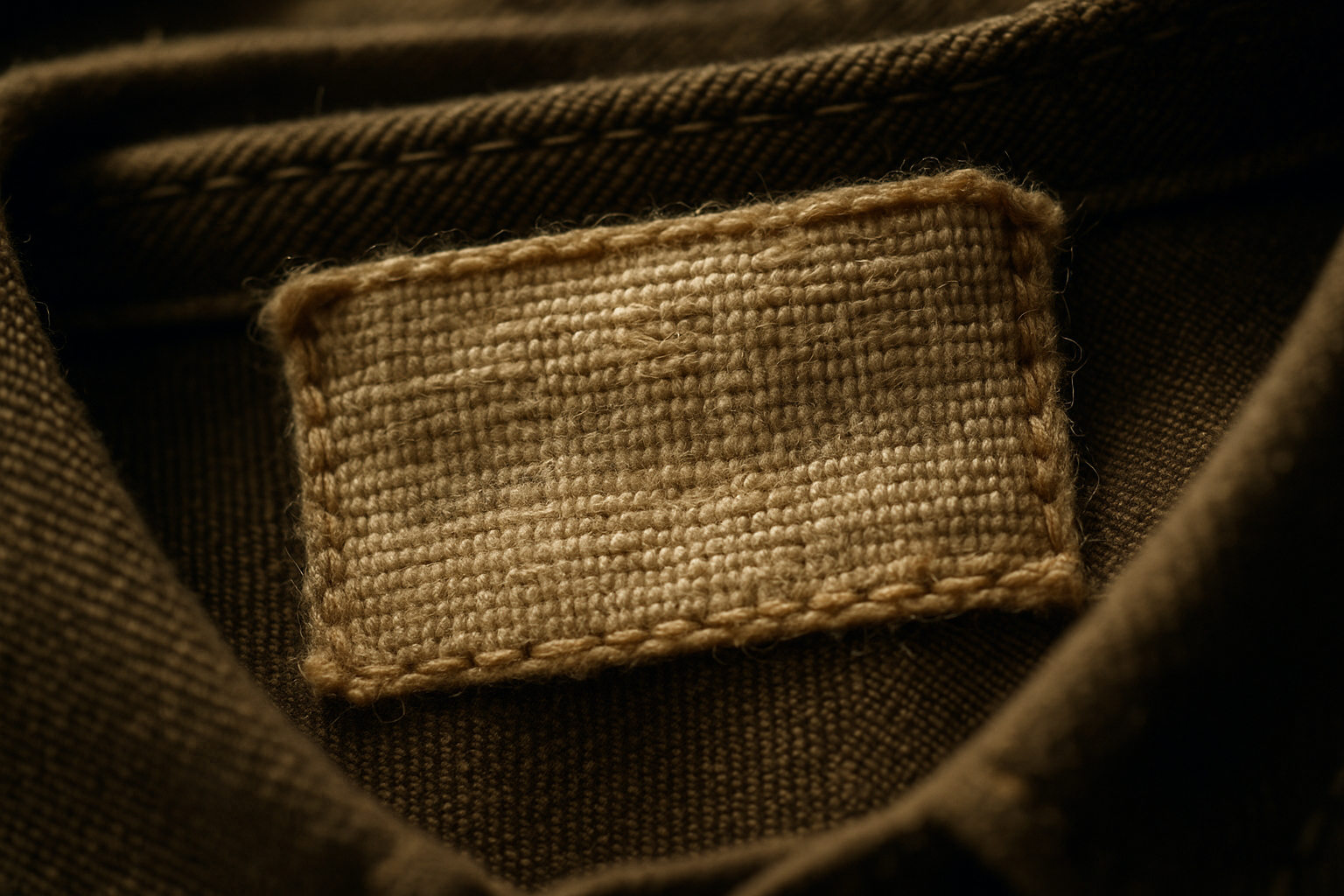
How to grade designer label and tag condition for authenticity comes down to two separate questions asked in order: is the tag legible enough to confirm the garment is what you say it is, and how much wear has the tag itself taken. A faded, cracked, or partially detached tag is almost never proof of a counterfeit — it's a condition issue, and it belongs in your grading report under Cosmetic Appearance, Structural Integrity, or Functional Elements depending on what actually failed.
We've watched resellers do this backwards for years. A buyer messages asking why the RN number on a 1994 Polo Ralph Lauren tag looks blurry, and the seller panics and relists the item as "vintage style" instead of grading the tag wear correctly and moving on. Meanwhile a genuinely sketchy relabel job — perfect print, wrong font, stitched in with modern thread — sails through because it looks crisp. Tag condition and tag authenticity are different evaluations. Confusing them costs you sales on real vintage and lets you miss real fakes.
The Tag Is Part of the Garment, Not a Separate Object
Every tag — brand label, size tag, care tag, RN/CA number tag — is a manufactured component sewn into the garment. It ages the same way the shell fabric does, just faster in most cases, because tags are usually thinner material (satin, taffeta, or a printed cotton twill) stitched at a high-friction point: the back neck, where it rubs against skin, hair product, and washing machine agitation for decades.
That means tag wear is a legitimate, gradable condition factor — not a footnote. Under GradeThread's five weighted factors, tag condition typically maps to:
- Cosmetic Appearance — fading, print flaking, screen-print cracking, edge fraying, discoloration.
- Structural Integrity — loose or torn stitching where the tag attaches, partial detachment from the neck seam.
- Functional Elements — missing size or care tags where that information is not recoverable elsewhere, or a size tag cut out (common on resale-flipped or thrifted goods), which removes usable buyer information.
Fabric Condition and Odor & Cleanliness rarely touch the tag directly, but a musty or bleach-damaged tag can still be a data point for how the whole garment was stored.
Tag Fading vs. Garment Fading: Different Mechanisms, Different Signals
Garment fading usually comes from UV exposure or repeated washing across the whole visible surface — even, gradual, matches the fabric's overall wear pattern. Tag fading is different because tags sit against skin and get isolated friction and moisture the outer shell doesn't. A woven Ralph Lauren pony label can go soft and pale at the exact spot where a hanger hook or hair rubbed it, while the shirt's shoulders and body still read full-strength color.
This matters for grading because a badly faded tag next to a strong-condition garment is not a mismatch you should treat as suspicious — it's the expected pattern. Screen-printed care tags (common on 80s–90s cotton tees) crack and flake independently of the shirt's print condition because they're a different ink formulation applied at a different point in manufacturing. Grade the tag on its own wear, not by comparing it to the shell fabric's grade.
What Actually Should Raise a Flag
Authenticity concerns come from construction mismatches, not wear level: a tag stitched with a thread color or stitch density that doesn't match the rest of the garment's construction, a font or logo proportion that's off from documented archives for that era, or a tag that looks brand-new and crisp inside a garment with twenty years of shell wear. Wear alone — fading, cracking, softening — is not a fake signal. A tag that's too perfect relative to the garment around it is worth a second look.
How to Grade Designer Label and Tag Condition
- Photograph the tag flat, under raking (angled) light, not straight-on flash — this shows print cracking and thread wear that direct light hides.
- Read every line of text on the tag out loud or transcribe it: brand name, size, RN/CA number, fiber content, care instructions, country of origin.
- Note what's illegible versus what's simply faded but readable — illegibility only matters if that information isn't available elsewhere (size on a size tag, fiber content nowhere else).
- Check the attachment seam: tug gently at each corner of the tag to see if stitching is loose, popped, or fully detached on one side.
- Look for print or weave degradation type: cracking (screen print), fraying edges (woven satin), or fading (dye-based print) — these age differently and call for different grade language.
- Cross-reference construction details against known archives for that brand/era if you're grading for vintage authenticity, not just condition — font, stitch color, tag shape.
- Assign the tag defect to the correct factor: Cosmetic Appearance for surface wear, Structural Integrity for attachment failure, Functional Elements for lost information.
- Weigh the tag defect against the rest of the garment — a torn tag on an otherwise Excellent jacket doesn't automatically drop the whole grade to Good, but it does get documented and can shift the grade by half a tier if the loss is functional (unreadable size, unreadable care instructions).
- Disclose the specific defect and location in your listing — "tag partially detached at left seam, text fully legible" reads very differently to a buyer than "tag damaged."
- Photograph the tag defect at the same standard you'd use for a stain or seam repair — close-up, in focus, well-lit — since buyers increasingly use tag shots to self-authenticate.
Tag Condition vs. Garment Condition: When They Diverge
The scenarios that actually cause disputes are the mismatches — a tag that reads much better or much worse than the garment around it. Here's how we'd grade five common combinations.
| Scenario | Likely Cause | Factor Affected | Grade Guidance |
|---|---|---|---|
| Excellent shell, tag faded to near-illegible | Normal neck-friction wear over decades; unrelated to shell care | Cosmetic Appearance | Grade tag wear on its own scale; shell grade unaffected if information is recoverable via size sticker or measurements |
| Very Good shell, tag looks brand-new and crisp | Possible relabel, replacement tag, or simply a low-friction placement (side seam vs. neck) | Flag for authenticity review | Do not auto-grade down — verify construction match before treating as a red flag |
| Good shell, tag stitching torn on one side, text legible | Repeated washing/drying tension at the attachment seam | Structural Integrity (minor) | Note as a minor structural defect; does not typically move the overall tier alone |
| Fair shell, tag missing entirely (cut out) | Prior owner removed for comfort or resale anonymity | Functional Elements | Grade drops if size/fiber content isn't documented elsewhere; disclose "tag removed" explicitly |
| NWOT-condition shell, size tag intact, care tag missing | Care tag often removed separately from brand tag by original owner | Functional Elements (minor) | Minor deduction only if care instructions aren't standard/inferable for the fabric type |
Common Tag Defects and What They Actually Cost You
- Print cracking on screen-printed care tags — cosmetic only, extremely common on 80s–90s cotton, rarely worth more than a note.
- Woven label fading at the fold — cosmetic, expected on satin/taffeta labels after repeated laundering; grade the fade, don't treat it as damage.
- Loose or partially popped tag stitching — minor structural defect; tighten if you can sew, disclose if you can't.
- Tag fully detached but present — structural defect with a functional edge if it's now loose in the garment rather than attached; disclose as "tag detached, included."
- Tag cut out entirely — functional loss if size/fiber/care information isn't recoverable; this is the defect that most often changes a grade tier.
- Bleach or heat damage discoloring the tag only — cosmetic, but worth flagging separately from garment-wide bleach spotting since it points to a specific laundering incident (tag caught against a heating element or bleach splash).
- Ink transfer or bleed from the tag onto the garment — this one does cross into garment Cosmetic Appearance, since it stains the shell fabric itself, not just the tag.
Why This Belongs in Your Listing, Not Just Your Head
Buyers of vintage designer pieces increasingly zoom in on tag photos before anything else — it's become the de facto authentication step on eBay and in vintage Instagram shops. If your tag photo shows a defect you haven't mentioned in the description, that's the fastest route to a "not as described" claim, even when the defect is minor and expected for the garment's age. Naming the tag condition explicitly — using the same tier and factor language you'd use for the rest of the garment — does two things: it heads off the authenticity question before it's asked, and it protects you from a return filed over something you already disclosed.
A GradeThread condition report treats the tag as its own line item precisely because it carries two jobs at once — proving what the garment is, and showing how it's held up. Run a vintage piece through a grading pass and see how the tag condition gets broken out from the shell condition in the report, instead of buried in one vague "good condition" line.