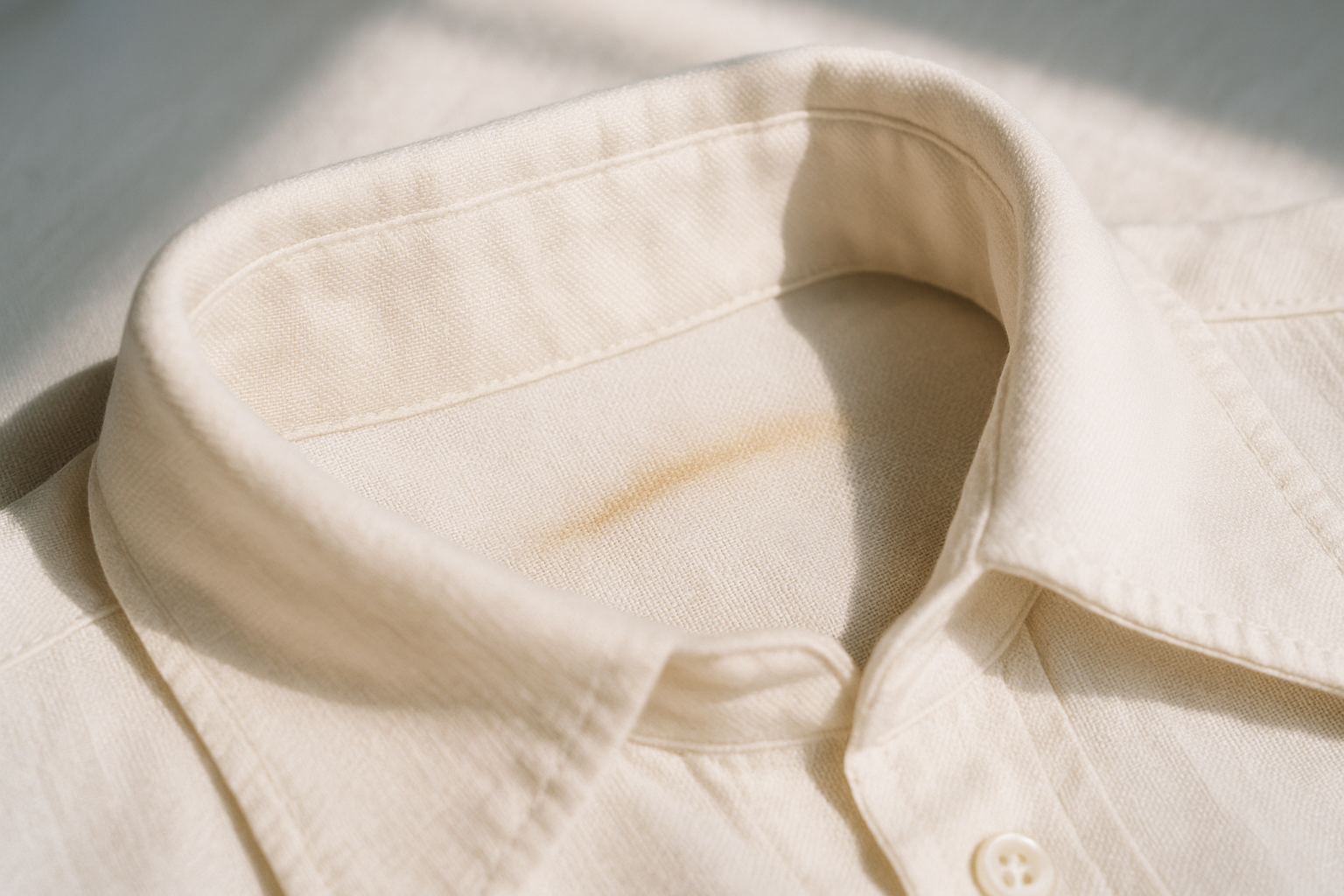
Collar oxidation — the yellow-brown ring that forms along the inside of a shirt collar and the fold line of a cuff — is a Cosmetic Appearance defect, not a cleanliness failure, and it caps most vintage white and cream shirts at Very Good or Good even when the rest of the fabric is pristine. The grade you assign depends on one question: has the discoloration stayed on the surface, or has it penetrated the fiber permanently? Answer that wrong and you either overgrade a shirt that will draw a not-as-described claim, or undergrade a perfectly sellable piece and leave money on the table.
We see this defect constantly on vintage oxford cloth, poplin, and cotton-blend dress shirts from the 1970s through the 1990s. Body oils, deodorant residue, and skin contact oxidize over decades, even on shirts that were laundered regularly before storage. The result looks like a stain. It behaves like one on the surface. But it grades on a different track, and sellers who treat it as ordinary dirt either panic-price a shirt into the bargain bin or list it as "like new" and get burned when a buyer photographs the collar under a lamp.
How to Grade Collar Oxidation on Vintage White Shirts: The Core Distinction
Oxidation is a chemical change in the fiber caused by prolonged exposure to sweat, oils, and air — not a soil deposit sitting on top of the weave. That distinction matters because soil can often be lifted with enzyme treatment or oxygen bleach, while true oxidation is a discoloration baked into the cotton itself. You cannot wash it out, and treating it aggressively (chlorine bleach, high heat) usually makes it worse by yellowing the surrounding fabric further.
Under GradeThread's five-factor standard, collar oxidation lives primarily in Cosmetic Appearance. It does not touch Fabric Condition unless the fibers have also weakened at the fold (a separate defect — collar wilt or fiber breakdown, which you test independently). It does not touch Structural Integrity or Functional Elements at all. And it only touches Odor & Cleanliness if the oxidized area also carries residual odor, which is common but not universal — plenty of oxidized collars smell like nothing after a proper wash.
The Oxidation Test: Step-by-Step Procedure
Run this test on every white or cream vintage shirt before you assign a grade. It takes under two minutes and it's the same sequence we use on every collar and cuff that shows discoloration.
- Inspect the collar under bright, direct light (natural daylight or a 5000K bulb — not warm ambient light, which masks yellow tones). Note whether the discoloration is confined to the inside fold or has migrated to the visible outer collar.
- Turn the collar inside out and stretch the fold flat. Oxidation concentrates along the crease line where skin contact is highest. If the darkening follows this exact line and fades outward gradually, that's consistent with oxidation, not a spill or stain.
- Press a white cotton swab dampened with water against the darkest point and hold for ten seconds. If any color transfers to the swab, you are looking at a topical stain or residue, not fiber-level oxidation, and it may respond to spot treatment.
- Check the reverse side of the fabric at the same point. True oxidation shows through to the underside of the collar fold at roughly the same intensity. A stain that sits on one layer only (no bleed-through) is more likely a localized spill.
- Compare color depth against the rest of the shirt body. Rate the severity as light (barely visible, only detected under direct light), moderate (visible at arm's length, clearly a ring), or heavy (visible from across a room, spans the full collar width).
- Repeat steps 1–5 on both cuffs. Cuffs oxidize independently of collars — a shirt can have a clean collar and heavily oxidized cuffs, or the reverse, depending on wear habits.
- Document severity and location in your condition notes before assigning the final grade, since this defect needs explicit disclosure regardless of tier.
Reading the Underarm as a Secondary Check
If the collar shows moderate-to-heavy oxidation, check the underarm area of the same shirt. Oxidation is a body-chemistry defect, and shirts that oxidize at the collar frequently show a parallel pattern at the underarm seam. Finding both confirms you're dealing with genuine oxidation rather than an isolated storage stain, and it tells you the whole shirt was worn heavily against skin — useful context for your condition report even if the underarm area doesn't independently change the grade.
Cosmetic Fade vs. Permanent Staining: Telling Them Apart
Sellers often lump every collar discoloration into one bucket, but oxidation, sun fading, and chemical staining are three different defects that grade differently and require different disclosure language.
- Oxidation: Yellow-to-brown gradient concentrated at contact points (collar fold, cuff fold, underarm). Fails the swab test — no transfer. Present on both fabric layers. Cannot be laundered out.
- Sun/UV fading: Uneven lightening or yellowing, typically on shoulders or one side of the garment (whichever faced a window or hanger light). Flat, not concentrated at a fold line. Also permanent, but a different visual signature and a different defect entry in your report.
- Chemical staining (deodorant, bleach splash): Sharp-edged, often localized to a single spot rather than a gradient. May show color transfer on the swab test if recent. Can sometimes bleach the fabric lighter rather than darker — a different failure mode entirely.
Confusing these three on a listing is one of the most common vintage-shirt disclosure errors we see. "Some yellowing at collar" is accurate for oxidation but misleading for a bleach spot, which behaves and often looks worse under wash-and-wear. Buyers who've been burned once by an inaccurate description are the ones who leave the harshest not-as-described feedback, so get the taxonomy right the first time.
Grade Thresholds: Oxidation Severity by Tier
Here's how collar and cuff oxidation maps to the standard grade tiers, assuming the rest of the shirt is otherwise clean and structurally sound.
| Grade Tier | Oxidation Severity | Disclosure Requirement |
|---|---|---|
| Excellent | None visible under direct light; collar and cuffs read true white/cream | Not required, but confirm with the light test before claiming Excellent |
| Very Good | Light oxidation, detectable only under direct light or close inspection | Yes — note location (collar, cuff, or both) and severity as "light" |
| Good | Moderate oxidation, visible at arm's length as a defined ring | Yes — include a defect photo of the collar fold under direct light |
| Fair | Heavy oxidation spanning the full collar or cuff width, visible from across a room | Yes — include severity, location, and a note that it is not stain-removable |
| Poor | Heavy oxidation combined with fiber weakening or fraying at the same fold line | Yes — disclose both defects separately; this usually stacks with a Structural Integrity or Fabric Condition deduction |
A shirt cannot be graded NWT or NWOT if any collar oxidation is present, regardless of severity — oxidation only develops through wear or extended storage against skin oils, so its presence contradicts an unworn claim outright.
Common Oxidation Mistakes That Cost Sellers Money
We've watched three mistakes repeat across vintage shirt listings often enough to call them out specifically.
- Treating light oxidation as disqualifying. A light, only-visible-under-lamp ring at the collar fold does not sink a shirt to Good. It's a normal aging marker on decades-old cotton and belongs at Very Good with disclosure — don't undersell a shirt that photographs clean in a standard listing shot.
- Attempting aggressive bleach removal before grading. Chlorine bleach on true oxidation frequently yellows the surrounding weave rather than lifting the discoloration, converting a Very Good collar into a Fair one. If the swab test confirms oxidation rather than surface stain, don't treat it — grade it and disclose it.
- Photographing the collar folded down instead of turned inside out. Buyers checking a listing for oxidation want to see the fold line, not the outer collar. A listing photo that only shows the collar as-worn hides the exact detail a careful buyer is looking for, and that's the detail that generates a dispute later.
Why Standardizing This Matters
"Some slight yellowing" means five different things depending on which seller wrote it. One person's slight is another's heavy ring spanning the full collar. That ambiguity is exactly what generates not-as-described returns on vintage shirts — buyers expect "slight" to mean barely visible, and if it turns out to be a defined line they can see from three feet away, the mismatch between description and reality is what gets disputed, not the oxidation itself.
A numerical grade with a documented condition report closes that gap. "Very Good, light collar oxidation visible under direct light, not present at arm's length" tells a buyer exactly what they're getting before they click buy — no adjective interpretation required.
Try It on One Shirt
Pull a vintage white or cream dress shirt from your inventory and run it through GradeThread. You'll get a numerical grade, a factor-by-factor condition report, and a certificate that documents the collar and cuff condition exactly as we've outlined here — so your listing states the real severity instead of a guess, and your buyer knows what they're getting before it ships.