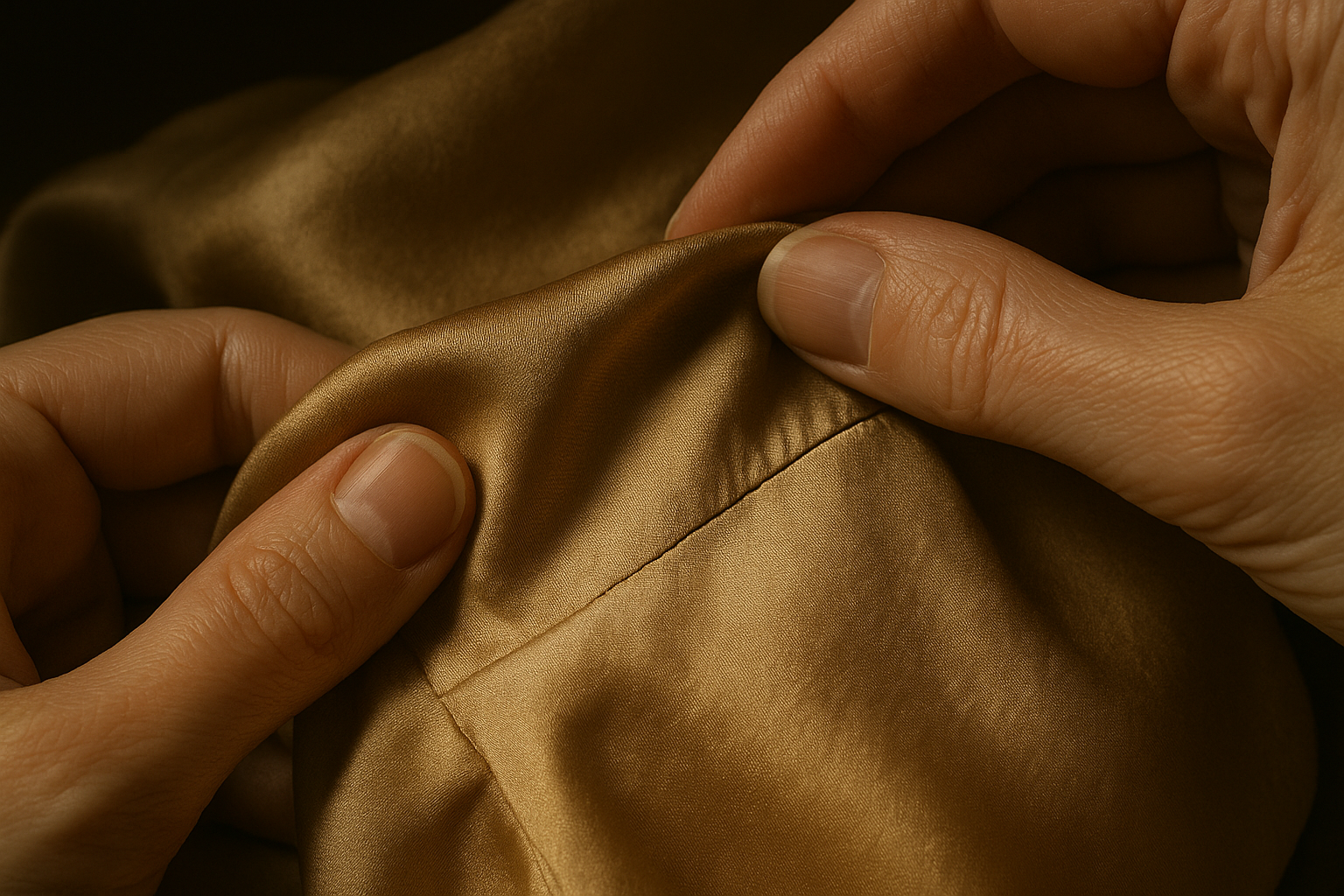
Brittle silk charmeuse that cracks or splits along its fold lines is a Fabric Condition defect, not cosmetic wear — and it caps the grade at Fair or Poor depending on crack length and location, even when the surface color and sheen look untouched. If you're grading vintage silk by eye alone, you will miss this every time, because charmeuse hides fiber breakdown behind a glossy face until the moment it splits in a buyer's hands.
We've had this exact return: a 1980s bias-cut charmeuse slip dress, photographed flat, sheen intact, no visible stains. Graded Excellent by the seller. It arrived with a two-inch crack along the underarm fold that the seller never bent the fabric to check for. That's not a shipping accident. That's a pre-existing structural failure that a five-second fold test would have caught.
Why Silk Charmeuse Fails Differently Than Other Fabrics
Charmeuse is a satin weave — long floats of filament silk on the face, a duller crepe-like back. That weave structure is what gives it its slip and sheen, but it also means stress concentrates unevenly. When the silk fibers themselves degrade — from decades of UV exposure, oxidation, dry storage, or simply age — the fabric doesn't fade evenly like cotton. It goes brittle in localized zones: underarms, waist folds, any spot that's been creased in storage for years.
Cotton and wool tend to thin and wear gradually, giving you a visible warning (see-through spots, thread show-through) before real failure. Silk charmeuse often gives you almost no warning. The face stays glossy, the drape stays fluid, and then a fold that's been sitting the same way for 30 years cracks the moment you unfold it or a buyer sits down in it. This is why silk brittleness gets its own defect category instead of getting lumped in with general fabric wear — the failure mode and the detection method are both different.
The Fold Test: How to Detect Brittle Silk Charmeuse Before You List
You cannot grade silk charmeuse condition from photos or from a flat visual scan. You have to physically manipulate the fabric at its known stress points. Here's the procedure we use before every silk garment gets a number:
- Locate the garment's natural fold lines — underarm creases, waistband folds, any area that's been compressed in storage or against a hanger for an extended period.
- Gently fold the fabric along each of these lines, away from you, using light pressure — do not force or yank.
- Listen and watch for a faint crackling sound or visible fiber whitening along the fold as you bend it; this is the first sign of fiber-level brittleness.
- Release the fold and inspect the crease under raking light (light held at a low angle) for hairline cracks in the weave, not just a wrinkle.
- Repeat the fold at a second, unrelated point on the garment — sleeve seam, hem — to confirm whether brittleness is localized or fabric-wide.
- If a crack appears anywhere during this test, gently press the surrounding fabric to check whether the crack propagates further or holds at its current length.
- Photograph every crack location under raking light before continuing any further handling, since additional folding can worsen an existing crack.
If the fabric folds cleanly with a smooth crease and no crackling, sound, or fiber whitening, you're looking at normal aging, not brittleness — proceed to grade on the other four factors as usual. If it cracks, stop manipulating that area and move to disclosure.
Cracking vs. Normal Silk Aging: What's the Difference
Sellers frequently call cracked silk "vintage patina" or "soft with age," which undersells the actual defect. These are not interchangeable conditions, and they don't grade the same.
| Characteristic | Normal Silk Aging | Fiber Brittleness / Cracking |
|---|---|---|
| Fold behavior | Creases smoothly, no sound | Crackles or splits along the fold |
| Sheen | May dull slightly overall | Sheen often unaffected until crack appears |
| Location pattern | Even, fabric-wide softening | Localized at folds, seams, stress points |
| Reversibility | None needed — not a defect | Permanent; cannot be pressed or steamed out |
| Grading factor | Cosmetic Appearance (minor, if any) | Fabric Condition, possibly Structural Integrity |
| Typical grade impact | None to half-point deduction | Caps grade at Fair (5) or Poor (3–4) |
The tell is the fold test itself. Aging softens silk uniformly and predictably. Brittleness announces itself at specific stress points and doesn't go away when you smooth the fabric back out. If you see whitening or a faint line at the fold that persists after you release it, that's fiber-level damage, not a wrinkle.
Grading Thresholds: From Excellent to Poor
Charmeuse brittleness maps onto our standard tier vocabulary the same way any other Fabric Condition defect does, but the thresholds are tighter than buyers expect because silk failure is progressive — a small crack today is a bigger tear after one more fold or one wash.
- Excellent (8): Fold test passes cleanly at all stress points. No crackling, no whitening, no hairline cracks under raking light. Sheen and drape intact.
- Very Good (7): Fold test passes but fabric feels slightly drier or stiffer than expected for the garment's age bracket. No visible cracking on inspection.
- Good (6): One minor hairline crack detected at a single fold point, under an inch, not actively propagating when pressed. Disclose location and length.
- Fair (5): Multiple crack points, or a single crack over an inch, confirmed by the fold test at more than one location. Garment is wearable but fragile — buyer must be warned about further handling risk.
- Poor (3–4): Cracking has progressed into an actual split or tear, or brittleness is present fabric-wide rather than localized. Garment risks further failure in normal handling, including shipping.
Note that this defect can also pull down Structural Integrity if a crack has widened into a true tear along a seam or stress point — at that stage you're grading two factors down, not one, and the numerical grade should reflect both.
Handling and Photographing Fragile Silk for Listing
Once you've identified brittleness, how you handle the garment for the rest of the listing process matters as much as the grade itself. A crack that's a half-inch today can become a three-inch tear if you steam it, hang it on a wire hanger, or fold it for storage the same way it's already failing.
- Lay the garment flat for photography instead of hanging it — hanger tension on a brittle shoulder seam or strap can worsen an existing crack.
- Skip the steamer on any confirmed brittle area. Heat and moisture won't reverse the damage and can accelerate fiber breakdown at the crack edge.
- Photograph the crack under raking light with a ruler or coin for scale, in addition to your standard flatlay shots — this is the evidence buyers and any dispute reviewer will look for.
- Ship flat in a garment bag with tissue support at the fold points, not compressed in a poly bag, to avoid adding new stress to already fragile fibers.
The Disclosure Standard That Stops Silk Returns
Silk charmeuse is one of the highest-return-risk fabrics in vintage resale precisely because the defect is invisible in a flat photo and often invisible to the seller until the fold test is run. A buyer who receives an undisclosed crack has a legitimate not-as-described claim — the garment genuinely wasn't what the grade implied — and platforms will side with them.
The fix isn't avoiding silk listings. It's running the fold test on every charmeuse garment before you assign a grade, disclosing exact crack location and length in the condition notes, and pricing the Fair or Poor tier honestly instead of hoping a good flatlay photo covers for it. A well-disclosed Fair-grade silk dress with a known crack sells to a buyer who knows what they're getting. An undisclosed one comes back.
Run this test on your next silk garment before you write the listing. GradeThread's condition report scores Fabric Condition, Structural Integrity, Cosmetic Appearance, Functional Elements, and Odor & Cleanliness independently and flags exactly this kind of fold-line brittleness in the report, so the number on your listing matches what's actually in the buyer's hands. Grade one silk piece and see what the report catches.