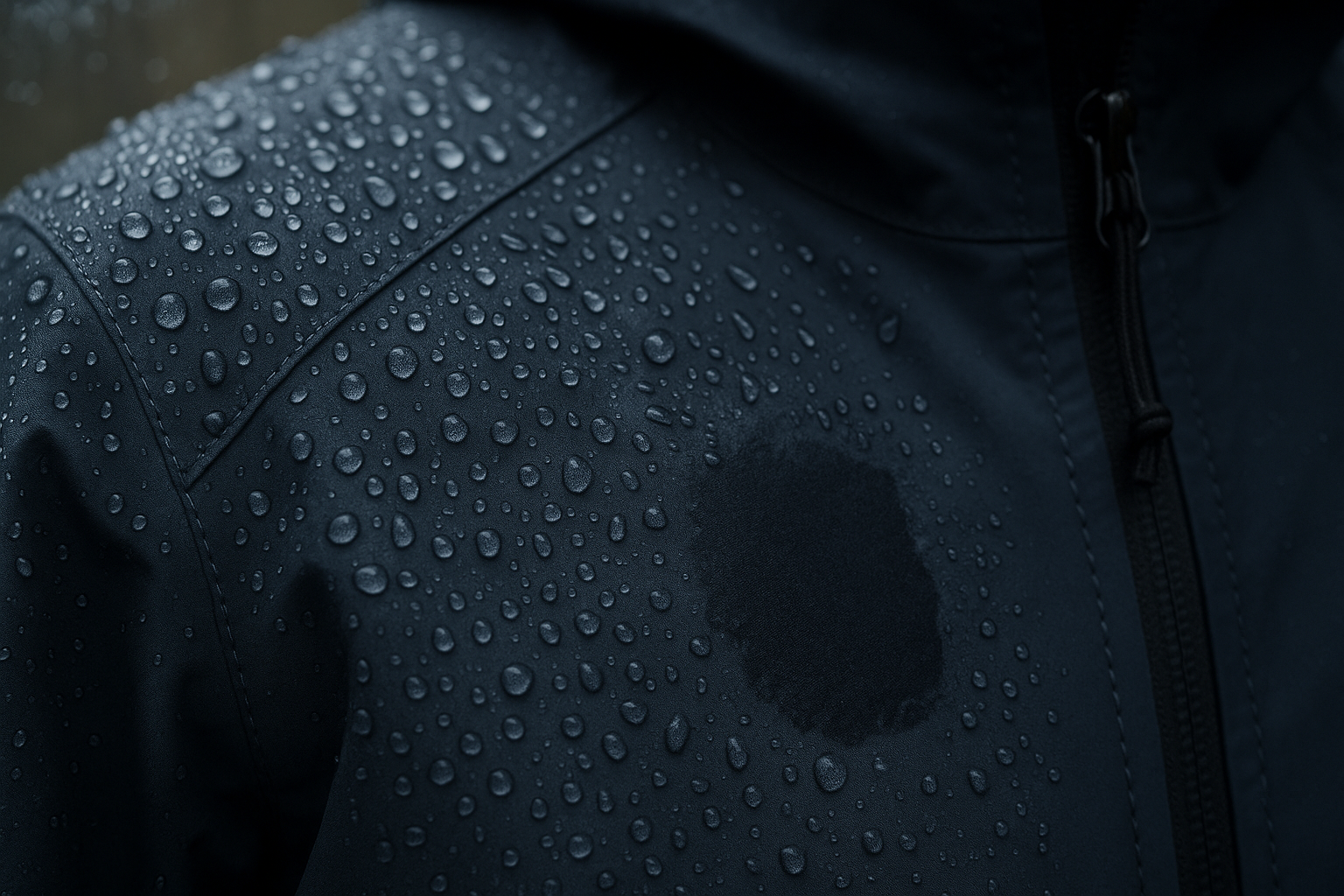
DWR (durable water repellent) coating loss is a Functional Elements defect, not a Cosmetic Appearance issue — grade it by how the fabric performs under water contact, not by how it looks dry. A shell that no longer beads water has lost a working feature of the garment, even if the fabric shows no visible damage, and that caps the grade regardless of how clean the jacket looks on a hanger.
We see this mistake constantly on vintage shells, ski jackets, and technical outerwear: the fabric looks Excellent, the zippers work, the lining is clean, so the seller grades it Excellent and moves on. Then a buyer wears it in light rain, the shoulders wet out in ten minutes, and a return request lands citing "not as described — not waterproof." The seller never tested for it because DWR failure doesn't show up in a flatlay photo. It only shows up when water hits the fabric.
What DWR Actually Is (and Why It Fails Silently)
DWR is a topical coating applied to the face fabric of technical outerwear — a thin layer of fluoropolymer or (in newer PFC-free formulations) silicone or wax-based treatment that makes water bead up and roll off instead of soaking in. It sits on top of the fabric's woven or knit structure. On laminated shells (Gore-Tex, eVent, and similar membrane constructions), the DWR is a separate layer from the actual waterproof-breathable membrane underneath.
That distinction matters for grading. A jacket can lose its DWR coating entirely while the membrane underneath is still fully intact and waterproof. What happens is called "wetting out": the outer face fabric absorbs water and turns dark and heavy, even though the membrane is still blocking moisture from reaching the wearer. The jacket technically still keeps you dry, but it feels wet, loses breathability, and looks saturated — and most buyers correctly read that as a failure, whether or not the membrane held up.
DWR degrades through repeated washing without re-treatment, body oils and dirt building up on the face fabric, abrasion at high-contact points (shoulders under a backpack, cuffs, chest), and UV exposure over years of storage or use. None of this shows up as a visible defect. That's why you cannot grade waterproofing by eye — you have to test it.
The Bead Test: How to Grade DWR Function Before You List
This is the fastest reliable check for DWR condition and it takes under two minutes per garment. Do it before you write the condition report, not after.
- Lay the jacket flat on a surface you don't mind getting wet, face fabric up, with the highest-wear zones exposed — shoulders, upper back, cuffs, and chest.
- Fill a spray bottle or cup with room-temperature water.
- Splash or spray a light, even amount of water directly onto a high-wear zone, such as the shoulder seam area.
- Watch the water's behavior for 10–15 seconds without touching the fabric.
- Note whether the water beads into distinct droplets and rolls off, spreads into a sheet across the surface, or gets absorbed and darkens the fabric.
- Repeat the test on a low-wear zone — the inside of a cuff placket or the underside of a collar — for comparison.
- Compare the two results. A significant gap between high-wear and low-wear performance tells you the coating has broken down specifically at contact points, which is the most common vintage DWR failure pattern.
- If you have access to a hydrostatic pressure or spray-rating reference, use it only as a secondary check — the visual bead test is sufficient for resale grading purposes.
Record what you saw in plain terms in the condition report: "beads and sheets cleanly across all tested zones" reads very differently to a buyer than "absorbs within 5 seconds at shoulders, beads normally at collar." Specificity here is what prevents the dispute later.
Grading Thresholds: From NWT to Poor on Water Repellency
Use this scale to translate bead-test results into a grade contribution. DWR condition affects the Functional Elements score directly and should be called out separately from Fabric Condition even when the shell fabric itself looks new.
| Grade Tier | Bead Test Result | What This Means for the Buyer |
|---|---|---|
| NWT / NWOT | Water beads and rolls off uniformly across the entire garment, no absorption anywhere | Full original waterproofing performance, coating unused or unwashed |
| Excellent | Beading strong overall; slight sheeting (not absorption) at one or two high-wear points like the shoulder seam | Minor, expected coating wear from light use — performance essentially intact |
| Very Good | Beading present on most of the garment; visible absorption and darkening at shoulders and cuffs within 10–15 seconds | Coating has worn unevenly at contact points; jacket still repels water in most areas but will wet out in sustained rain at those zones |
| Good | Beading weak or absent across most of the shell; water absorbs and darkens fabric within seconds almost everywhere tested | DWR is functionally spent; jacket needs re-treatment to perform as rainwear again, though it's still wearable as a shell or layering piece |
| Fair | No beading anywhere; face fabric wets out immediately on contact, feels damp-heavy after light splashing | Waterproofing function is gone; buyer should expect a fashion or transitional-weather jacket, not rain protection |
| Poor | Full wet-out plus evidence of membrane failure — delamination, bubbling, or peeling visible on the interior face | Not just DWR loss but structural failure of the waterproof-breathable system itself |
Note the jump between Good and Fair versus Poor. DWR loss alone, even total loss, generally caps a jacket in the Good-to-Fair range on the waterproofing factor — annoying but not catastrophic, since re-treatment products exist and the garment still functions as outerwear. Delamination is a different animal entirely: that's Structural Integrity failure inside the fabric system, and it belongs in Poor regardless of how the face fabric beads.
DWR Loss vs. Other Outerwear Defects
Sellers frequently lump waterproofing problems in with general fabric wear. They're not the same defect and they don't grade the same way.
- DWR breakdown: a coating issue on the fabric surface. Affects Functional Elements. Reversible with re-treatment products. Doesn't necessarily indicate poor Fabric Condition.
- Delamination: the membrane separating from the face fabric or lining, often showing as bubbling, peeling, or a crackled texture on the interior. This is Structural Integrity failure and is not reversible. Grade Poor if present in any meaningful area.
- Seam tape failure: the taped seams inside a waterproof jacket lifting or peeling, creating leak points at stitch lines. Also Functional Elements, but distinct from DWR — a jacket can have perfect DWR and failed seam tape, or the reverse. Check seams separately with a light stretch-and-peek at the interior tape edges.
- Fabric frosting or sheen loss: a change in how the shell fabric reflects light, usually from fiber-level wear on synthetics. This is Cosmetic Appearance and has no bearing on water repellency — don't confuse a dull-looking shell with a wet-out one. Test both independently.
Each of these can exist independently or in combination. A jacket that fails the bead test but has clean, unpeeled seam tape and no visible delamination is a Good-to-Fair waterproofing call with everything else graded on its own merits. A jacket with perfect beading but bubbling seam tape at the shoulders needs a Functional Elements flag too — don't let strong DWR performance mask a leak point elsewhere.
Disclosure Rules When You've Re-Treated the Jacket
Re-waterproofing sprays and wash-in treatments are common and legitimate, but they change what you're actually grading and buyers deserve to know which one they're getting.
If you treat a jacket with a DWR spray or wash-in product before listing, disclose it explicitly in the condition report: "DWR re-applied prior to listing; beads uniformly at time of grading." This is different from an original, unaltered coating, and treated coatings typically don't last as long or perform as evenly as factory-applied DWR — buyers who know outerwear will ask, and sellers who don't disclose it invite a dispute if the treatment wears off faster than expected. If you did not re-treat, say so too: "original factory DWR, not re-treated" tells a technical-outerwear buyer exactly what they're bidding on.
Common Grading Mistakes on Technical Outerwear
The two errors we see most often both come from skipping the bead test entirely. First, grading a technically sound jacket down for cosmetic fading or sheen changes that have nothing to do with waterproofing — that's punishing the wrong factor. Second, and more costly, grading a jacket up to Excellent or Very Good because the fabric looks pristine, without ever confirming the coating still repels water. A dry-looking shell tells you nothing about wet performance. The only way to know is to get it wet on purpose, on your terms, before a buyer does it for you in a rainstorm.
One more thing worth checking: hydrostatic performance drops with age even on unused, deadstock technical outerwear. A NWT ski shell from 1998 sitting in storage for two decades may show weaker beading than a lightly-worn shell from three years ago, simply because DWR coatings break down chemically over time, not just through wear. Test every technical piece regardless of apparent age or use — don't assume newer-looking means better-performing.
Try It on Your Next Technical Piece
If you're sitting on a shell, ski jacket, or vintage rain layer you haven't graded yet, run the bead test before you write the listing. GradeThread's condition reports score Functional Elements separately from Fabric Condition and Cosmetic Appearance, so a jacket with worn DWR but clean fabric gets an accurate grade instead of a guess — and a buyer-verifiable certificate that shows exactly what you tested and what you found. Grade one piece and see the report before you decide it's worth doing on the rest of your outerwear rack.