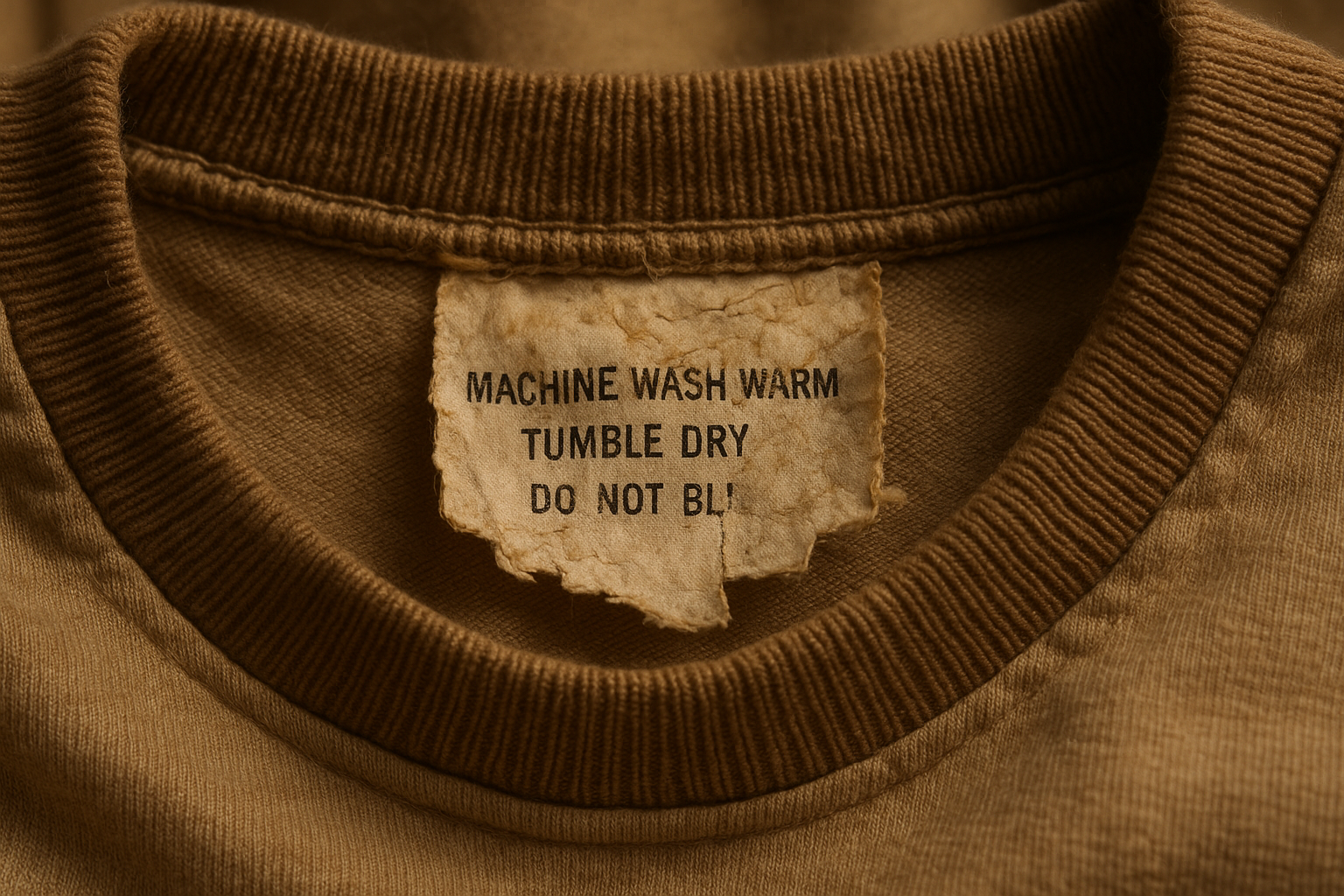
A missing or illegible wash care tag does not automatically lower a vintage garment's grade — but it can, depending on why the tag is gone. A tag that was cut out reduces the Functional Elements score and caps the overall grade. A tag that never existed because the garment predates mandatory care labeling is period-correct and requires disclosure, not a deduction.
Resellers get this wrong in both directions constantly. We've seen sellers grade a 1965 wool coat down to Good because it has no care tag, when the absence is completely normal for its era. We've also seen sellers grade a cut-and-relisted 2010s dress as Excellent because the fabric and seams are flawless, ignoring the frayed threads at the neck seam where a tag was clearly removed. Both mistakes create the same downstream problem: a buyer who feels misled, and a return request citing "item not as described."
Why the Care Tag Is a Functional Elements Factor, Not Just Trivia
Under GradeThread's five-factor standard — Fabric Condition, Structural Integrity, Cosmetic Appearance, Functional Elements, and Odor & Cleanliness — the care tag sits inside Functional Elements alongside zippers, buttons, snaps, and drawstrings. That placement is deliberate. A care tag isn't decorative. It's the manufacturer's instruction for how to safely maintain the garment without damaging it. When it's gone, the buyer loses functional information, not just a collectible scrap of fabric.
This matters more on vintage than on modern resale. A 2022 poly-blend blouse without a wash tag is a minor inconvenience — most buyers can guess synthetic care correctly. A 1970s silk-blend dress without a wash tag is a real risk. Guess wrong and the buyer hand-washes something that needed dry cleaning, or throws a wool-blend sweater in a hot dryer. The missing information has a real cost, which is why it belongs in a functional factor, not a purely cosmetic one.
Three Failure Modes That Grade Differently
Not all "missing care tag" situations are the same defect. We separate them into three categories, and each one has a different effect on the grade.
1. Never existed (period-correct absence)
In the US, the FTC's Care Labeling Rule (16 CFR Part 423) took effect in 1972 and made permanent care labels mandatory on most textile apparel. Garments made before that date legitimately never had a sewn-in care tag. This is not a defect — it's a dating cue. A missing care tag on a garment with construction details consistent with a pre-1972 production date (union labels, certain zipper hardware, fabric weight and finishing) should be treated as expected, not deducted.
2. Removed (cut or torn out)
This is the one that actually costs points. Consignment shops, thrift processors, and some sellers cut care tags to discourage wear-and-return fraud, or because the tag was scratchy and a previous owner removed it. Look at the neck seam or side seam interior: cut threads, a small fabric discoloration outline, or a visible stitch-hole pattern are all evidence of removal. This reduces the buyer's functional information the same way a missing button does — the garment still works, but a piece of it is gone, and that's disclosable.
3. Present but illegible
Decades of washing can fade printed care instructions to nothing while the tag itself stays intact. This is a milder case than removal because the documentation object is still there — it just doesn't communicate anything. It typically costs less than a fully removed tag but still needs disclosure, since a buyer scanning your photos will assume they can read care instructions that in fact they can't.
Grade Impact by Tag Condition
The table below assumes everything else about the garment — Fabric Condition, Structural Integrity, Cosmetic Appearance, Odor & Cleanliness — is otherwise consistent with the tier shown. The care tag condition is the variable being isolated.
| Tag Condition | Functional Elements Impact | Effect on Grade Ceiling | Disclosure Needed |
|---|---|---|---|
| Present, fully legible | No deduction | No cap — grade determined by other factors | No |
| Present, partially faded | Minor deduction | Can still reach Excellent; unlikely to reach NWT/NWOT if hangtag-dependent | Yes — note reduced legibility |
| Present, fully illegible | Moderate deduction | Typically caps at Very Good even if fabric and structure are excellent | Yes — state fiber content source (label elsewhere, hand ID, or seller estimate) |
| Removed (cut/torn, visible evidence) | Moderate-to-significant deduction | Typically caps at Good, regardless of fabric condition | Yes — disclose as removed, not "never had one" |
| Never existed (pre-1972 or foreign equivalent, no removal evidence) | No deduction | No cap — grade determined by other factors | Yes — note era-appropriate absence, positive dating signal |
Notice the asymmetry: a tag that never existed carries no grade penalty, but a tag that was cut out does — even though both listings show the exact same photo of a bare neck seam. The disclosure language is what separates them, and it's why guessing isn't good enough. You need to look for the evidence.
How to Inspect and Grade a Missing or Illegible Care Tag
- Check every label location before concluding the tag is missing — neck, left side seam, and hem facings all used to carry care information, and some manufacturers placed it away from the neck entirely.
- Examine the neck seam and side seam interior for cut threads, a faded fabric outline, or a stitch-hole pattern. Any of these is evidence of a removed tag, not a never-existed one.
- Date the garment using construction cues — union labels, RN number format, zipper hardware, fabric finishing — to determine whether a care tag was legally or commercially expected at the time of manufacture.
- Photograph the neck interior and any side-seam label area in close, even light so the buyer can verify your finding themselves.
- If fiber content is uncertain and functional risk is real (silk, wool, rayon blends especially), note that a burn test or hand-feel assessment was used to estimate care requirements, and say so plainly rather than guessing silently.
- Score the Functional Elements factor using the table above, and apply the appropriate grade ceiling if the tag was removed or is fully illegible.
- Write the disclosure into your listing description in one direct sentence — not buried in bullet points — so it reads as transparency rather than an afterthought.
Disclosure Requirements: What to Actually Write
Vintage garment documentation disclosure requirements aren't complicated, but they need to be specific. "No tags" is not a disclosure — it's an omission that invites a return. Compare these two listing lines:
- Weak: "Vintage dress, no tags, great condition."
- Strong: "Care label has been removed (cut threads visible at neck seam, photo 6). Fabric is a wool-blend based on hand feel; we recommend dry clean only. Graded Good for this reason despite excellent fabric and structure."
The second version does three things the first doesn't: it identifies which failure mode applies (removed, not never-existed), gives the buyer a functional substitute for the missing instructions, and explains how that fact affected the grade. That's the difference between a condition report and a guess dressed up as one.
The Pre-1971 Exception: When No Tag Is a Feature, Not a Flaw
This is worth repeating because it cuts against reseller instinct: on a genuinely pre-regulation garment, the absence of a care tag is a positive authentication signal, not a gap to apologize for. Buyers who collect true vintage — 1950s-1960s pieces especially — often look for the absence of a modern-style printed care tag as one data point confirming the garment's age. If you're grading a piece like this, say so directly: "No care label present, consistent with pre-1972 manufacture; see union label and finishing details in photos 3-4 for dating context." That sentence builds trust instead of raising a red flag, and it keeps the grade from being needlessly dragged down for something that was never a defect in the first place.
Try It on One Garment
If you've got a vintage piece sitting in inventory with a cut, faded, or missing care tag, run it through GradeThread and see how the report handles the Functional Elements call — and how the disclosure language comes out. One graded garment will show you exactly where the line falls between period-correct and disclosable defect.