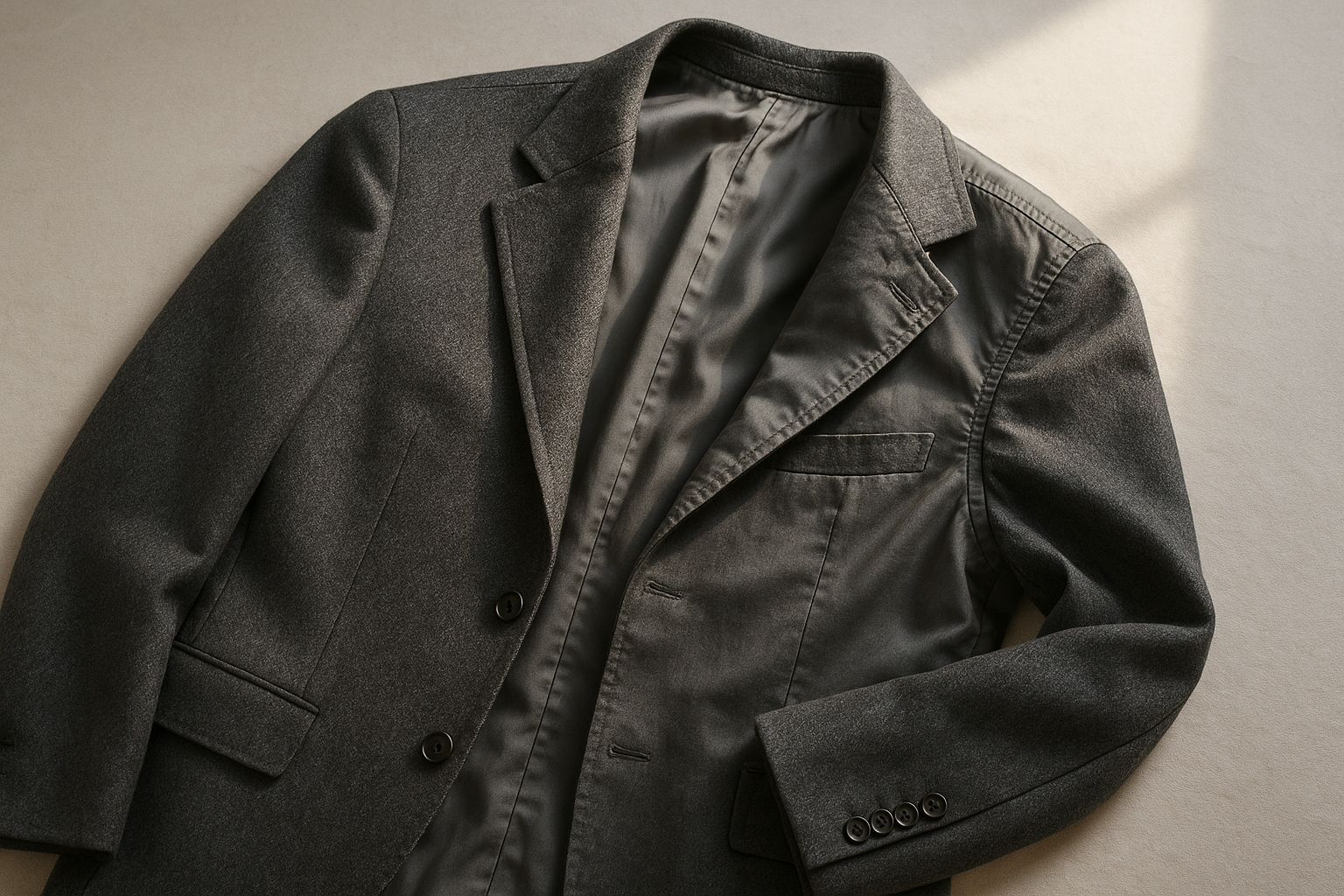
To grade vintage suit and blazer condition correctly, check three structural zones before you touch the fabric surface: the shoulder seam and canvas underneath it, the lining at the armpit and pocket bags, and the buttonholes at the point of most repeated stress. A jacket can look pressed and clean in photos and still drop a full tier once you flex the shoulder or turn the lining inside out.
Structured tailoring is unforgiving. Unlike a knit or a tee, a blazer has a skeleton — canvas, shoulder pads, interfacing — sitting between the shell fabric and the lining. That skeleton fails silently. You won't see it in a flatlay. You'll see it when a buyer opens a return case three weeks later saying the shoulder "looks lumpy" or the sleeve "pulls funny." We've graded enough secondhand tailoring to know the surface almost never tells the whole story.
Why Structured Jackets Grade Differently Than Casual Wear
A cotton tee has one layer. A blazer has five to seven, depending on construction: shell fabric, chest canvas, shoulder pad, sleeve head wadding, interfacing, lining, and interlining in some wool coats. Each layer ages at a different rate, and each layer can fail independently of the others.
This is why a jacket that scores well on Fabric Condition — no pilling, no fading, wool still has its hand — can still land at Very Good or Good once you factor in Structural Integrity. The shell can be immaculate while the canvas underneath has broken down, delaminated, or bubbled. That's a defect a casual-wear grader never has to think about, and it's the single biggest reason suits and blazers get graded wrong by sellers used to grading tees and hoodies.
Construction type matters here too. Fused jackets (canvas glued rather than stitched to the shell) are the majority of mid-market tailoring made after the 1990s, and the glue is exactly what fails with age and dry cleaning heat — you'll see bubbling across the chest panel that no amount of pressing fixes. Full-canvas and half-canvas construction, more common on better vintage tailoring, ages differently: the horsehair canvas can shift or the pad stitching can loosen, but you rarely see the bubbling failure. Note construction type in the report when you can identify it, since a fused-jacket buyer expects a different failure mode than a full-canvas buyer.
The Shoulder Seam Test: How to Assess Structural Integrity
The shoulder seam is where a blazer's frame either holds or gives out. Under Structural Integrity, this is the first place we check, before hems, before pockets, before buttons.
Here's what separates cosmetic wear from a real structural fail:
- Rope or roll at the seam line — a slight ridge is normal construction, not damage. Ignore it.
- Puckering that wasn't there when new — this signals the canvas or shoulder pad has shifted or the seam has been let out. Grade this as a Structural Integrity deduction, not a cosmetic one.
- Divots or lumps under the shoulder pad — press two fingers into the shoulder cap and rotate. Foam pads break down and crumble with age; horsehair canvas can bunch. Either drops the garment out of Excellent territory.
- Seam separation at the sleeve head — pull the sleeve gently away from the body at a 45-degree angle. Any daylight visible at the stitch line is a functional failure, not a cosmetic one, and it belongs in the report even if it's a quarter-inch.
- Asymmetry between shoulders — lay the jacket flat, shoulder to shoulder. A half-inch difference from wear or a bad past alteration should be disclosed, not smoothed over in photos.
- Chest canvas bubbling — hold the front panel up to a raking light. A rippled or blistered texture under the shell means the fusible canvas has delaminated. This is a Structural Integrity fail even if the shell fabric itself is flawless.
A jacket with a clean seam line and full range of shoulder movement can still earn Excellent. One with any of the above should not clear Very Good, regardless of how the outer wool photographs.
Lining Damage: Where It Tears and How to Grade It
Lining fails in predictable places, and predictable failure is good news for grading consistency. Check these zones in order every time:
- Underarm seam, where friction and body heat break down rayon or acetate lining fastest.
- Inside pocket bags, where keys, phones, and pens create pinhole wear.
- Back vent lining, where sitting and reaching stress the seam.
- Sleeve lining at the cuff, where hands pull the jacket on and off.
Grade lining damage on severity, not just presence:
| Lining Condition | What You'll See | Grading Impact |
|---|---|---|
| Minor shine or thinning | Fabric looks slightly worn but intact, no holes | Compatible with Excellent to Very Good |
| Small tear under 1 inch, not at a stress point | Isolated tear, edges don't fray on handling | Very Good, must be disclosed with a close-up photo |
| Tear at underarm or pocket bag, actively fraying | Growing tear, visible pulling at the seam | Good at best, needs repair note or price adjustment |
| Missing lining panel or unstitched hem | Structural failure, lining detached from shell | Fair, functional defect that affects wearability |
A torn lining almost never affects how the jacket wears on the body — that's why sellers routinely underweight it. But it affects buyer perception of overall garment care, and a buyer who paid Excellent-tier money for a jacket with a hidden six-inch armpit tear will file a not-as-described case even though the shell is flawless. Disclose lining condition every time, with a photo, even when it feels like a minor deduction. On eBay listings specifically, note lining condition in the item description text, not just the photos — buyers who search "suit lining tear" in return disputes are checking whether it was disclosed in words.
Buttonhole Wear Standards for Resale
Buttonholes are a Functional Elements check, and they age faster than most sellers expect because they take direct mechanical stress every time the jacket is worn.
What to look for, in order of severity:
- Fraying at the edge — loose threads around the buttonhole opening, no structural loss. Cosmetic, minor deduction at most.
- Stretching — the hole has visibly elongated and the button no longer sits centered when closed. This is a Functional Elements issue, not cosmetic, because it affects how the garment closes.
- Thread breakage at the bar tack — the reinforcing stitch at each end of the buttonhole has snapped, and the hole is starting to run. This should cap the grade at Good until repaired.
- Full separation — the buttonhole no longer holds a button closed at all. This is a Poor-tier functional failure regardless of how the rest of the jacket looks.
Working buttonholes on the cuff (a genuine surgeon's cuff, common on higher-end tailoring) deserve their own check. A stuck or non-functional working buttonhole should be noted separately from the front closure, since buyers who specifically seek out functioning cuffs will ask, and misrepresenting a decorative cuff as functional is a fast route to a return.
The Five Factors Applied to a Structured Jacket
Every GradeThread report scores five weighted factors. Here's what each one actually means on a suit or blazer, concretely, not abstractly:
- Fabric Condition — wool nap, cotton twill integrity, or linen weave. Check for shine from repeated pressing, moth damage (small, round holes, often clustered), and color evenness across panels that may have faded at different rates if the jacket was displayed or stored folded.
- Structural Integrity — the shoulder seam, canvas, and shoulder pad checks above, plus vents that lie flat and a collar that sits without rolling.
- Cosmetic Appearance — visible stains, shine at elbows and seat (for matching trousers), and press quality. A jacket that's structurally sound but heavily creased from improper hanging can still lose points here.
- Functional Elements — buttons, buttonholes, and zipper or hook closures on double-breasted styles. Every button should be tested for looseness, not just presence.
- Odor & Cleanliness — wool holds cigarette smoke and mildew longer than synthetic fabrics and is harder to fully deodorize without professional dry cleaning. This factor carries real weight on vintage tailoring specifically because home laundering isn't an option.
How to Grade a Vintage Suit or Blazer, Step by Step
- Lay the jacket flat on a hanger or form and check shoulder symmetry side to side before handling anything else.
- Flex each shoulder seam by rotating the sleeve at a 45-degree angle and check for seam gap or canvas divots.
- Hold the front chest panel up to a raking light and check for bubbling that signals fused-canvas delamination.
- Turn the jacket inside out and inspect the lining at the underarm seam, pocket bags, and back vent for tears or thinning.
- Test every button for looseness and inspect each buttonhole for fraying, stretching, or bar-tack breakage.
- Check the collar and lapel roll for permanent creasing or a collar that no longer sits flat against the neck.
- Smell the interior lining and underarm area directly — don't rely on a quick sniff at arm's length, since smoke and mildew concentrate in the lining fibers.
- Score each of the five factors independently, then apply the lowest-scoring factor as the ceiling for the overall grade rather than averaging them upward.
- Photograph any defect found in steps 2 through 7 close-up, even if it feels minor, before assigning a final tier.
That last step matters more on tailoring than almost any other category. A buyer paying Excellent-tier prices for a suit is usually buying it for a specific event or a specific fit, and a hidden lining tear or a stretched buttonhole discovered after the fact reads as a bigger breach of trust than the same defect on a t-shirt.
Where Suits and Blazers Land on the Grading Scale
Structured tailoring rarely earns NWT or NWOT once it's been altered, which happens to the majority of suits at point of sale. A jacket that's been tailored but never worn should be graded on the alteration quality and any leftover pin marks or chalk residue, not automatically bumped down.
For everything else, the ceiling is usually set by whichever factor scores lowest:
- Excellent — clean shoulder seams, intact lining with no tears, buttonholes tight and centered, no odor.
- Very Good — minor lining thinning or a single small tear away from stress points, buttonhole fraying that doesn't affect function.
- Good — visible lining tear at a stress point, one stretched buttonhole, or minor shoulder pad shifting that doesn't affect fit.
- Fair — canvas separation, multiple buttonhole failures, or lining detachment that affects how the jacket wears.
- Poor — structural failure at the shoulder, missing lining panels, or odor that resists professional cleaning.
Price accordingly. A blazer marketed as Excellent but graded honestly at Very Good because of a quarter-inch seam gap isn't a loss — it's a correct price, and it's one that won't come back to you as a return.
Grade the Jacket Before the Buyer Does
Suits and blazers hide their real condition under the surface, which makes seller-written descriptions especially prone to disputes. A structural defect at the shoulder or a stretched buttonhole is easy to miss in a quick photo shoot and expensive to explain after a buyer notices it themselves. Run one jacket through GradeThread and see how the five-factor report and certificate handle the parts of a suit that a normal listing photo never shows.