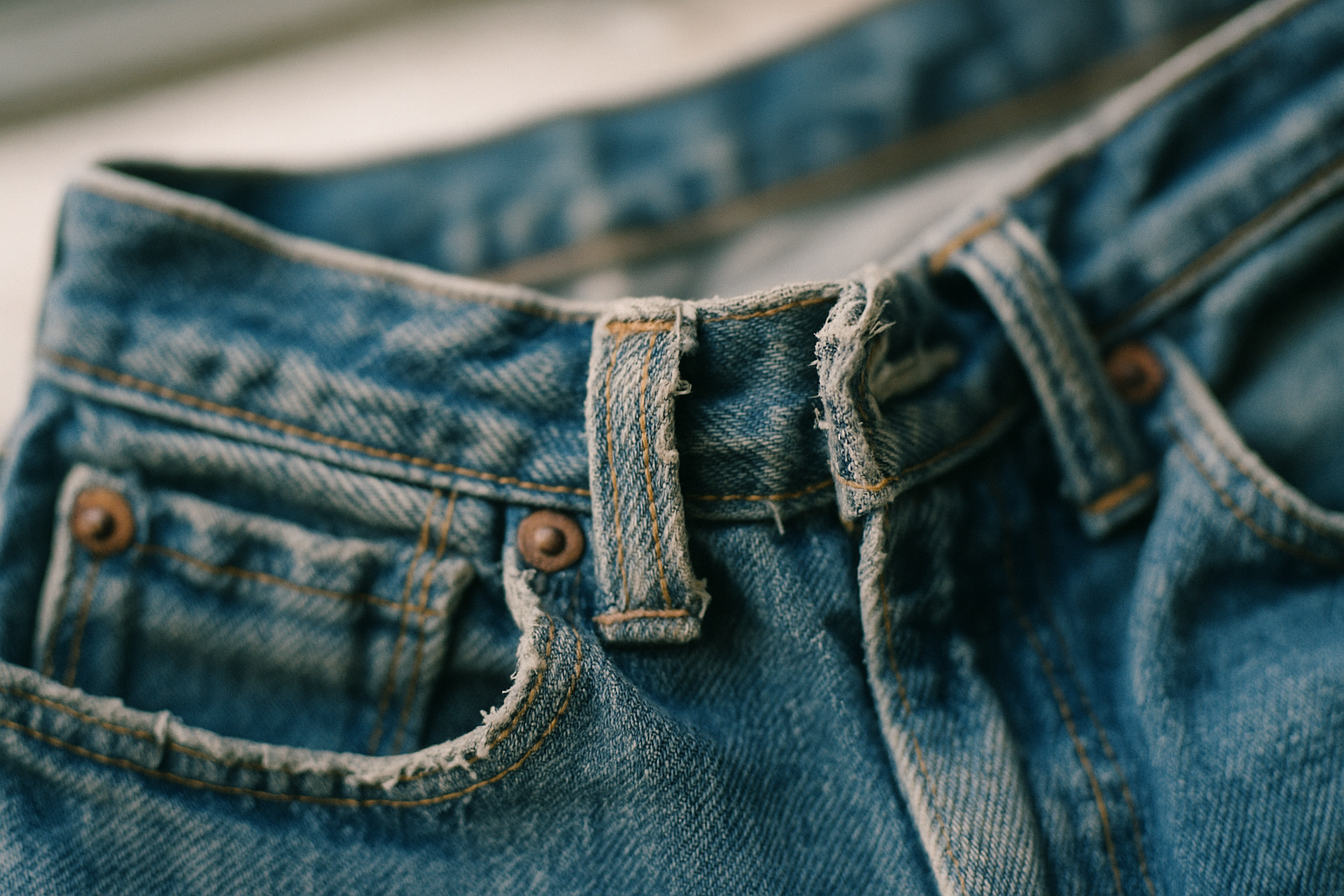
To grade vintage jeans waistband wear and tear, check three things in order: whether the waist seam still holds its shape under tension (Structural Integrity), whether the fabric or belt loops show visible fraying (Cosmetic Appearance and Functional Elements), and whether the waistband has permanently lost recovery compared to the rest of the garment (Fabric Condition). A jean that fails any one of these caps below Very Good, no matter how clean the legs look.
The waistband is the single most under-inspected zone on a pair of vintage 501s, 505s, or unbranded '90s denim. Sellers photograph the knees, the hem, and the back pockets, and skip the one place that touches a body every single wear. That is how an "Excellent" listing becomes a return with the buyer message: "waistband is shot, doesn't sit right at all." On eBay that is a not-as-described claim, and the seller usually pays return shipping.
Why the waistband fails before anything else does
Denim waistbands carry more stress than any other seam on the garment. Every sit, bend, and belt cinch pulls against the same band of reinforced fabric, usually backed by interfacing or a doubled-over seam. Over years of wear, that tension does three things the rest of the jean does not experience at the same rate:
- The waistband fabric stretches faster than the leg fabric, because it is under constant horizontal load.
- The waist seam, where the waistband meets the body of the jean, takes shear stress every time the wearer sits, which is where thread failure starts.
- Belt loops get yanked, twisted, and loaded unevenly, so they fray or tear loose well before the loop fabric looks worn.
A jean can have near-mint legs and a waistband doing structural damage control. We have seen 501s with barely-there whiskering and a clean selvedge ID that still had to grade Good because the waistband had gone slack and the seam was pulling.
How to grade vintage jeans waistband wear and tear: the inspection in order
Run this sequence every time. It takes under 90 seconds per garment and it is the difference between a grade that holds up and one that generates a dispute.
- Lay the jeans flat, buttoned, and measure the waistband edge to edge at rest. Double it for the circumference. Do not rely on the tag; vintage sizing runs inconsistent.
- Grip the waistband at both hips and pull to a natural wearing tension, then release.
- Check whether it returns to within roughly 5% of its at-rest measurement within a few seconds. This is the stretch recovery test.
- Run your fingers along the inside of the waist seam, feeling for loose or popped stitches, especially at center back and the side seams where load concentrates.
- Inspect every belt loop individually, tugging each one gently at the base where it attaches, not at the top.
- Check the top edge of the waistband for fraying, especially at the center back (wallet friction) and just above the front pockets.
- Compare the waistband's texture and color to the leg fabric under the same light. If it looks thinner, shinier, or more faded, that is accelerated wear, not just age.
- Test the button closure and any waistband rivets under tension, not just by sight.
- Photograph every defect found, plus an inside-waistband shot and a stretched-versus-rest measurement shot.
Jean waistband stretch assessment: the recovery test standard
Stretch is the trickiest waistband defect because some give is expected. Denim waistbands are not meant to be rigid, and mild break-in stretch is normal wear, not damage. The line we use: does the waistband return to within roughly 5% of its rest measurement after tension, or does it stay visibly gapped?
A waistband that snaps back, even after visible break-in creasing, is a Fabric Condition note at most and does not move the grade on its own. A waistband that stays stretched, gapes at the back when buttoned, or sits noticeably lower than intended is a Structural Integrity issue. That is the difference between an Excellent jean with normal break-in and a Good jean with real waist stretch.
Do not confuse stretch denim failure with rigid denim give. Elastane-blend waistbands that stay permanently stretched grade more harshly, because the failure is fiber-level and will not improve with washing. Rigid cotton waistband give is often mechanical and can sometimes be partly reset with a hot wash and dry, though we never grade assuming a future fix. Check the fiber content label before you decide which case you have.
Waistband fraying condition grading and belt loop integrity resale
Fraying shows up in two zones, and they are graded differently because one is cosmetic and one is functional.
Edge fraying, where the top of the waistband starts to unravel or fuzz, is a Cosmetic Appearance defect when isolated to a small area. Light, contained fraying that does not compromise the seam stays in Excellent-to-Very Good territory with a disclosed note.
Belt loop failure is a Functional Elements defect, because a loop's job is to hold a belt. Here is how we grade belt loop integrity:
- All loops intact, no fraying at the base: no grade impact.
- One loop with surface fraying but a solid base attachment: minor Cosmetic Appearance note, no tier change.
- One loop with a partial tear at the base (still attached, visibly compromised): caps at Very Good.
- One loop fully detached or missing: caps at Good; disclose location and whether it is repairable.
- Two or more loops detached or missing: caps at Fair, regardless of the rest of the garment.
Loops are cheap to replace but hard to match on vintage denim. Originals share the waistband's fabric weight and fade, so an undisclosed mismatched replacement is itself a Cosmetic Appearance flag.
Denim waist seam degradation standard
The waist seam is the structural backbone of the garment, and this is where we draw the hardest line, because failure here is not cosmetic. The jean can fail in wear.
| Waistband condition | What you'll see | Grading tier impact |
|---|---|---|
| Normal break-in | Slight softening, minor creasing, stretch recovers fully | No impact; Excellent range holds |
| Mild edge fraying | Small area of fuzzing at top edge, no thread loss at seam | Cosmetic Appearance note, Very Good |
| Stretch without recovery | Gapes when buttoned, does not snap back | Structural Integrity defect, caps at Good |
| Loose or popped waist seam stitching | Visible gaps in stitch line, seam pulling from body | Structural Integrity defect, caps at Fair unless professionally repaired |
| Belt loop detachment (1 loop) | Loop torn at base or missing | Functional Elements defect, caps at Good |
| Belt loop detachment (2+ loops) | Multiple loops torn or missing | Functional Elements defect, caps at Fair |
| Full seam separation | Waistband partially detached from yoke or panel | Poor; unwearable without repair |
A popped stitch or two, caught early and still holding the seam, is a note, not a failure. Once you see daylight through a gap in the waist seam, or the waistband separates under normal handling, that is a Poor-range defect. We have seen jeans listed as Very Good with a two-inch seam gap hidden by a folded photo angle. That produces a not-as-described claim, because the buyer feels it the first time they sit down.
What to disclose, and how it affects price
Vintage buyers accept waistband wear. It is proof the jeans were worn, and for collectors that is part of the story. What they do not accept is finding it themselves after paying Excellent-tier prices. Disclose:
- Any stretch that does not recover, with at-rest and stretched measurements listed.
- The exact location of any fraying (center back, front placket, side seam).
- Belt loop status per loop, not just "loops in good condition."
- Any waist seam repair, professional or home, with photos of the stitch work.
A well-disclosed Good-grade waistband on an otherwise excellent pair of vintage 501s still sells, often close to Very Good pricing when the rest of the garment carries the value. What kills price realization is not the defect. It is the buyer finding it first.
Try it on your next pair
Grade one pair of vintage jeans through GradeThread and see how the waistband factors into the full condition report: stretch recovery, seam integrity, and belt loop status, scored against the same five factors we use here. It takes a few photos and a couple of minutes, and it catches a waistband issue before a buyer does.