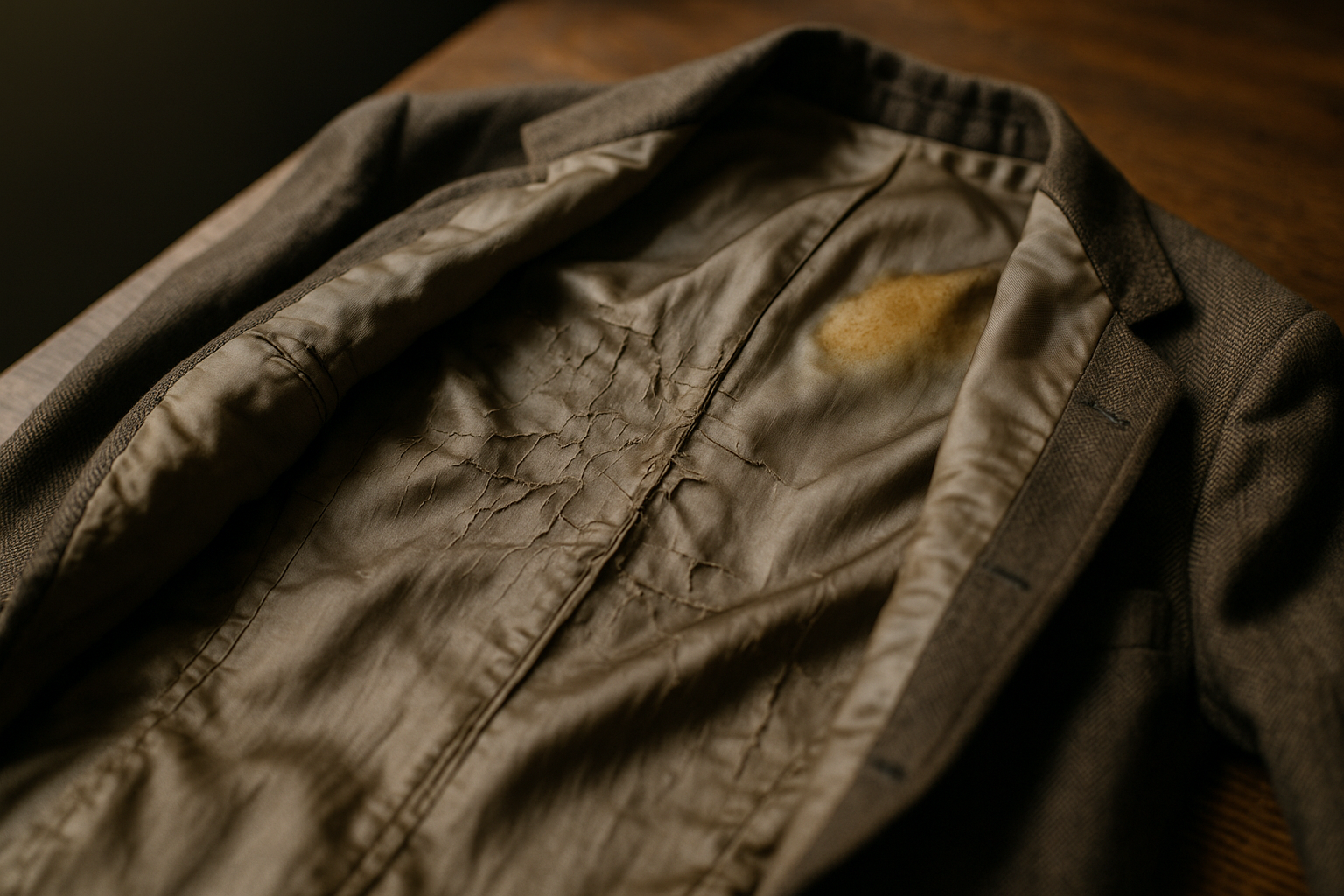
Lining Degradation: How to Grade Jacket Lining Damage for Resale
Grade jacket lining damage by which of the five factors it hits and how far it's progressed: fiber shattering or thinning is a Fabric Condition defect, seam separation is a Structural Integrity defect, staining and yellowing is Cosmetic Appearance, and a torn pocket bag is a Functional Elements failure. A jacket with pristine shell fabric and a shattered lining does not grade Excellent — the lining sets its own ceiling.
We see this mistake constantly in vintage suit jackets and 1990s outerwear: the shell looks Excellent, so the seller grades the whole garment Excellent, and the buyer opens it to find the lining split at the back yoke or hanging loose from the hem. That's a not-as-described return waiting to happen, and it's an avoidable one. Lining sits behind the shell, but it's still garment fabric — it gets its own inspection pass, its own defect call, and its own weight in the final grade.
Why Lining Damage Gets Missed
Resellers photograph and grade from the outside in. The shell gets steamed, styled, and shot on a form. The lining gets a glance while the jacket is being hung back up. That's backwards for two categories in particular: tailored jackets and suits, where linings are often silk, rayon (Bemberg), or acetate and degrade faster than the wool shell around them; and vintage outerwear, where polyester or nylon linings absorb decades of body oil, foam pad breakdown, and moisture that the shell fabric never sees.
Lining damage is also a delayed-reaction defect. A shell holds its structure and finish for years. A cellulose-based lining like Bemberg rayon starts to weaken from oxidation the moment it's manufactured, and by 20–30 years it's often the first thing to fail — sometimes before a single wear cycle happens to the outer fabric. Grading the shell and assuming the lining matches is a category error, not a shortcut.
The Five Factors, Applied to Linings
Lining defects map onto the same five weighted factors we use for the whole garment. Treat the lining as its own inspection zone within each one.
- Fabric Condition — fiber shattering, splitting, thinning, or transparency in the lining fabric itself, independent of the shell.
- Structural Integrity — seam separation, detachment from the shell at the hem or armhole, and any point where the lining no longer hangs as constructed.
- Cosmetic Appearance — staining, yellowing, foam-pad migration discoloration, and dye transfer visible on the lining.
- Functional Elements — torn pocket bags, detached interior pocket linings, and any lining failure that affects usability, not just looks.
- Odor & Cleanliness — trapped musty smell between shell and lining, which is often worse in the lining layer than on the surface.
Lining Defect Taxonomy: What Caps the Grade
Not every lining flaw carries the same weight. A pinhole in a hem lining is not the same defect as a shattered back panel. Use this as a working reference.
| Defect | Primary Factor | Typical Grade Ceiling |
|---|---|---|
| Small seam gap at hem, under 2 inches, no fabric loss | Structural Integrity | Very Good |
| Foam-pad yellowing on shoulder lining, localized | Cosmetic Appearance | Very Good to Good |
| Single tear or split under 1 inch, isolated panel | Fabric Condition | Good |
| Lining detached from shell at armhole or full hem | Structural Integrity | Fair |
| Fiber shattering across a full panel (common in aged silk/rayon) | Fabric Condition | Fair to Poor |
| Torn pocket bag lining, pocket no longer usable | Functional Elements | Good to Fair |
| Musty odor trapped between shell and lining | Odor & Cleanliness | Good (regardless of visual grade) |
A jacket can pass every visual check and still cap at Good if the lining smells musty when you open the front panels. Odor & Cleanliness doesn't care how the fabric looks — it's a separate factor with its own ceiling, and lining odor is one of the most commonly under-disclosed defects we see in vintage outerwear submissions.
How to Grade Jacket Lining Damage for Resale
Run this sequence every time, before you touch the shell grade. It takes under two minutes per garment and catches the defects that generate returns.
- Turn the jacket inside out, or open it fully flat on a table so the entire lining is visible in one pass.
- Check the shoulder and upper back lining first — this is where foam shoulder pad breakdown causes yellow migration staining, and it's the most commonly missed defect on jackets over 15 years old.
- Run your hand along every interior seam — hem, armhole, side seams, and the seam where lining meets facing — feeling for gaps, loose stitching, or separation.
- Hold the lining up to a light source and look through it, panel by panel, checking for thinning or shattering the way you'd check shell fabric for transparency.
- Open every pocket and check the pocket bag lining specifically — this is a separate piece of fabric from the body lining and fails independently.
- Smell the interior directly, with your face close to the open jacket, not just a casual sniff from arm's length — trapped odor between layers is easy to miss at a distance.
- Photograph every defect you find in place: the torn panel, the detached seam, the stain, each with a ruler or coin for scale.
- Assign the lining's own condition call for each of the five factors, then let the worst qualifying defect across shell and lining set the overall grade — the lining doesn't get graded in isolation from the final number.
- Disclose the defect by location and approximate size in the listing ("lining seam separated at left hem, approx. 3 inches") rather than a generic "some lining wear."
Silk and Rayon Linings Fail Differently Than Poly
Silk lining tearing and rayon lining shattering are not the same defect as a worn polyester or nylon lining, and they don't follow the same timeline. Bemberg rayon and cupro linings — standard in mid-century and vintage tailored jackets — degrade through oxidation of the cellulose fibers. The fabric goes from supple to brittle, and it shatters: fine, spiderweb-like splits that spread under light tension, often before any visible wear pattern shows up. This can happen even on a jacket that's been stored, unworn, for decades. It's a Fabric Condition defect driven by age, not use, and it typically caps a jacket at Fair once it's spread across more than one panel, regardless of how clean the shell looks.
Polyester and nylon linings, common in outerwear and casual jackets from the 1980s onward, fail differently — they don't shatter, they tear at stress points (usually the underarm seam and hem) and they stain rather than split. A poly lining with a 2-inch tear at the underarm is a Structural Integrity call, often gradable to Good with disclosure, because the fabric around the tear is still sound. A rayon lining shattering across the back yoke is a Fabric Condition call that will keep spreading no matter how carefully the jacket is handled from here — that's the distinction that determines whether you grade Good-with-disclosure or Fair.
Loose Seams vs. Detached Linings: Where Structural Integrity Draws the Line
A lining seam coming loose is common and often minor. A lining detaching entirely is a different tier. Use fabric loss and reattachment feasibility as your line:
- Loose stitching, under 2 inches, at a low-stress point (side seam, lower hem) — easily re-stitched, minimal wear impact. Grade Very Good with disclosure.
- Loose seam at a high-stress point (armhole, shoulder), 2–4 inches — affects how the jacket hangs and wears. Grade Good.
- Lining detached along an entire hem or armhole, hanging free inside the jacket — functionally compromised, visible when worn. Grade Fair, and disclose it as a repair-needed item rather than a cosmetic note.
- Lining torn away from its attachment points in multiple locations — treat as Poor unless the buyer is explicitly sourcing for repair or reconstruction.
The test we use: can a competent home sewer re-tack this in under 15 minutes with a needle and thread, or does it need a lining replacement? The former is a Very Good or Good disclosure. The latter is Fair or Poor, and it should be priced and listed as a project garment, not a wearable one.
Disclosing Lining Damage Without Losing the Sale
Lining defects scare buyers more than shell defects because they're hidden until the item arrives — which is exactly why disclosing them well protects you. State the defect, the location, and the size in plain terms: "Lining has a 3-inch tear at the left underarm seam, does not affect shell." That single sentence does more to prevent a return than three paragraphs of hedging. Buyers who know what they're getting rarely file a not-as-described claim over it. Buyers who find it themselves almost always do.
GradeThread's condition reports call out lining defects as their own line items under Fabric Condition, Structural Integrity, and Cosmetic Appearance, so the defect location and severity are documented before the buyer ever has to ask. If you've got a jacket with a lining you're not sure how to score — shattered silk, a stained shoulder, a seam hanging loose at the hem — run it through GradeThread and see exactly which factor it hits and where the grade lands.