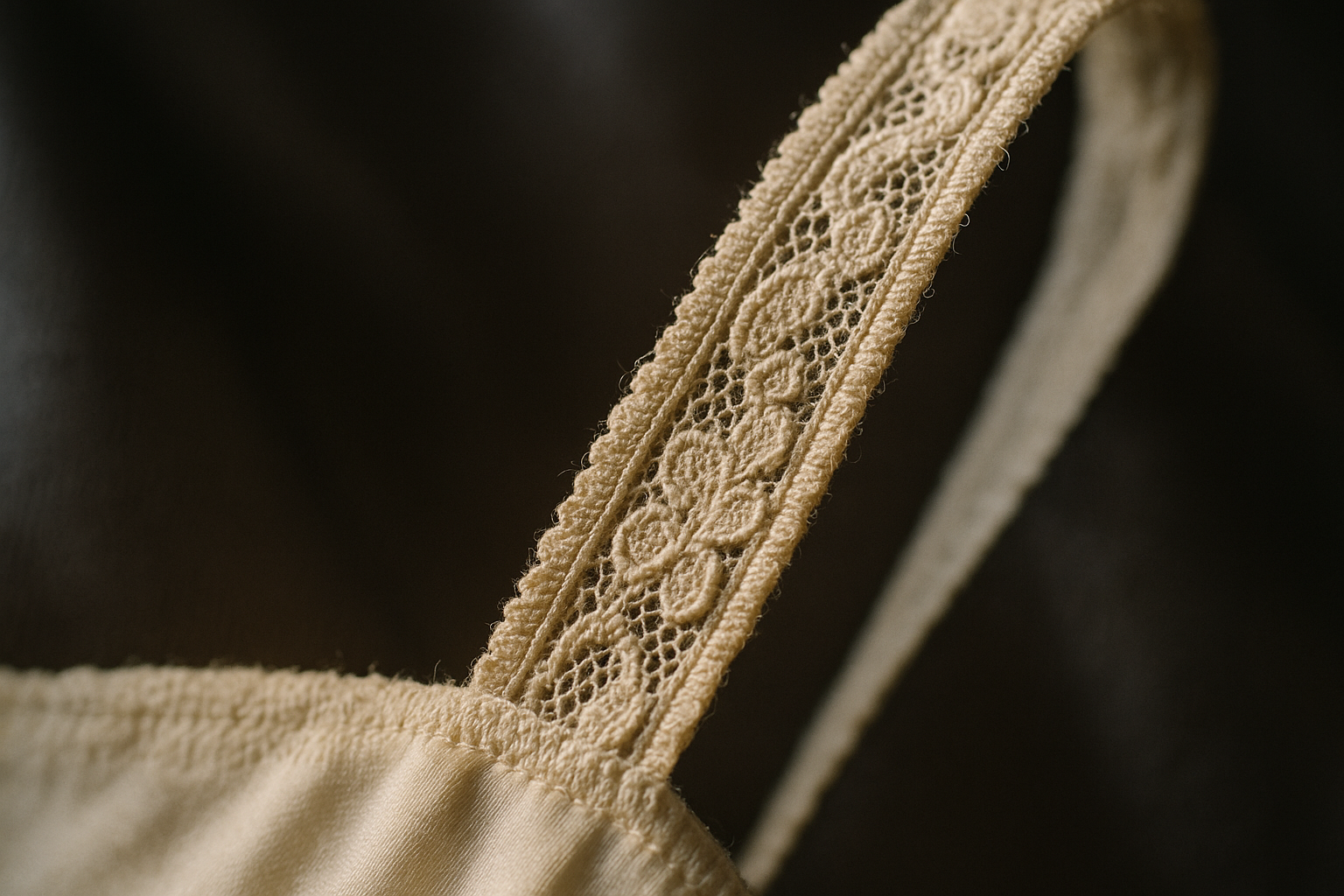
How to Grade Brittle Lace on Vintage Clothing (Before It Tears in Shipping)
Brittle lace grades on tear risk, not on color. A yellowed but flexible Chantilly lace can still hit Very Good, while a bright-white lace that cracks when you flex it caps at Fair or lower — even if it looks fine in photos. The grading question isn't "does it look old," it's "will it survive being worn or shipped."
We've had more disputes over lace than over any other single trim category. Buyers see a creamy, romantic vintage slip in photos, receive it, gently pull the strap to try it on, and a motif detaches at the net. That's not a buyer being rough. That's degraded lace failing under normal handling — and it's a grading miss, not a shipping accident.
Why Lace Fails Differently Than Woven Fabric
Woven cotton or denim degrades mostly at contact points — collars, cuffs, inner thighs. Lace degrades everywhere at once, because the failure isn't abrasion. It's fiber embrittlement.
Most vintage lace is one of four constructions, and each ages on a different clock:
- Cotton bobbin or Chantilly lace (common in 1930s–1950s lingerie and christening gowns) — cellulose fiber that yellows with age and becomes brittle when the cellulose chains break down, often accelerated by acidic storage (tissue paper, cardboard boxes, wood drawers).
- Rayon and viscose lace (common in 1940s–1960s slips and negligees) — highly moisture-sensitive; loses tensile strength when it's been through repeated humidity cycles, even without visible staining.
- Nylon Raschel machine lace (common from the 1960s onward) — more stable than natural fiber lace, but elastic-blend versions lose recovery and the lace itself can go stiff and papery if it was heat-exposed (dryer, iron, storage near a radiator).
- Guipure and Venise (heavy motif) lace — thicker threads mean it resists tearing longer, but once the connecting bars between motifs go brittle, whole appliqués detach rather than fraying.
Knowing which construction you're holding tells you where to test and how fast it degrades from here.
The Three Stages of Lace Deterioration
We break lace condition into three progressive stages. Each stage maps to different grading outcomes, and skipping straight to a color assessment is how sellers misgrade.
- Stage 1 — Discoloration only. Yellowing, ivory-ing, or light tea-staining. The lace still flexes freely, motifs hold, no fiber loss. This is a Cosmetic Appearance issue only.
- Stage 2 — Fiber weakening. The lace has lost some tensile strength. It doesn't tear on gentle handling, but you can feel a difference in drape — stiffer, less springy — and a close look shows fine fiber breaks at stress points (strap attachments, seam allowances, motif connectors). This is a Fabric Condition issue that's starting to threaten Structural Integrity.
- Stage 3 — Active brittleness. The lace cracks, splits, or sheds fiber fragments when flexed. Motifs separate from the net ground under light tension. This is a Structural Integrity failure regardless of how it looks in a photo.
A garment can jump straight to Stage 3 in isolated spots — a strap junction, a bra underwire channel, a hem edge that took repeated friction — while the rest of the lace is still Stage 1. Grade the worst functional zone, not the average.
How to Grade Brittle Lace on Vintage Clothing: The Procedure
This is the sequence we use every time lace is present, whether it's a full lace slip, a trim edge on a blouse collar, or an insert panel on a vintage dress.
- Identify the lace construction (cotton, rayon, nylon Raschel, guipure) and note the fiber content on the label if present — this sets your baseline expectation for age-related brittleness.
- Inspect under raking light first. Angle a light source across the lace surface to spot fiber breaks, thinning, or stress whitening before you touch it.
- Perform the flex test on a low-stress area first — fold a small section of lace along its bias and release. Flexible lace springs back with no fiber shedding. Brittle lace holds a crease, cracks audibly, or sheds fine white fiber dust.
- Apply gentle tension at every stress point — strap attachments, motif connector bars, seam allowances, closures. Pull to the tension a buyer's hands would realistically apply, not beyond it. Note any give, cracking, or separation.
- Check motif security separately from net security. Heavy appliqué lace can have a sound net ground with loose motifs, or vice versa — grade whichever is worse, since either one fails the garment functionally.
- Assess color and staining as a separate, later step. Don't let yellowing influence your brittleness call — a Stage 1 garment with heavy tea-staining is still structurally fine and grades on Cosmetic Appearance alone.
- Test odor and storage smell last, since lace holds must and cedar odor more than most fabrics due to its open weave and typical long-term storage in trunks or drawers.
- Assign the grade based on the worst-performing factor, and disclose the specific stress point in your condition notes — "lace brittle at left strap junction" is a fundamentally different disclosure than "lace shows age."
Lace Condition by Grade Tier
Here's how lace-specific findings map onto our standard tiers. Use this alongside your Fabric Condition and Structural Integrity scoring — lace rarely fails on Cosmetic Appearance alone once it's past Stage 1.
| Grade Tier | Lace Condition | Typical Findings |
|---|---|---|
| NWT / NWOT | No age-related change | Full flexibility, no discoloration, all motifs and net fully secure, original elasticity in any lace trim bands |
| Excellent | Stage 1 only | Light ivory-ing or even coloring change, lace remains fully flexible, no fiber breaks anywhere, all motifs secure under tension test |
| Very Good | Stage 1, isolated Stage 2 | Noticeable yellowing or a single stress point (e.g., one strap junction) showing early fiber weakening; rest of lace flexes normally |
| Good | Widespread Stage 2 | General stiffening across the lace, reduced spring-back on flex test, no active cracking yet, but tear risk is elevated for shipping and wear |
| Fair | Isolated Stage 3 | One or more confirmed brittle zones — cracking, motif detachment, or fiber shedding under gentle tension — contained to specific stress points |
| Poor | Widespread Stage 3 | Brittleness across most of the lace surface; motifs detaching, net splitting on handling, garment not safely wearable without further damage |
Lace Tear Risk in Shipping — Disclosure and Packaging
Brittle lace doesn't just risk a bad buyer experience during wear. It risks damage in transit, which turns into an INR-adjacent dispute where the buyer swears the item arrived torn and you swear it left intact. Both of you might be right — the lace failed somewhere in between.
Three practical rules cut this risk:
- Disclose tear risk explicitly, not just condition. "Lace is delicate — hand wash only, avoid tension on straps" in your listing notes does more to prevent a dispute than a grade number alone.
- Pad every lace stress point separately. Don't fold a lace slip at the strap junctions. Tissue-pad those folds specifically, since that's where Stage 2 lace crosses into Stage 3 under shipping compression.
- Photograph the flex test. A short clip or before/after photo showing the lace flexing without damage, included in your listing or kept on file, is strong evidence if a buyer later claims a pre-existing tear was undisclosed.
Category Quirks: Lingerie, Dress Lace, and Trim
Lace grading shifts slightly depending on what the lace is doing in the garment:
- Lingerie lace (slips, bras, teddies) — grade the highest-tension zones first: strap junctions, underwire channels, closure attachment points. These see the most repeated stress in both original wear and buyer try-on. A Functional Elements failure here (a lace-covered elastic band that's lost recovery) often outweighs any cosmetic yellowing.
- Dress and gown lace (bodices, sleeves, overlays) — grade for motif security across the full visible surface, since dress lace is decorative rather than structural; a detached motif here is a Cosmetic Appearance and Structural Integrity issue but rarely a Functional Elements one.
- Trim lace (collar edges, hem borders, insert panels) — grade the attachment seam as carefully as the lace itself. Trim lace often fails at the stitch line before the lace fiber itself goes brittle, which is a Structural Integrity call on the seam, not the lace.
In all three cases, resist the instinct to grade lace softer because "it's vintage, it's supposed to be fragile." Age explains why brittleness happens. It doesn't change what grade the brittleness earns.
Brittle lace is one of the clearest cases where a seller's eye and a buyer's hands disagree — and where a standardized report settles it before it becomes a return. If you've got a lace garment you're not sure how to call, run it through GradeThread. You'll get a numbered grade across all five factors, including a specific note on any brittleness or tear risk, plus a certificate your buyer can check before they ever touch the strap.