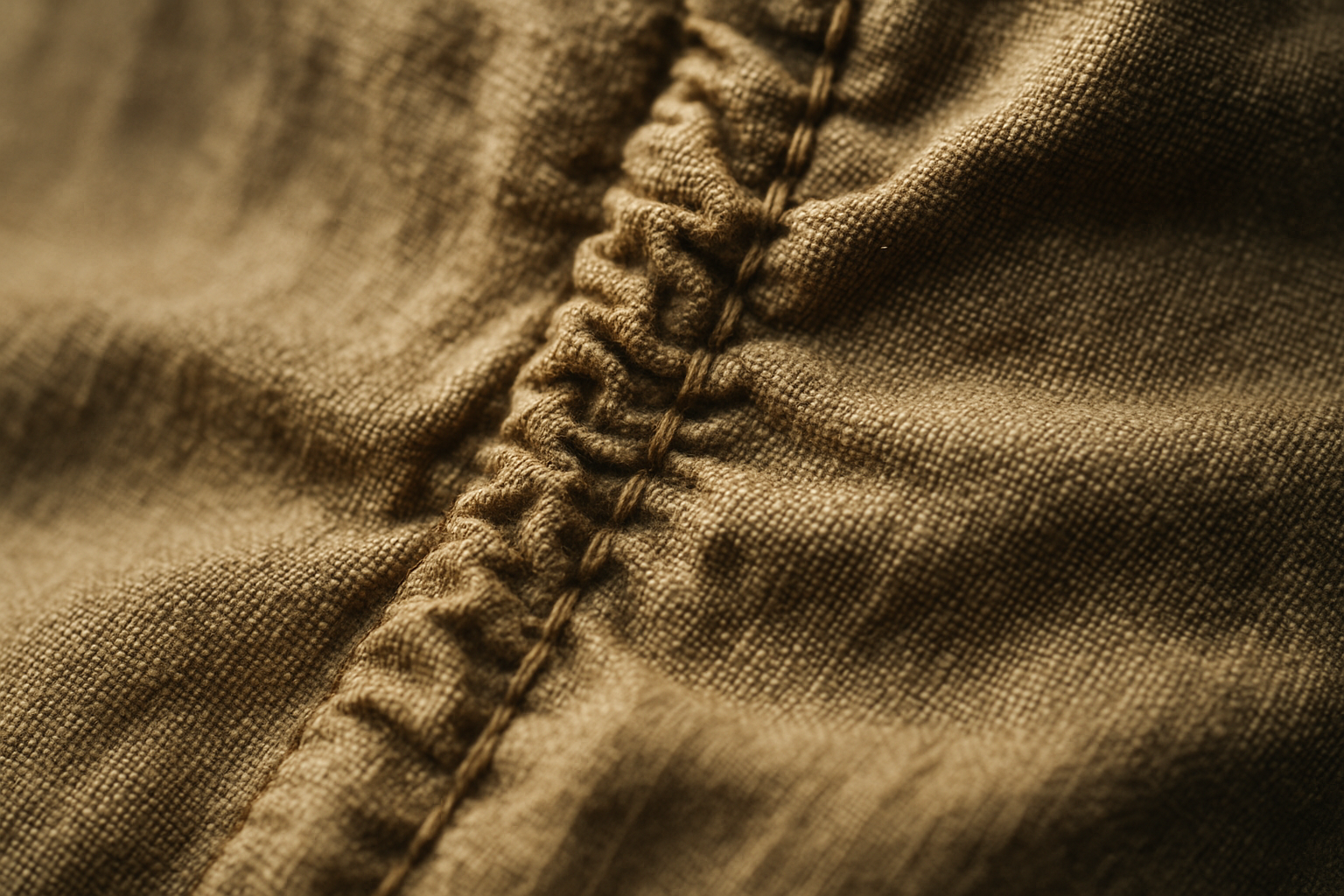
Fabric Puckering and Gathering: The Difference Between Shrinkage and Structural Failure
Fabric puckering grades under Fabric Condition when it comes from differential shrinkage between fabric and thread, and under Structural Integrity when it comes from seam allowance failure, elastic breakdown, or repeated stress at a stitch line. The distinction matters because one is cosmetic and stable, and the other gets worse every time the garment is worn or washed.
We've graded thousands of garments where a seller flags "some puckering near the hem" like it's one defect. It isn't. Puckering and gathering are symptoms with at least four different root causes, and they land in completely different places on the 1.0–10.0 scale depending on which one you're looking at. Call a stable, ironed-flat pucker a structural defect and you'll underprice a perfectly good Very Good garment. Call a failing seam allowance "just shrinkage" and you'll ship a Fair-condition item as Excellent — and eat the return.
What Puckering and Gathering Actually Are
Puckering is small, repeated ripples or bunching along a seam or fabric plane, usually running parallel to a stitch line. Gathering is fabric deliberately or accidentally drawn together into folds — sometimes a design feature (a gathered waistband, a smocked yoke), sometimes a defect (fabric pulled tight because elastic recoiled or a seam shrank faster than the body of the garment).
The grading question is never "is there puckering." It's "why is the fabric behaving this way, and does that cause stop once you notice it, or does it keep progressing?" That second question is what separates a Fabric Condition note from a Structural Integrity failure.
The Four Root Causes, and How Each One Grades
1. Differential shrinkage between fabric and thread
Cotton thread and cotton fabric don't always shrink at the same rate, especially on garments sewn with mixed-fiber thread (poly-core thread on a cotton or rayon body is common in mid-market clothing). After a hot wash and dry, the thread stays put while the fabric around it shrinks slightly — the seam puckers because there's now more fabric than thread length. This is stable once it happens. It doesn't progress with wear. Grade it under Fabric Condition, and in most cases it doesn't drop the garment out of Excellent unless it's visible from three feet away or distorts the drape.
2. Relaxation shrinkage in knits
Knit fabrics — jersey, ribbing, waffle knits — get stretched during manufacturing and relax back toward their natural dimensions with washing and heat. This shows up as gathering at shoulder seams, side seams, or ribbed cuffs that weren't there when the garment was new. It's permanent, it's a Fabric Condition issue, and unlike thread-shrinkage puckering, it can shift the garment's measurements enough to matter — check the flat-lay measurements against the original size if you suspect this.
3. Seam allowance and stitch failure
This is the one that matters most and gets missed most often. When the seam allowance itself is under chronic stress — a fitted waist seam, a set-in sleeve, a stress point at a pocket bag — the stitches can pull through the fabric slightly with each wear cycle, bunching fabric at the needle holes. Unlike shrinkage puckering, this keeps getting worse. Each wear adds a little more distortion. This is a Structural Integrity defect, not a cosmetic one, and it caps the grade lower because the failure mode is active, not settled.
4. Elastic and shirring degradation
Gathered waistbands, smocked bodices, and shirred sleeves rely on elastic thread or elastic tape holding fabric in a bunched state on purpose. When that elastic degrades — loses recovery, breaks in sections — the gathering becomes uneven: tight in some spots, slack and puckered in others. That's a Functional Elements failure first (the elastic no longer does its job) with a Cosmetic Appearance consequence (uneven, lumpy gathering) riding along with it.
Shrinkage vs. Structural Puckering: The Comparison
| Cause | Primary factor | Progresses with wear? | Typical grade impact |
|---|---|---|---|
| Thread/fabric differential shrinkage | Fabric Condition | No — stable once set | Excellent to Very Good, rarely lower |
| Relaxation shrinkage (knits) | Fabric Condition | No, but may recur with each wash | Very Good to Good depending on severity |
| Seam allowance / stitch pull-through | Structural Integrity | Yes — active failure mode | Good to Fair, sometimes Poor |
| Elastic/shirring degradation | Functional Elements + Cosmetic Appearance | Yes — elastic keeps losing recovery | Good to Fair depending on function loss |
| Intentional design gathering, undamaged | Not a defect | N/A | No grade impact |
The Test: How to Grade Fabric Puckering on Vintage Clothing
Run this sequence before you assign a grade. It takes under two minutes per garment and it's the same process we'd want a human reviewer to follow before trusting an automated read.
- Lay the garment flat on a hard surface and identify every area with visible puckering, bunching, or gathering — mark each with a pin flag or note the location (side seam, shoulder, waistband, hem).
- Check the design intent first. Compare against a reference photo or listing photo of the same style new. If the gathering matches the original silhouette (a smocked yoke, a gathered sleeve cap), it's not a defect — skip it.
- Apply a gentle stretch test: pull the fabric on either side of the puckered seam flat with moderate hand tension. If the pucker fully releases and the seam lies flat, you're looking at thread-tension puckering, not fabric distortion — note it under Fabric Condition, likely minor.
- If the pucker doesn't release under the stretch test, apply steam or a warm iron (test on an inside seam first for heat sensitivity) directly to the area. If it presses out and stays flat, it's residual shrinkage that can be corrected — still Fabric Condition, but check whether it recurs after the garment is worn and washed again.
- If puckering remains after both stretch and steam, examine the stitch line under raking light. Look for needle holes that have enlarged, thread that's visibly loose or has pulled slightly away from the fabric, or fabric bunched directly at the stitch rather than across the panel. This pattern is seam allowance failure — grade under Structural Integrity.
- If the puckering is at a waistband, cuff, or shirred panel, test the elastic directly: stretch it by hand and watch for recovery. Uneven recovery or a section that doesn't stretch at all confirms elastic failure — grade under Functional Elements, with a Cosmetic Appearance note for the uneven bunching it causes.
- Record which factor took the hit and whether the defect is stable (won't worsen) or active (will worsen with continued wear), and grade accordingly — active structural defects should cap the grade at least one full tier below a comparable stable cosmetic one.
Where Puckering Actually Caps the Grade
- Excellent (Grade 8): Faint, ironed-flat seam puckering visible only on close inspection, fully stable, no fit change. Common on rayon and viscose blends with poly-core thread.
- Very Good (Grade 7): Noticeable seam puckering at one or two locations, stable, doesn't distort drape or silhouette. Acceptable on set-in sleeves and side seams of mid-market woven garments.
- Good (Grade 6): Visible gathering that has changed the garment's silhouette at one point — a hem that no longer hangs straight, a waistband that sits unevenly — but the garment remains fully wearable.
- Fair (Grade 5): Active structural puckering at a stress-point seam, with early signs of stitch pull-through or thread breakage. Wearable now, but the defect is progressing.
- Poor (Grade 3–4): Seam allowance visibly failing, fabric bunched tight enough that stitches are exposed or partially separated, or elastic gathering has failed to the point the garment no longer fits as designed.
Don't Confuse Manufacturing Puckering with Wear Damage
One more distinction worth making explicit: some puckering ships from the factory. Cheap overlock stitching on knit hems, mismatched interfacing weight on a collar, or bias-cut panels sewn without stay tape can all pucker on a garment that's never been worn. This is a pre-existing manufacturing flaw, not wear damage, and it should be graded the same way regardless of the garment's age — under Fabric Condition or Structural Integrity depending on severity, with a note that it's original to construction rather than caused by use. Buyers care less about the cause than the outcome, but disclosing "factory puckering, not wear-related" heads off a dispute before it starts.
The Bottom Line
Puckering and gathering are not one defect — they're at least four, and each one belongs to a different factor in the five-factor standard. Stable, ironed-flat puckering from thread-fabric shrinkage barely moves the needle. Active seam failure at a stress point does, and it keeps moving the needle the longer the garment stays in circulation. The stretch-and-steam test takes two minutes and tells you which one you're holding.
Run one puckered or gathered garment through GradeThread and see how the report separates a stable Fabric Condition note from an active Structural Integrity flag — with the certificate to back it up when a buyer asks.