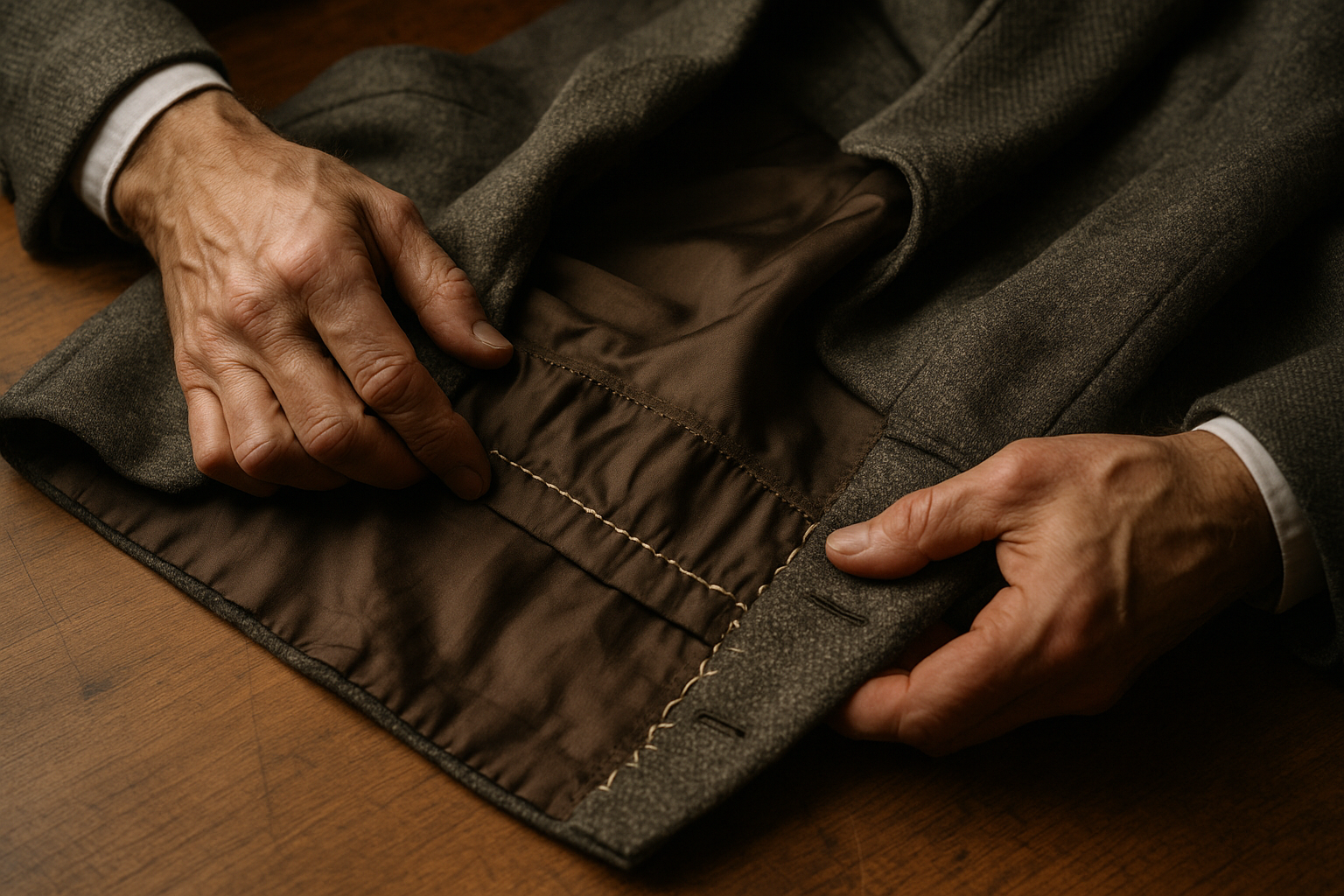
A professionally altered vintage suit can still earn Excellent — alterations only lower the grade when the work itself introduces a defect in Structural Integrity, Cosmetic Appearance, or Functional Elements. The alteration's existence is a disclosure issue, not automatically a condition penalty. Get those two things confused and you'll either underprice a $400 Southwick three-piece with a clean taken-in waist, or overgrade a suit with a puckered inseam that's going to bounce back as a return.
We've graded enough altered tailoring to know the pattern: sellers either panic and knock every altered garment down to Good on principle, or they ignore the alteration entirely and list it as if the factory made those exact stitches. Both approaches cost money. Here's the actual standard for how to grade altered vintage suits for resale.
Why Alterations Aren't Automatically a Defect
Tailoring is not damage. A vintage suit that's been let out at the waist, shortened at the sleeve, or had its trouser break adjusted has been improved for wearability — that's the entire point of buying tailored clothing in the first place. Under the GradeThread scale, a suit with invisible, well-executed alterations and no other wear issues can still land at Excellent (8) or even NWOT (9) if it's unworn since the tailoring.
What actually moves the needle is execution. A skilled tailor works inside the seam allowance, matches thread weight and color, presses the new seam flat, and leaves no visible stitch ghosting from the original hem line. That work is invisible unless you're looking for it — and it doesn't touch Fabric Condition, Structural Integrity, or Cosmetic Appearance at all. A home alteration with visible puckering, mismatched thread, or a chalk-marked hem that never got pressed out is a different animal, and it gets graded like the defect it is.
The Five Factors, Applied to Tailored Jacket Condition Assessment
Every garment gets scored across Fabric Condition, Structural Integrity, Cosmetic Appearance, Functional Elements, and Odor & Cleanliness. For altered suits, three of those five factors are where alteration quality actually shows up:
- Structural Integrity — Did the tailor cut into the seam allowance in a way that limits future adjustment? Is the new seam under tension, or does it lie flat? A taken-in jacket that pulls at the button point when buttoned has a structural problem, not just a cosmetic one.
- Cosmetic Appearance — Visible stitch lines, thread color mismatch, puckering along a shortened hem, or a pressed crease that didn't fully set. These are the tells that separate professional work from a home sewing machine.
- Functional Elements — Do buttons still align with buttonholes after a waist adjustment? Does a shortened sleeve still clear the shirt cuff by the standard half-inch? Functional elements fail when tailoring changes proportions without adjusting everything that depends on them — vents, pocket placement, button stance.
Fabric Condition and Odor & Cleanliness are graded exactly as they would be on an unaltered suit — the tailoring doesn't touch fiber wear or smell.
How to Grade an Altered Vintage Suit: The Procedure
Work through the garment in this order every time. It's the same sequence we use internally and it catches the alterations that actually matter before you get distracted by surface polish.
- Check the interior seams at the waist, side seams, and center back vent for any let-out or taken-in stitching, and note whether the original seam allowance is still intact.
- Turn the jacket inside out and inspect the hem and sleeve linings for a second stitch line — a ghost line from a previous hem sits slightly higher or lower than the current one and signals the garment has been shortened at least once.
- Button the jacket and check that the button stance sits at the natural waist and that no pulling or gapping shows across the front panels — gapping means a waist alteration went too far.
- Lay the trousers flat and measure the inseam against the original tag measurement if available; a difference of more than half an inch confirms a hem or full inseam alteration.
- Examine the alteration stitching itself under raking light — professional work shows even, matched-tension stitches with thread color within one shade of the original; home work shows visible puckering or thread that doesn't match.
- Test all functional points affected by the alteration — buttons, buttonholes, vent alignment, pocket flap position — to confirm they still operate and sit correctly after the modification.
- Assign the grade using the standard five-factor scoring, applying any deduction only where the alteration itself introduced a visible or functional problem — not for the fact that an alteration exists.
- Write the alteration into the condition report by location and type (for example: "waist taken in approximately 1 inch, professional finish, no visible puckering") so the buyer sees exactly what was done.
Hem and Inseam Modification Grading: What Actually Changes the Grade
Hem and inseam modification grading is the most common judgment call on vintage suits, and it's also where sellers most often either overgrade or overreact. The rule: a clean, single hem adjustment with matched thread and proper pressing has no grade impact. A hem shows problems in three specific ways worth checking every time.
The three hem failure modes
First, a visible "shine line" where the old hem crease was pressed in and never fully released — this shows as a faint horizontal line a few inches above the current hem and is a Cosmetic Appearance issue, typically a half-tier deduction. Second, uneven hem width around the leg circumference, which happens when a home tailor doesn't work off the original hem line and results in a trouser leg that doesn't hang straight — this is a Structural Integrity call and usually caps the garment at Good regardless of how clean everything else is. Third, exposed or fraying raw edge inside a shortened hem where the fabric wasn't finished — that's a Functional Elements and durability problem, since it will continue to fray with wear.
A let-out inseam — common on suits bought slightly small and later resized — carries its own tell: check for a lighter, un-faded strip of fabric inside the seam where the original seam allowance was hidden from light and washing. That strip is cosmetic and visible only if you're looking, so it rarely drops a grade below Very Good on its own, but it should be disclosed since a buyer inspecting the interior will see it and wonder what happened.
Vintage Tailoring Quality Standards Resale Buyers Actually Care About
Buyers shopping altered vintage tailoring aren't judging against a factory bar — they're judging against "could my own tailor have done this," and most can spot the difference between a hand-finished hem and a machine-only rush job. A few markers that separate solid vintage tailoring from work that should get flagged: hand-pick stitching along a lapel roll instead of visible machine topstitching, a canvassed chest that still drapes cleanly after a waist take-in (fused fronts tend to bubble slightly at the alteration point), and buttonholes that were re-spaced rather than just left in their original position after the button stance moved. None of these are pass/fail on their own, but taken together they tell you whether the alteration was done by someone who understood the garment's original construction or by someone who just needed it to fit for one wearing. Note the construction type (canvassed vs. fused) in the condition report — it affects how much future alteration the garment can tolerate, which matters to the next buyer as much as the current fit does.
Disclosed Alterations Resale Value Impact: The Real Numbers
Disclosure changes what a buyer will pay, independent of the grade itself. A suit graded Excellent with a clearly disclosed, professionally executed waist alteration sells close to full comp value for an unaltered Excellent suit in the same size — buyers who need that exact adjustment done anyway see it as value added, not a flaw. The same suit graded Excellent with an undisclosed alteration that the buyer discovers on arrival generates a not-as-described dispute even though the physical garment is identical. The grade didn't change; the trust did.
The opposite failure mode costs more. Sellers who assume any tailoring must mean a lower grade routinely list solid Excellent-condition altered suits at Good-tier pricing — leaving 20–30% of the sale price on the table for no reason tied to actual condition. If the alteration is clean and the rest of the garment checks out, price it at the grade it earns, not the grade you assume alterations deserve.
Alteration Type Comparison Table
| Alteration | Typical Grade Impact | Factor Affected | Disclosure Required? |
|---|---|---|---|
| Waist taken in, professional, no puckering | None | None | Yes — note location and amount |
| Sleeve shortened, ghost line barely visible | -0.5 (Cosmetic) | Cosmetic Appearance | Yes |
| Hem shortened, uneven width around leg | Caps at Good (6) | Structural Integrity | Yes, with photo |
| Inseam let out, faded strip visible inside | None to -0.5 | Cosmetic Appearance | Yes |
| Home-sewn hem, visible mismatched thread | -1.0 to -1.5 | Cosmetic Appearance, Structural Integrity | Yes, explicitly as home repair |
| Button stance moved, buttons no longer align | -1.0 | Functional Elements | Yes |
Note the pattern: it's never the alteration itself in the left column that drives the deduction — it's the execution quality shown in the third column. Two suits with the same alteration type can land a full tier apart depending on who did the work.
Disclosing Modifications Without Killing the Sale
State the alteration plainly in the listing, name the location, and say whether it was professionally done. "Waist tailored in approximately 1 inch, clean professional finish, no visible puckering" reads as a selling point to the exact buyer who needs that fit. Vague language — "has been altered" with no detail — reads as a warning sign and pushes buyers to assume the worst. Photograph the interior seam where the alteration lives; a clear shot of even, matched stitching does more to close the sale than any adjective. On eBay and Poshmark item specifics or descriptions, list the alteration the same way you'd list a measurement — factually, with a location and an amount, not buried in a paragraph of marketing copy.
Grade the garment on what's actually true today — fabric, structure, cosmetics, function, cleanliness — and disclose the tailoring history separately as information, not as a penalty. That's the distinction that keeps altered vintage suits selling at the price their condition actually supports.
Not sure whether that taken-in blazer in your closet clears Excellent or Very Good? Run one through GradeThread and get a factor-by-factor report — including exactly where the alteration lands and how to word the disclosure — before you write the listing.