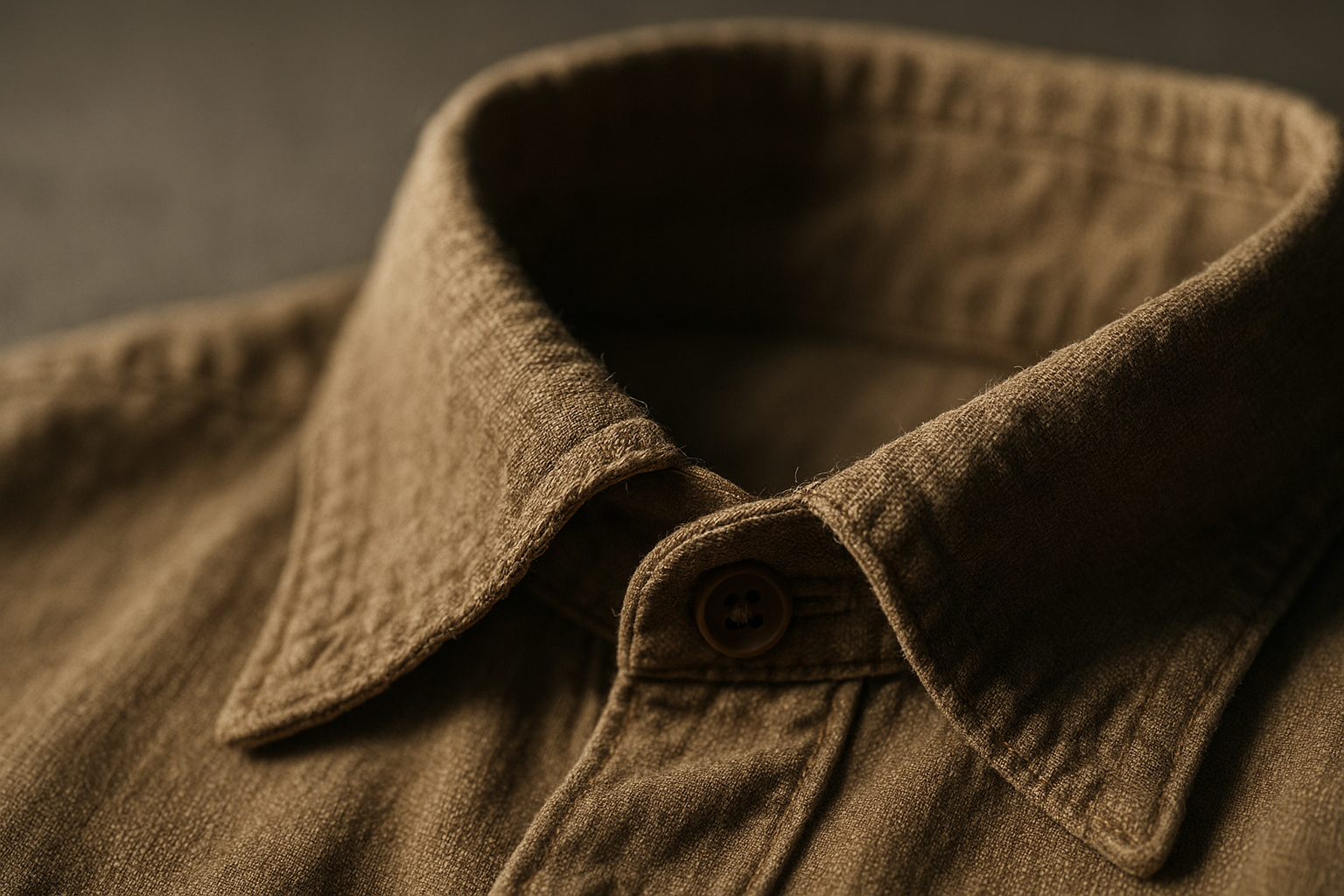
A worn collar or frayed cuff typically drops a garment's grade further than a visible stain of comparable size, because collar and cuff wear signals fabric degradation at a high-stress, high-visibility zone — not a surface event you can spot-clean away. A stain is often cosmetic and sometimes removable. A worn collar is usually structural, permanent, and located exactly where a buyer's eyes and hands go first.
We see this mistake constantly: a seller grades a shirt "Excellent" because the body is pristine, the print is sharp, and there's no visible staining anywhere. Then a buyer opens the package, runs a thumb along the collar edge, feels the fabric gone soft and fuzzy at the fold line, and files a not-as-described return. On eBay, that claim typically lands as an "item not as described" case, which usually means you pay return shipping and take the hit on the sale. The stain would have been forgivable. The collar wasn't, because it changes how the garment functions and how it will hold up going forward — and buyers know it.
Why High-Contact Areas Wear Differently Than the Rest of the Garment
Collars and cuffs take mechanical stress that the rest of a shirt never sees. Every time the garment goes on or off, the collar folds, rubs against skin oil and neck movement, and gets pulled at the same crease points. Cuffs get shoved up forearms, dragged across desks, and caught on watch bands. That's thousands of repetitive flex cycles concentrated in a two-inch band of fabric, compared to a torso panel that mostly just hangs there.
This is why a shirt can look ten years newer everywhere except the collar. The wear isn't random — it's location-specific fatigue. Fatigue at a fold line behaves differently than a stain: it doesn't come out in the wash, it doesn't respond to a stain pen, and it tends to get worse with every additional wear instead of staying static.
Vintage shirts add a wrinkle. Older cotton, rayon, and poly-cotton blends were often built with fused or sewn-in interfacing that has aged for decades. Fusing can bubble or release, and cotton thread at the fold can rot before the cloth does. Age alone isn't a defect, but wear at these points is judged on condition, not on how old the shirt is.
The Grading Factors Collar and Cuff Wear Actually Hits
Under GradeThread's five weighted factors, collar and cuff condition rarely stays contained to one category. That's part of why it's costlier than a stain, which usually only touches Cosmetic Appearance.
- Fabric Condition — thinning, sheen loss, or a soft/fuzzy hand-feel at the fold line means the fiber structure itself is breaking down, not just the surface.
- Structural Integrity — fraying threads, a collar point losing its shape, or interfacing separating from the collar band is a build-quality failure, not a cosmetic one.
- Cosmetic Appearance — visible discoloration, shine from repeated friction, or a curling collar edge that won't lie flat.
- Functional Elements — a button-down collar that no longer buttons flat, a missing collar stay, or a cuff placket that's stretched out and won't stay closed.
- Odor & Cleanliness — collars and cuffs are where body oils concentrate, so ring discoloration often carries a faint odor component that a straightforward stain doesn't.
A stain, by contrast, is usually a single-factor problem. That's the real reason it grades more leniently even when it looks worse in a photo.
How to Grade Worn Collars and Cuffs on Vintage Shirts
Use this sequence every time you're evaluating a shirt with visible neckline or cuff wear. It keeps you from either overgrading (missing the fatigue) or undergrading (calling normal patina a defect).
- Fold the collar flat and check whether it lies naturally or curls at the points — persistent curling indicates interfacing failure, a Structural Integrity issue.
- Run two fingers along the inside fold of the collar and cuff, feeling for a change in texture — thinning or a fuzzy, worn hand-feel signals Fabric Condition breakdown, not just a Cosmetic mark.
- Hold the collar under raking light (light angled across the surface, not straight on) to check for sheen or shine caused by friction — this shows up as a subtle color shift that flat lighting hides.
- Check the underside of the collar band and cuff edges for fraying threads or exposed weave — visible fraying moves the item down at least one full tier from where the topside alone would suggest.
- Smell the collar band and cuff interior, then check for yellow or gray ring discoloration — this is an Odor & Cleanliness call, separate from fabric wear.
- Button the collar and cuffs closed and check whether they hold shape or gap — a button-down collar that won't stay flat, or a cuff that won't stay closed, is a Functional Elements failure and should be disclosed separately from the cosmetic wear.
- Compare wear severity at the collar/cuff against the rest of the garment — if the body is Excellent-level but the collar shows Fair-level fraying, the garment grades to the lower of the two, not an average.
Collar Wear vs. Stains: A Grading Comparison
Sellers consistently underweight collar wear relative to stains because stains photograph more dramatically. Here's how the two compare at similar visual severity. The tier drops are our working guidelines, not fixed rules; exact grades depend on size, location, and the rest of the garment.
| Defect | Factor(s) affected | Typical grade impact | Removable/reversible? |
|---|---|---|---|
| Small visible stain, isolated | Cosmetic Appearance | Usually a half-tier drop (e.g., Excellent to Very Good) | Sometimes — spot treatment, professional cleaning |
| Collar ring discoloration | Cosmetic Appearance, Odor & Cleanliness | Half-tier to full-tier drop | Occasionally — depends on how set-in it is |
| Collar fraying or thinning fabric | Fabric Condition, Structural Integrity | Full-tier drop minimum, often two | No |
| Cuff placket stretched or won't close | Functional Elements | Full-tier drop; caps grade at Good regardless of other condition | No, without repair |
| Curling or misshapen collar points | Structural Integrity | One-tier drop, sometimes disqualifies Excellent entirely | No, without re-interfacing |
Notice the pattern: stains max out at one factor and are sometimes reversible. Collar and cuff wear routinely hits two factors at once and almost never reverses. That's the mechanism behind the price gap, not seller pickiness.
What Collar Wear Looks Like at Each Grade Tier
Buyers searching for vintage shirts have learned to check the collar first, so your grade needs to match what they'll find when they do.
- NWT / NWOT — no wear at all; collar and cuffs hold factory shape and stiffness.
- Excellent — collar lies flat with no curling, no visible thinning, no discoloration under raking light. Light wash-softening is fine; fatigue is not.
- Very Good — minor softening at the fold, no fraying, collar still buttons and holds shape. This is where most well-cared-for vintage shirts land.
- Good — visible ring discoloration or light fraying at the collar edge, collar still functional but shows its age at a glance.
- Fair — noticeable fraying, curling that won't press out, or a cuff placket that won't stay closed. Still wearable, clearly worn.
- Poor — collar or cuff fabric has thinned to the point of holes, tearing, or complete loss of shape. Functionally compromised.
The Averaging Mistake
The most common grading error we see is treating collar wear as one data point in an overall average. It isn't. A shirt with a pristine body and a Fair-condition collar doesn't grade to Good by splitting the difference — it grades to Fair, because the collar is the first thing a buyer's hand finds, and Structural Integrity issues at a high-contact zone tend to predict what's coming for the rest of the garment.
Disclosure Language That Doesn't Kill the Sale
You don't need to bury a listing in caveats. You need to be specific about location and severity, the same way you'd disclose a stain. Here are three examples, one per tier band:
- Very Good: "Light softening at collar fold, no fraying, buttons flat."
- Good: "Faint ring discoloration on inner collar band, light fraying at underside edge, fully functional."
- Fair: "Collar points curl and won't press flat, fraying along both cuff edges. Priced accordingly."
What kills trust isn't disclosing collar wear — it's grading a shirt Excellent and letting the buyer discover the fraying themselves. Specific disclosure also matters on marketplaces: eBay's item specifics and Poshmark's condition tags are coarse, so the description and photos have to carry the detail.
Pair the written disclosure with a raking-light photo of the collar fold, a close shot of the underside edge, and a flat shot of the cuff placket buttoned. Those images resolve more collar-related disputes than any amount of listing copy.
Try It on Your Next Vintage Shirt
Collar and cuff wear is exactly the kind of high-contact, easy-to-underweight defect that GradeThread's five-factor model was built to catch — it scores Fabric Condition, Structural Integrity, and Functional Elements separately instead of one gut-feel number. Grade one shirt with visible collar wear and see how the report breaks it down, factor by factor, before you write the listing.