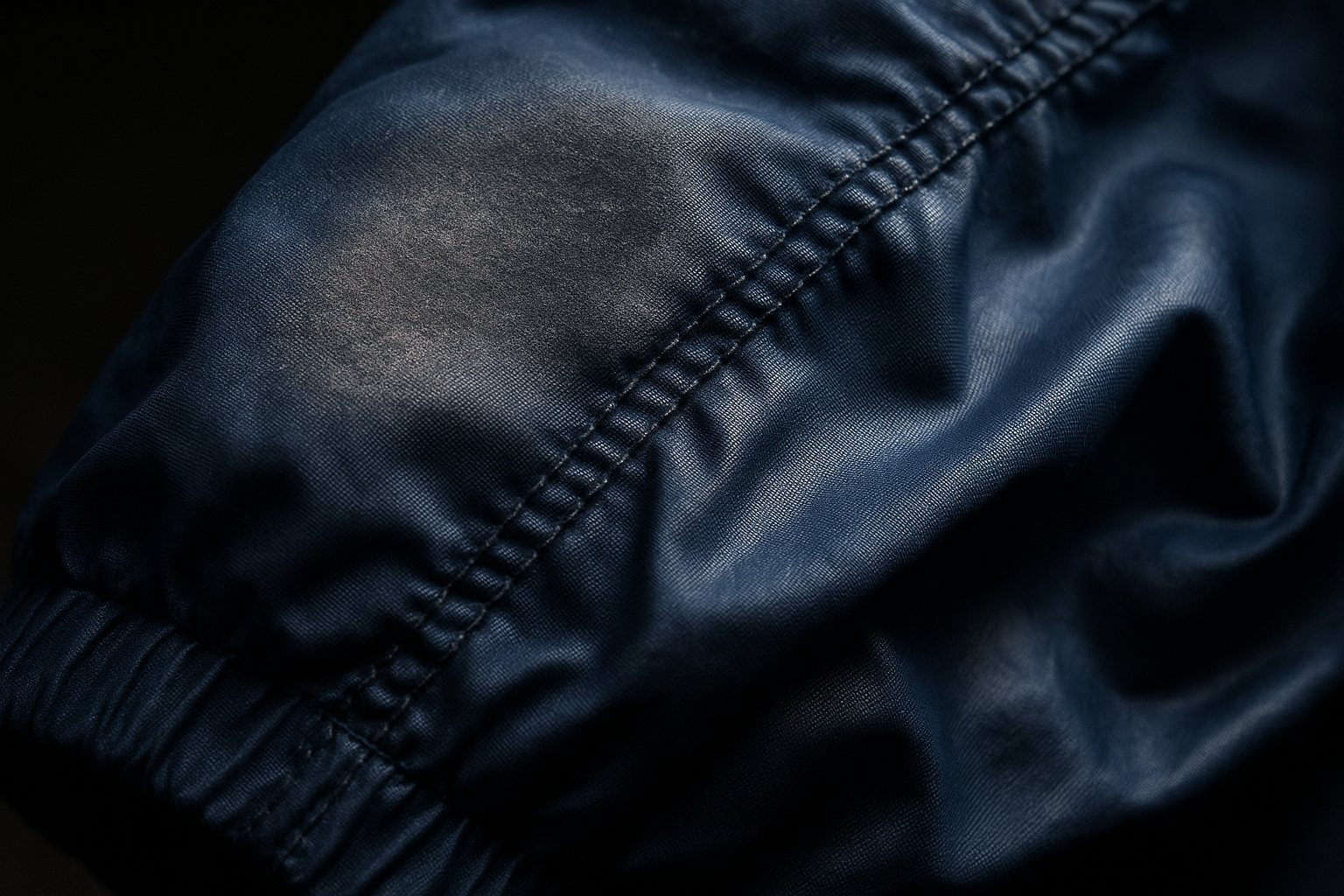
That Dull Windbreaker Isn't Faded — How to Grade Synthetic Sheen Loss
Sheen loss on polyester and nylon is a Fabric Condition defect, not a cosmetic stain or a color-fading issue — and it can drop a garment from Excellent to Good even when there's no visible mark on it. The grading question isn't "does it look shiny," it's whether the fiber's surface has been physically abraded down to a matte, frosted state, and how much of the garment that covers. Get that distinction wrong and you'll either overgrade a track jacket that photographs fine under flat light, or undergrade a nylon shell that just needs a steam and a better angle.
We see this constantly on '90s windbreakers, poly-blend blouses, and nylon bomber jackets. A seller lists a shell as Excellent because there's no stain, no tear, no odor. Then a buyer opens the package under a lamp and messages: "this looks worn out, not like the photos." Nobody lied. Nobody looked closely enough at sheen.
How to grade synthetic fabric sheen loss on vintage clothing
Sheen is a physical property of the fiber surface, not the dye. Polyester and nylon filaments are extruded smooth and round, which is what makes them reflect light evenly and read as "shiny" when new. Repeated friction — from wear, washing, or just decades of contact with a hanger or another garment in a bin — roughens that surface at a microscopic level. Light stops reflecting cleanly and starts scattering. The result is a dulled, sometimes chalky or frosted look that has nothing to do with color loss and everything to do with fiber-surface wear.
This matters for grading because sheen loss lives under Fabric Condition, one of the five weighted factors in the grading model — alongside Structural Integrity, Cosmetic Appearance, Functional Elements, and Odor & Cleanliness. A buyer or seller who calls sheen loss "fading" is misfiling it as a Cosmetic Appearance issue, which under-weights how much it can matter. Genuine fiber-surface degradation is closer to pilling or fabric thinning than it is to a sun-bleached logo.
Polyester vs. nylon: how they dull differently
The two fibers don't degrade the same way, and grading them with one rule of thumb is how sellers get caught out.
Polyester dulls primarily through mechanical abrasion. High-friction zones — elbows, underarms, the inside of a collar, the seat of athletic pants — develop a flattened, matte patch where the round filament surface has been worn down to something closer to a fibrillated mat. It's gradual and localized. You'll usually see a sharp contrast between the dulled zone and an unworn panel like the inner lining or a hem allowance that's been folded under.
Nylon degrades through both abrasion and UV/oxidative exposure. Nylon is more photo-reactive than polyester, so vintage nylon shells and bombers that spent years near a window or in direct light will show a broader, more even sheen loss across the whole garment rather than isolated friction patches. This type of degradation often comes packaged with a second problem: nylon loses tensile strength as it photo-degrades, so a dulled nylon windbreaker is more likely to also show thread weakening or seam stress than a dulled polyester blouse showing the same visual sheen loss.
The DWR complication
Nylon shells with a factory Durable Water Repellent (DWR) finish add a Functional Elements wrinkle. Sheen loss on a DWR-treated nylon jacket can indicate the coating itself has worn off, not just the fiber surface. If water no longer beads and instead soaks in, that's a functional failure on top of a cosmetic one, and it needs to be graded and disclosed separately.
The grading procedure
Use this sequence every time you're assessing a synthetic garment for sheen loss. It takes under two minutes once you've done it a few times.
- Inspect the garment under raking light — a lamp held at a low angle, not overhead room lighting — since sheen variation is nearly invisible under flat, diffuse light.
- Identify and compare high-friction zones (elbows, cuffs, underarms, inner thighs, seat) against low-friction reference zones (inner lining, seam allowances, underside of a collar) to establish a sheen baseline for that specific garment.
- Photograph both zones under identical lighting conditions so the comparison is documented, not just observed.
- Run a light fingernail or fabric scrape test on the dulled area — surface-level dulling will show a faint sheen shift when buffed; fiber-level frosting will not brighten no matter how it's rubbed.
- Hold the fabric up to a light source to check for thinning. If the dulled zone is also noticeably more translucent than the reference zone, the defect has crossed into Structural Integrity, not just Fabric Condition.
- For nylon shells with a factory water-resistant finish, run a quick water-drop test on the dulled area to confirm whether the DWR coating is still functional or whether Functional Elements are also compromised.
- Separate any sheen loss from unrelated cosmetic issues — a genuinely faded logo or sun-bleached panel is a different defect and should be graded independently under Cosmetic Appearance.
- Estimate the percentage of the garment's surface area affected and whether the pattern is localized (friction-based) or global (UV/oxidative), then assign the grade tier using the table below.
- Note the specific location and cause in the condition report — "sheen loss at elbows, friction-based" reads very differently to a buyer than "fabric dull throughout, UV-related."
Grading sheen loss by tier
Fabric luster vs. wear condition is really a question of degree and location. Use this as a baseline — pair it with the other four factors before finalizing a grade, since sheen loss rarely travels alone.
| Grade Tier | Sheen Condition | Fiber Surface | Typical Cause |
|---|---|---|---|
| NWT / NWOT | Full original luster, uniform across garment | Smooth, unabraided | None — unworn |
| Excellent | Sheen loss only detectable under raking light, no visible patches | Minimal surface change | Light wear, minimal wash cycles |
| Very Good | Mild, even dulling at contact points; garment still reads as "shiny" from normal viewing distance | Slight roughening, no fiber breakdown | Normal wear, regular washing |
| Good | Visible dulled patches at elbows, underarms, or seat; clear contrast with unworn zones | Moderate abrasion, fiber flattening | Repeated friction, sun exposure over years |
| Fair | Significant, widespread dulling; frosted or chalky appearance in multiple zones | Noticeable fiber whitening, fabric hand changed | Long-term UV exposure or heavy abrasion |
| Poor | Matte throughout, no reflective quality remaining | Fiber structurally degraded, often thin or fragile | Extended sun exposure, age, repeated hard wear |
Where sellers misgrade this
Three mistakes show up over and over in synthetic-heavy categories like vintage windbreakers, track suits, and poly blouses.
- Calling sheen loss "fading." Fading is a dye/color issue and belongs under Cosmetic Appearance. Sheen loss is a fiber-surface issue under Fabric Condition. They can co-occur, but they're graded separately and a buyer dispute over one won't resolve the other.
- Grading only under flat, bright light. Flat overhead lighting flattens sheen variation the same way it flattens shadows. A garment that looks uniform under a ring light can show obvious dulling patches under a raking side light — which is exactly the light a buyer will use once the garment is on their body near a window.
- Ignoring the thinning correlation. Sheen loss caused by abrasion often precedes fabric thinning at the same location. If you're grading a dulled elbow patch as a cosmetic issue and missing that the fabric is also thinner there, you're underweighting a Structural Integrity problem that will show up as a hole in six months of continued wear.
Disclosure language that actually helps
Buyers don't dispute condition they were told about — they dispute condition that surprised them. For synthetic sheen loss specifically, name the location and the cause: "mild sheen loss at elbows from wear, fabric intact" tells a buyer exactly what they're getting. "Some fading" doesn't, and it invites a return when the buyer's mental model (color fade) doesn't match what they're holding (a dulled, slightly rougher fabric surface). Photograph the dulled zone under raking light in your listing photos — it's the single photo most likely to prevent a not-as-described claim on this specific defect.
This is also where a standardized grade earns its keep. "Very Good — mild sheen loss at high-friction points, fabric integrity intact" is a claim a buyer can verify against a condition report. "Good condition, barely worn" is a claim they can only verify by disputing it.
Try it on one garment
If you've got a polyester track jacket or nylon shell sitting in inventory that you've been grading by eye, run it through GradeThread. You'll get a numbered grade, a condition report that separates sheen loss from fading and thinning across all five factors, and a certificate your buyer can check before they open a return case instead of after.