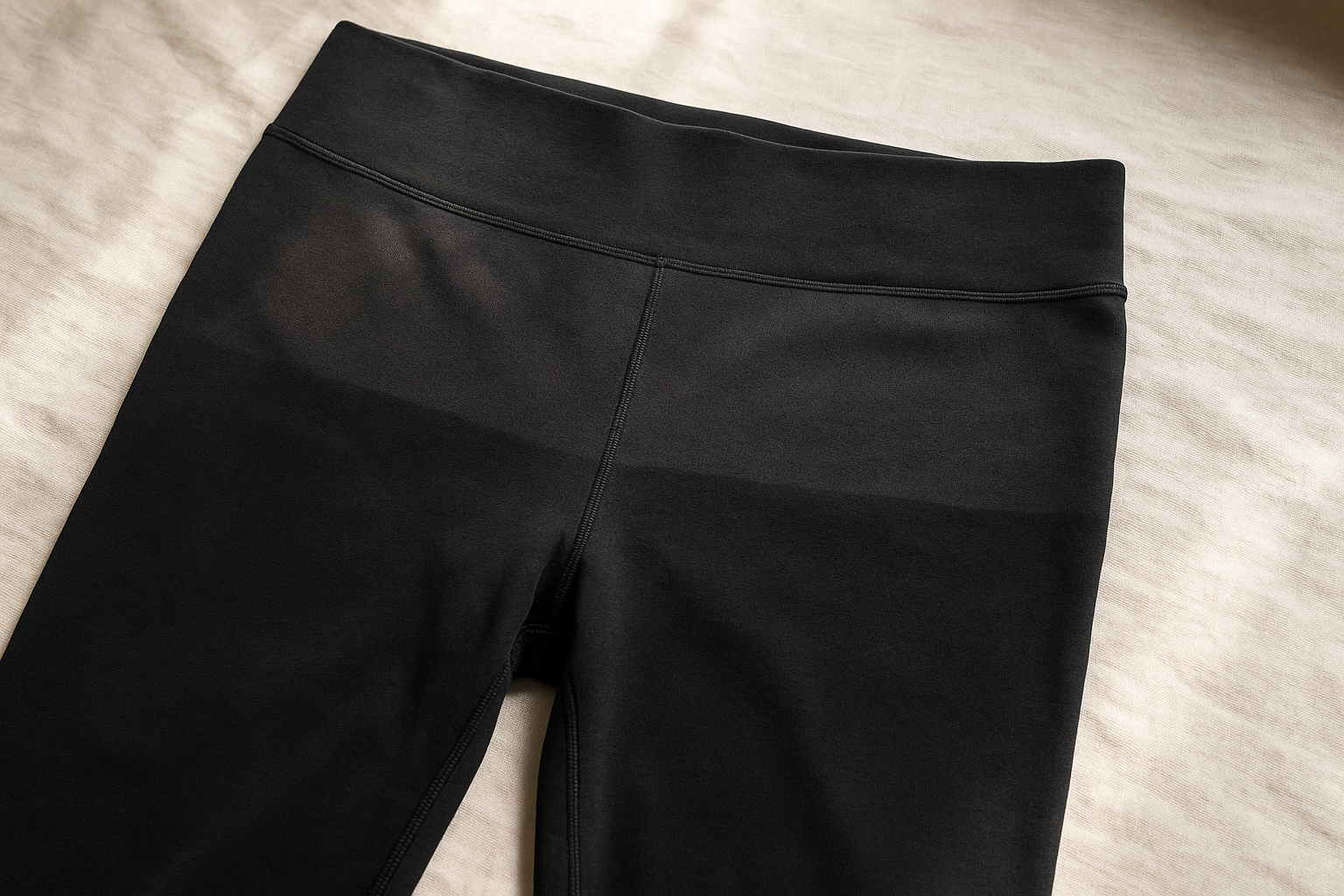
Grade Faded Spandex Blend Clothing: Spandex Degradation vs. Color Loss on Lycra Blends
A faded spandex blend garment and a structurally degraded one can look nearly identical on a hanger, but they grade differently: color loss alone is a Cosmetic Appearance issue capped around Very Good, while lost elastic recovery is a Structural Integrity failure that can drop a garment to Fair or Poor even if the color looks fine. The two defects often show up together, and telling them apart is the single most missed call in activewear and legging grading.
We see this constantly with leggings, bike shorts, swim bottoms, and compression tops. A seller photographs a pair of leggings under bright light, sees the dulled black-to-charcoal shift, and lists it as "Good — some fading." What they didn't check: the waistband no longer snaps back, the fabric has gone thin and papery at the crotch seam, and the garment sags after ten minutes of wear. That's not fading. That's spandex breakdown, and it's a return waiting to happen.
How to Grade Faded Spandex Blend Clothing Condition: The Two Failure Modes
Spandex (Lycra is DuPont's branded version) is never the whole fabric — it's blended at 2% to 20% with cotton, nylon, or polyester to create stretch and recovery. When a stretch garment looks "tired," one of two things is happening, and sometimes both:
- Color loss — the dye has faded or shifted from UV exposure, chlorine, detergent stripping, or repeated washing. The fabric still stretches and snaps back the way it did new. This is purely cosmetic.
- Elastic fiber degradation — the spandex filaments themselves have broken down from heat (dryers), chlorine, body oils, or age. The fabric loses recovery: it stretches out and stays stretched, goes baggy at stress points, or develops a permanently slack waistband. This is structural, and it changes wearability.
The mistake sellers make is grading by eye color alone. A charcoal-black legging that's lost 20% of its depth of shade can still have full recovery and grade Excellent. A legging that looks perfectly black under gallery lighting can have dead elastane and belong in Fair.
Why Spandex Content Changes the Grading Math
Not all stretch fabrics degrade at the same rate, and the percentage of spandex in the blend tells you how much margin you're working with. A 90/10 cotton-spandex tee has a thin margin — that 10% elastane is doing all the recovery work, and once it goes, the garment behaves like a regular cotton tee with permanent stretch-out at the neckline and cuffs. An 80/20 nylon-spandex compression short has more elastane to lose before recovery visibly suffers, so it tolerates more wash cycles before the failure shows.
Check the care label or listing's original item specifics for fiber content before you grade. If you can't find it, the construction gives clues: swimwear and compression gear typically run 18–22% spandex; leggings and yoga pants run 5–12%; cotton-blend tees and underwear run 2–5%. Lower-spandex garments fail faster and more visibly, so grade them more conservatively when you see any recovery loss at all.
Where Elastic Failure Shows First
Spandex breaks down at stress points before it breaks down uniformly. Check these zones first, in this order of likelihood:
- Waistband — check for a slack band that doesn't snap back after a 30-second stretch.
- Underarm and crotch gussets — check for thinning, sheen change, or visible give beyond the original panel shape.
- Knee and elbow zones on leggings and rash guards — check for baggy "elephant knee" that doesn't recover.
- Behind the calf and ankle cuffs — check for loosened ribbing that used to sit snug.
- Seam allowances — check for puckering or separation where stretched fabric has pulled at the stitch line, a sign the surrounding fabric has lost its give.
The Stretch-Recovery Test: How to Tell Degradation From Fade
This is the test we run on every stretch-fabric garment before grading it. It takes under two minutes and it's the difference between an honest Very Good and an inflated Excellent that comes back as a return.
- Lay the garment flat and measure a known dimension — waistband circumference, or the width of a cuff — with a soft tape measure.
- Grip the fabric at that point and stretch it to roughly 150% of its resting length, holding for 10 seconds.
- Release and let it rest, unstretched, for 30 seconds on a flat surface.
- Re-measure the same dimension. Full recovery means it returns within 2–3% of the original measurement.
- Repeat the stretch-and-release cycle three times in a row at the same point. Elastane that's degrading will show progressively worse recovery on each cycle — a garment with healthy spandex holds steady.
- Separately, check color under a single consistent light source (a north-facing window or a 5000K bulb) and compare the stressed area — waistband, seat — against a low-wear area like the inside hem. A visible tonal shift between the two with equal recovery on both means you're looking at pure fade, not degradation.
- Record both findings independently: recovery percentage and color delta. Grade fabric structure and cosmetic appearance as separate line items even though they came from the same test.
If recovery holds and only color has shifted, you're grading a cosmetic defect. If recovery fails and color is intact, you're grading a structural defect — and it caps the grade regardless of how the garment looks in photos.
Grading Table: Color Loss vs. Elastic Failure by Tier
| Grade Tier | Color Loss Only (Cosmetic Appearance) | Elastic Recovery Loss (Structural Integrity) |
|---|---|---|
| Excellent (8) | Slight tonal dulling, not visible beyond 3 feet, no shift at stress points vs. low-wear areas | Full recovery on all three stretch cycles; no permanent set anywhere on garment |
| Very Good (7) | Noticeable dulling or shift at seat/knee zones, garment still reads as its original color family | Minor recovery lag (returns within 5% after rest) at one stress point only |
| Good (6) | Visible two-tone effect between stressed and unstressed areas, color has shifted a full shade | Recovery lag at two or more stress points; waistband noticeably looser than new but still functional |
| Fair (5) | Significant fade or discoloration changing the garment's apparent color | Waistband or gusset stays visibly stretched after rest; garment sags in wear |
| Poor (3–4) | Uneven, blotchy discoloration suggesting chemical damage (chlorine bleaching, detergent stripping) | Recovery failure across multiple zones; garment no longer holds intended shape or fit |
Notice that these two columns can land at different tiers on the same garment. A pair of leggings can be Very Good on color and Fair on structure. When that happens, the lower of the two tiers governs the overall grade — a garment isn't more wearable than its weakest factor.
Common Misgrades We See
Three patterns account for most of the bad calls we catch on stretch fabric:
- Grading by photo brightness, not by stretch test. Studio lighting can mask both fade and recovery loss. A garment photographed under warm light can look richly colored while the elastane underneath is shot.
- Confusing chlorine whitening with sun fade. Chlorine exposure (pool and hot tub wear) causes a distinct blotchy, uneven lightening concentrated at the seat and inner thigh of swimwear — different from the even, gradual dulling of UV fade. Chlorine damage also tends to accompany elastic breakdown, since chlorine attacks spandex fibers directly. Treat blotchy, uneven whitening as a signal to run the recovery test immediately.
- Assuming higher spandex content means the garment is bulletproof. A 20%-spandex compression short with 40+ wash-and-wear cycles can still fail recovery. Content percentage sets your starting margin, not a pass on testing.
How This Maps to the Five Factors
When you write the condition report, keep color and recovery as separate line items even though one garment produced both readings:
- Fabric Condition — note thinning, sheen change at stress points, or fiber breakdown texture (crackly, papery feel at the gusset).
- Structural Integrity — this is where elastic recovery loss lives. Report the stretch-test result specifically: which zones failed recovery and by how much.
- Cosmetic Appearance — this is where color loss and blotchy discoloration live. Report the tonal shift and whether it's even (UV/wash fade) or uneven (chemical damage).
- Functional Elements — a dead waistband that no longer holds the garment up, or a compression short that no longer compresses, is a functional failure on top of a structural one. Call both.
- Odor & Cleanliness — degraded spandex often smells different than intact fabric — a faint rubbery or sour note from breaking-down elastic fibers, distinct from sweat odor. Note it separately if present.
Buyers shopping activewear and swimwear resale care about function more than they care about color. A listing that says "slight fading, full stretch recovery confirmed" sells with more confidence than one that just says "good condition, some wear." Specificity is what stops the return.
Grade one of your stretch-fabric garments through GradeThread and see how the report separates the color-loss call from the recovery call — two numbers, one honest grade, and a certificate your buyer can check before they click buy.