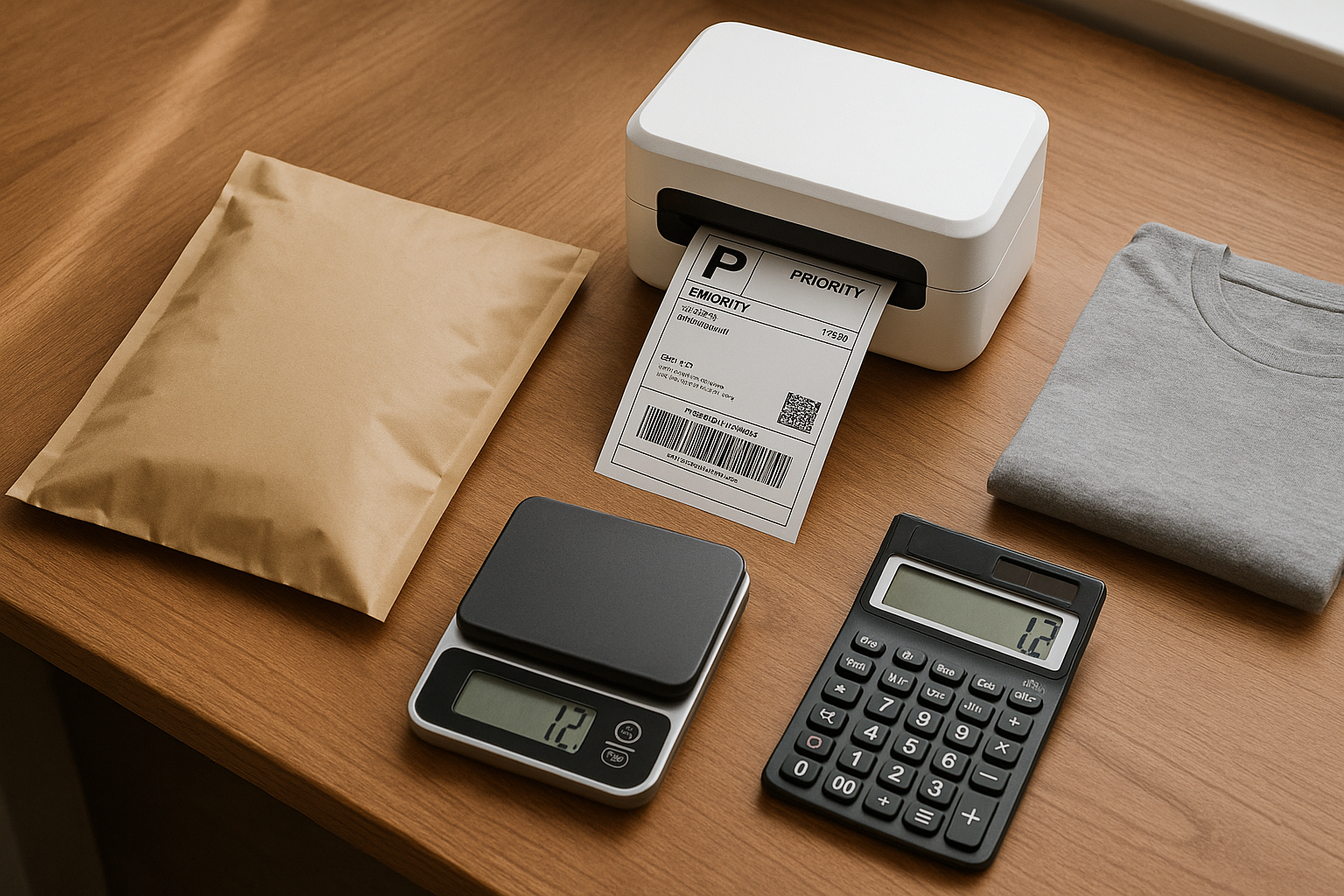
Shipping usually costs a clothing reseller 12–18% of the sale price once you count everything — not the 6–8% most sellers assume when they only look at the postage label. That gap between assumed and actual shipping cost is one of the quietest places margin disappears between the sale notification and the payout hitting your bank account.
You priced the $28 hoodie to clear $10 profit after a $9 cost basis and a $5.50 label. Then the payout lands and it's $3.40 lower than you expected. The label was right. Everything else attached to getting that hoodie into a buyer's hands wasn't in your math.
What Actually Belongs in Your Shipping Cost Per Item
"Shipping cost" is not the number printed on the label. It's every dollar and minute spent getting the item from your shelf to the buyer's door, including the failure cases. Here's the full list resellers under-count:
- Postage label — the number everyone tracks. USPS Ground Advantage, Priority Mail, or a platform-discounted rate.
- Packaging materials — poly mailer, box, tissue paper, fragile stickers, tape. Usually $0.20–$1.10 per shipment depending on category.
- Dimensional weight overages — a $9 boot listing that ships in a box big enough to trigger dim weight pricing can cost $3–$6 more than the sticker rate.
- Free shipping subsidy — if you price items to include "free" shipping, that cost is baked into your list price and needs to be backed out before you calculate real margin.
- Packing labor — the 3–5 minutes it takes to pull, fold, box, label, and stage an item, priced at your effective hourly rate.
- Returns and reshipping — when an item comes back for any reason, you eat the return shipping label, the replacement label if you reship, and the packaging twice.
Most spreadsheets capture line one. Serious P&L tracking captures all six.
The Math: What Sellers Assume vs. What Shipping Actually Costs
Here's the same $32 flannel shirt sale, calculated two ways.
| Line Item | What Sellers Usually Track | What It Actually Costs |
|---|---|---|
| Postage label | $5.60 | $5.60 |
| Packaging (poly mailer, tape) | — | $0.35 |
| Packing labor (4 min @ $18/hr effective rate) | — | $1.20 |
| Prorated return/reship cost (8% return rate on category) | — | $0.68 |
| Total shipping cost per item | $5.60 | $7.83 |
| Shipping as % of $32 sale price | 17.5% | 24.5% |
That's a 7-point swing in shipping cost percentage of sale — on a single item. Multiply that gap across 400 monthly sales and you're looking at a margin story that doesn't match your bank balance, which is exactly the reconciliation problem we cover in reconciling payouts across platforms.
How to Calculate Shipping Cost Per Item for Your Store
Run this once per quarter, per category if your mix is diverse (a $9 t-shirt and a $180 leather jacket do not share a shipping profile).
- Pull your last 90 days of shipping label costs from your platform's shipping report (eBay Seller Hub, Poshmark shipping label history, or your carrier account export).
- Add your average packaging materials cost per item — weigh a typical shipment's mailer, tape, and inserts and price them from your last supply order.
- Calculate packing labor cost by timing 10 typical shipments, averaging the minutes, and multiplying by your effective hourly rate.
- If you offer free shipping, back that subsidy out of your list price before calling it profit — it's a cost, not a marketing feature.
- Add your prorated return and reshipping cost: (return rate % × average shipping cost) ÷ total items shipped.
- Sum all five components to get your true average shipping cost per item.
- Divide that number by your average sale price to get shipping cost as a percentage of sale price — the number that should live in your pricing formula, not just your accounting.
[Screenshot placeholder: FlipDesk Reconcile shipping cost breakdown by category, showing label + materials + labor + returns as separate line items feeding into per-item margin.]
Average Shipping Cost by Category — Why One Number Doesn't Work
Shipping margin erosion hits categories unevenly. A t-shirt and a winter coat do not belong in the same average.
| Category | Avg. Sale Price | Avg. True Shipping Cost | Shipping as % of Sale |
|---|---|---|---|
| Graphic t-shirt | $18 | $5.10 | 28% |
| Jeans | $34 | $6.90 | 20% |
| Jacket/outerwear | $65 | $11.40 | 17.5% |
| Boots/shoes | $48 | $10.20 | 21% |
Notice the pattern: cheap, light items get hit hardest as a percentage, because label costs don't scale down proportionally with sale price. A $5.60 label is brutal on an $18 t-shirt and barely noticeable on a $65 jacket. If your sourcing mix skews toward low-price basics, your true blended shipping cost percentage of sale will run higher than a seller focused on outerwear and boots — worth knowing before you decide which categories to specialize in.
Where the Margin Actually Disappears
Three specific mechanics account for most of the gap between assumed and real shipping cost:
- Dimensional weight pricing. Carriers bill oversized-but-light packages (a puffy coat in a big box) by volume, not just weight. A box that's technically "1 lb" but measures 18x14x8 inches can price out closer to a 4 lb shipment. Compress packaging where the item allows it.
- Free shipping baked into list price without re-checking comps. Sellers set a "free shipping" price once, then forget to revisit it when carrier rates change. Postage has moved multiple times over the past few years — a price set 18 months ago is quietly eating more margin today than when you set it.
- Returns that trigger a second shipment. A return isn't one shipping cost — it's two: the return label back to you, and if you resell or reship the item, another outbound label plus packaging repeated. This is where accurate condition grading pays for itself indirectly. A buyer who receives an item graded Very Good and finds it matches — clean Fabric Condition, no surprise Structural Integrity issues, Cosmetic Appearance as described, Functional Elements intact, no Odor & Cleanliness problems — has no reason to return it. A buyer who expected Excellent and received something closer to Good does, and that return doubles your shipping cost on that item overnight.
Cutting Shipping Cost Without Cutting Service
You don't need to charge buyers more to fix shipping margin erosion. You need tighter packaging and fewer avoidable returns.
- Buy poly mailers and boxes in three sizes only — small, medium, large — and standardize which category goes in which, so nobody's guessing per item.
- Weigh and measure your five best-selling categories once, then set that as your default label size instead of re-measuring every shipment.
- Recalculate your free-shipping price floor whenever carrier rates change, not once a year.
- Grade condition accurately and disclose defects in the listing before the buyer finds them in hand — this is the single highest-leverage lever against return-driven double shipping cost.
Put a Real Number on It
You don't need a finance degree to fix this — you need the true number in front of you. Run the seven-step calculation above against your last quarter of sales, category by category, and compare it to what you've been assuming in your pricing. If the gap is more than 3–4 points, that's real money you're pricing wrong every single listing.
FlipDesk's Reconcile module pulls label costs, packaging averages, and return-driven reshipping straight from your platform payouts, so your per-item P&L reflects actual shipping cost instead of the label alone. Try it on your last 30 days of sales and see where the real number lands.