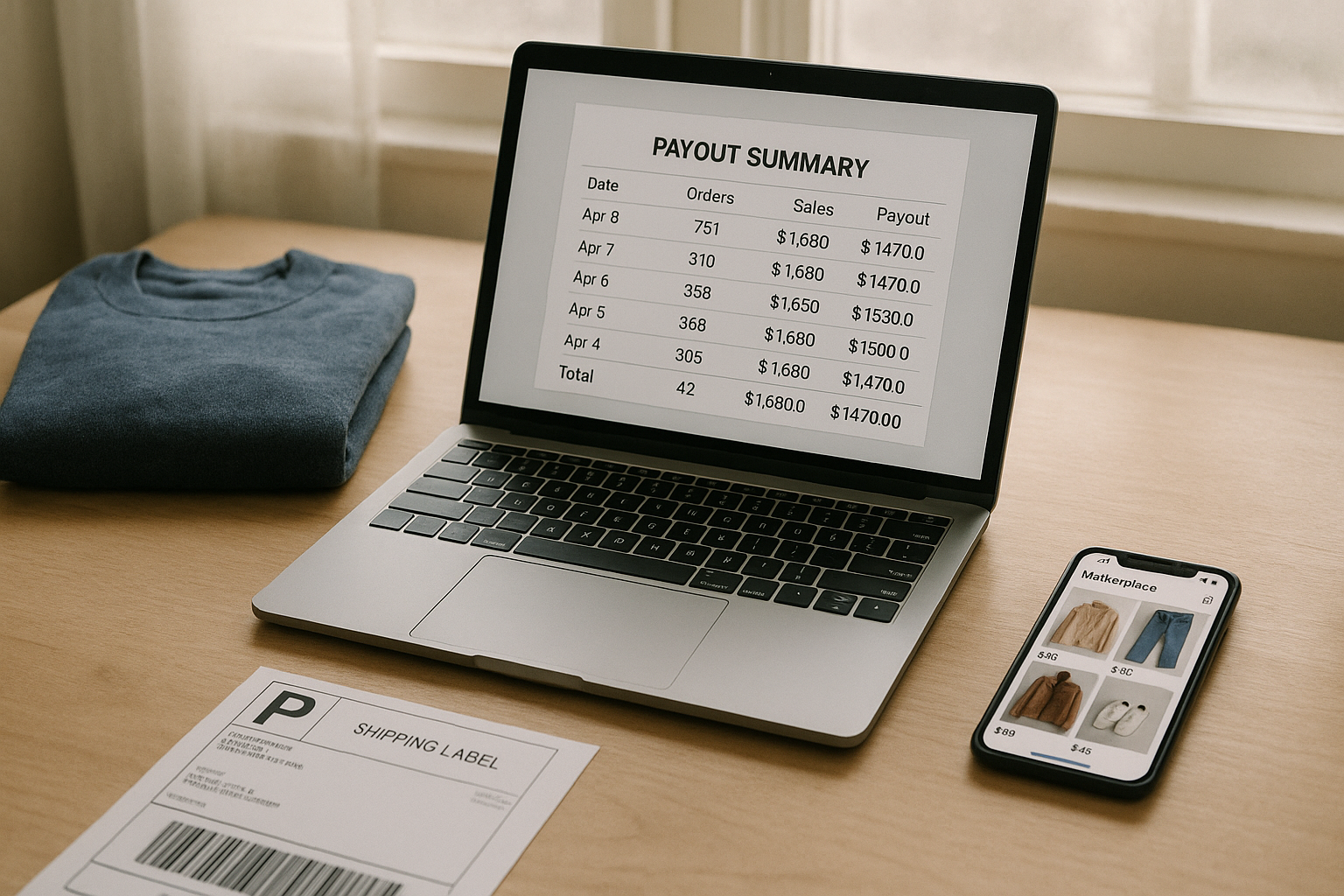
The Partial Refund Trap: When Poshmark and Mercari Split Payouts and Hide the Deduction
When you issue a partial refund on Poshmark or Mercari, the platform keeps its full commission on the original sale price — you absorb the entire refund amount out of your own earnings. That means a $15 partial refund on a $60 sale doesn't cost you $15. It costs you $15 plus a chunk of the fee you already paid on money you no longer have.
Most resellers only notice this when a payout looks short and they can't figure out why. The sale showed $48 net. The deposit showed $33. Somewhere in between, a partial refund happened, and the platform's math didn't work the way sellers assume it does. This is where returns-and-reconciliation work gets sloppy — not because the numbers are hidden, exactly, but because they're scattered across export files that were never designed to make this obvious.
How partial refunds quietly inflate your effective fee rate
Here's the mechanic both platforms share: fees and commissions are calculated once, at the time of sale, based on the original sale price. When you later issue a partial refund to resolve a buyer complaint — a missing button, a stain you missed, a size that runs small — the refund comes straight out of your net earnings. The platform's commission does not recalculate downward to match the new, lower effective sale price.
The result is an effective fee rate that climbs every time you issue a partial refund. You agreed to a 20% commission structure. After a partial refund, you might actually be paying 26% or 30% of what you actually collected. Nobody tells you this in the app. You have to do the division yourself.
Poshmark's partial refund mechanics — commission stays put
On Poshmark, sellers can offer partial refunds directly through the app when a buyer opens a case, usually for minor issues rather than full returns. Say you sold a jacket for $60. Poshmark's commission on sales over $15 is 20%, so it took $12, and you netted $48. The buyer flags a small stain you didn't catch and you offer a $15 partial refund to keep the sale rather than take the item back.
Poshmark deducts that $15 from your $48 net earnings. Your payout drops to $33. But Poshmark still keeps its original $12 commission — based on the $60 sale price, not the $45 the buyer effectively paid. Do the math on what you actually gave up: $12 commission on a $45 effective sale is a 26.7% rate, not the 20% you budgeted for. You didn't just give the buyer $15. You gave up $15 plus 6.7 percentage points of margin you thought you'd banked.
Mercari's partial refund mechanics — same problem, different fee math
Mercari stacks a 10% selling fee with payment processing around 2.9% + $0.30. On a $50 sale, that's $5 in selling fees and roughly $1.75 in processing, for $6.75 total. You net $43.25.
Now the buyer messages about a broken zipper pull — not enough to justify a full return, but enough that you offer a $10 partial refund to close the case without an INR or a not-as-described claim going on your record. Mercari deducts the $10 from your $43.25, dropping your payout to $33.25. The $6.75 in fees stays exactly where it was, still calculated against the original $50 sale price. Your effective fee rate goes from 13.5% to 16.9% on a sale that's now effectively worth $40.
Neither platform is doing anything against its terms of service. This is standard partial refund seller payout deduction behavior on both marketplaces. The problem is that it's invisible unless you go looking, and most sellers processing 50 to 2,000 items a month don't have time to go looking on every single refund.
Side-by-side: what a partial refund actually costs on each platform
| Scenario | Poshmark ($60 sale, $15 partial refund) | Mercari ($50 sale, $10 partial refund) |
|---|---|---|
| Original commission/fees | $12.00 (20%) | $6.75 (10% + processing) |
| Net earnings before refund | $48.00 | $43.25 |
| Partial refund issued | $15.00 | $10.00 |
| Final payout | $33.00 | $33.25 |
| Effective sale price (post-refund) | $45.00 | $40.00 |
| Effective fee rate | 26.7% | 16.9% |
| Fee rate inflation vs. stated rate | +6.7 points | +3.4 points |
The pattern holds regardless of platform: the smaller the sale relative to the refund, the harder the effective fee rate gets hit. A $10 partial refund on a $25 item does far more proportional damage than the same $10 refund on a $150 coat.
Why these deductions are hard to spot in your books
The real problem isn't the math — it's the paper trail. Poshmark's sales report lists partial refunds as separate line items, sometimes days after the original sale, without a clean link back to the order ID in the CSV export. Mercari's payout history batches transactions into lump-sum deposits that combine multiple sales, fees, and refunds into a single number hitting your bank account. If you're logging revenue from the deposit total instead of the itemized transaction detail, a partial refund just looks like "the payout was smaller than expected" — with no record of why.
This is exactly the kind of thing that breaks a per-item P&L. If your cost basis and expected margin were built off the original sale price, and the partial refund never gets logged against that specific item, your books show a profit that doesn't exist. Multiply that across a few dozen partial refunds a month and you've got a material gap between what your spreadsheet says and what actually landed in the bank.
How to reconcile split payouts across Poshmark and Mercari
- Export the platform payout report or sales report covering the full period, including both the original sale and any subsequent refund activity.
- Match every partial refund line to its original order using the transaction or order ID the platform provides — don't rely on item name or date alone, since duplicates happen.
- Record three separate figures per item: the original sale price, the original fee or commission amount, and the partial refund amount.
- Calculate the effective fee rate by dividing the original fee by the post-refund net sale price, not the original sale price.
- Flag any item where the effective fee rate exceeds your target margin threshold — this tells you which categories or defects are triggering the most costly partial refunds.
- Update the item's line in your P&L to reflect true net proceeds, not the original listed sale price, so your margin numbers stay honest.
- When deposits arrive as a batched lump sum, break out each individual transaction before recording it — never log the batch total as a single revenue line.
Do this consistently and you get a real answer to a question most resellers can't currently answer: how much of your margin is partial refunds actually eating, by platform, by category, by month. That number is usually bigger than people expect, and it's one of the clearest signals for where your listings need better condition disclosure.
Cut off the refunds at the source
Most partial refunds trace back to the same root cause: the listing said one thing and the item showed up saying another. A seller calls something Excellent when the fabric shows pilling that belongs in Very Good. A missing button gets missed under Functional Elements. A faint odor issue never gets flagged under Odor & Cleanliness. The buyer isn't wrong to ask for money back — the grade was wrong.
Standardizing your condition calls against a defined scale — NWT, NWOT, Excellent, Very Good, Good, Fair, Poor — and checking each of the five factors (Fabric Condition, Structural Integrity, Cosmetic Appearance, Functional Elements, Odor & Cleanliness) before you list is the cheapest fix available. It doesn't eliminate partial refunds. It does reduce the volume of low-grade disputes that turn into $10 and $15 payout hits, one after another, month after month.
You can't get Poshmark or Mercari to recalculate their commission when you issue a refund. You can control how often you need to issue one in the first place.
Try it on your next batch: run a GradeThread condition report on ten items before you list them, and track how many partial refund requests come in against that batch versus your usual run rate. Then let FlipDesk's Reconcile module match every sale, fee, and partial refund back to the original order automatically, so your P&L reflects what actually hit your bank account — not what the original listing price implied.