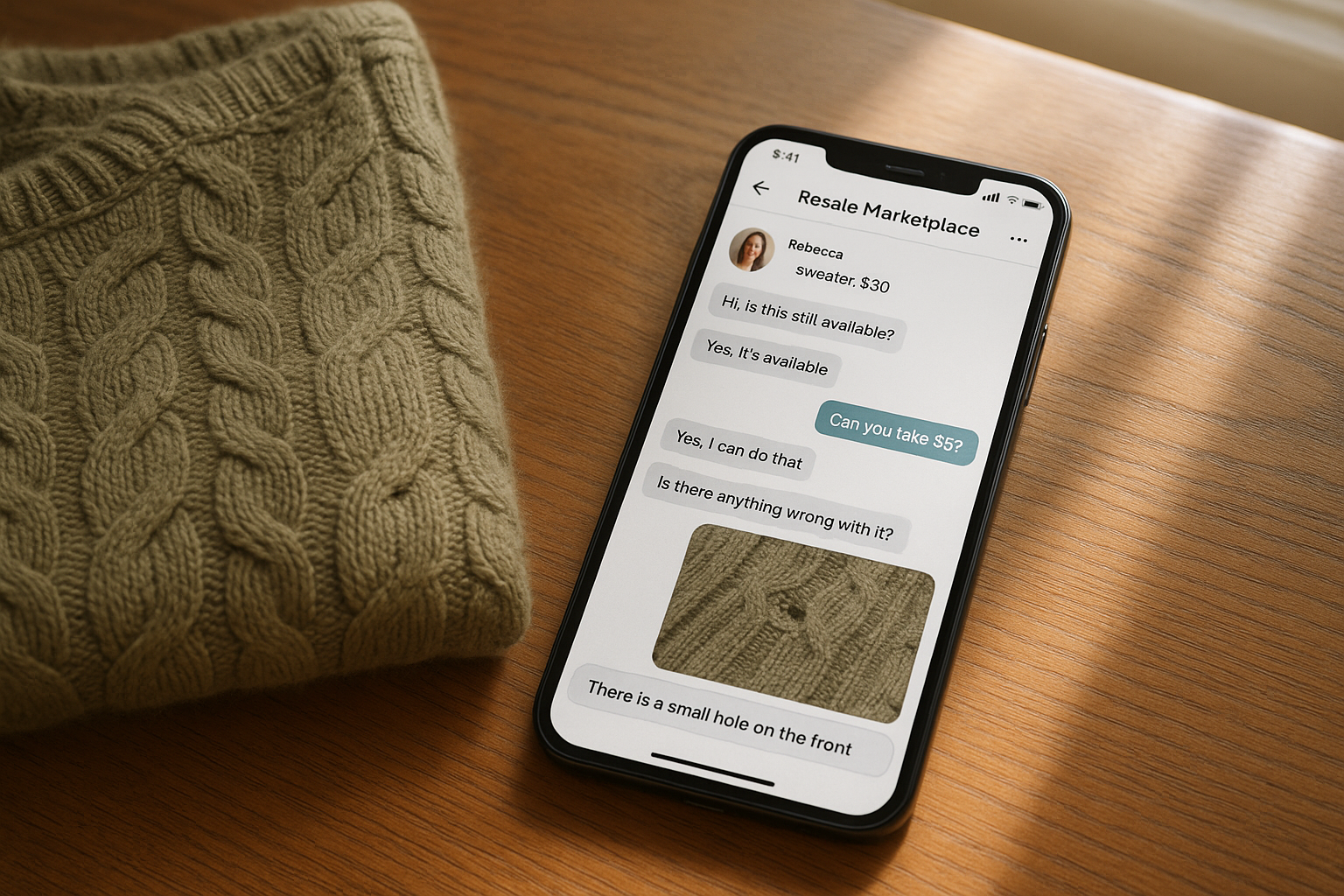
Mercari's default return system is binary: a buyer opens a return request, and the outcome is either a full refund or the buyer keeps the item as-is. There is no built-in "partial refund" button. But partial refunds do happen on Mercari — they just occur through direct seller-buyer negotiation in the message thread, or through a Mercari support agent stepping in on an escalated case. Knowing which path applies to your situation is the difference between a fast resolution and a week of back-and-forth.
We spend most of our time at GradeThread on the front end of this problem — grading garments before they ship so buyers know exactly what they're getting. But return requests still happen, and when an item is genuinely somewhere between "as described" and "garbage," a partial refund is often the fairest outcome for both sides. Here's how to actually get there on Mercari.
How Mercari's Return Process Works By Default
When a buyer receives an item that doesn't match the listing, they have 3 days after delivery to open a return request through the app. Mercari's stated policy gives two outcomes:
- Full refund — the buyer ships the item back and gets their money returned once Mercari confirms the return.
- Keep the item, no refund — the buyer and seller agree the issue doesn't warrant a return, and the case closes.
Nowhere in that flow is a slider for "refund me 30%." That's the root of most seller confusion when a buyer asks for a partial refund on Mercari — the platform's own return mechanics don't natively support it. Partial refunds exist in a gap between the automated system and human judgment.
The Three Paths to a Partial Refund on Mercari
In practice, a partial refund happens one of three ways. Each has different speed, different leverage, and a different amount of money on the table.
| Path | Who initiates | Typical speed | Typical refund range |
|---|---|---|---|
| Seller offers directly in-app messages | Seller | Same day | 10%–40% of item price |
| Buyer requests, seller counters | Buyer | 1–3 days | 15%–50%, negotiated |
| Mercari support escalation | Either party, after stalled negotiation | 3–7 days | Case-by-case, sometimes full refund instead |
Most partial refunds close in the first path or second path — a direct conversation in the order's message thread. Mercari support only gets involved when the buyer and seller can't agree, and support's default lean is toward the buyer, especially on "not as described" claims with photo evidence. That's worth knowing before you dig in on a $6 discrepancy.
How to Request a Partial Refund on Mercari as a Buyer
If an item arrived with a defect that wasn't disclosed but you still want to keep it — a missed stain, a small tear, a size that runs slightly off — a partial refund is usually faster than a full return, since you skip the reshipping step entirely.
- Open the order in your Mercari app within the 3-day return window — this keeps you covered by buyer protection even if the conversation runs long.
- Photograph the specific defect in daylight, including a close-up and a wider shot showing where it sits on the garment.
- Message the seller directly through the order thread, not a return request, if you want to negotiate a partial refund instead of a full return. State the defect plainly and propose a dollar amount or percentage.
- Reference what the listing said versus what arrived — for example, if the listing said Excellent condition and the item has a Fabric Condition issue like a thin patch or a Cosmetic Appearance flaw like a stain, name it specifically.
- Give the seller 24–48 hours to respond before escalating. Most sellers would rather refund $8 than process a full return and relist.
- If the seller won't negotiate, open a formal return request instead. Mercari support can review the case and may issue a partial refund on their own initiative even without seller sign-off, though a full return is more common at that stage.
How to Offer a Partial Refund on Mercari as a Seller
If a buyer opens a return request or messages you about a defect, offering a partial refund upfront often closes the case faster than fighting it and protects your seller rating.
- Ask for photos of the specific issue before agreeing to anything — you need to see whether this is a Fabric Condition, Structural Integrity, Cosmetic Appearance, Functional Elements, or Odor & Cleanliness problem to price the refund fairly.
- Compare the photos against your own listing photos and description. If you disclosed the flaw and it's visible in your photos, you're not obligated to refund anything — but a small goodwill gesture can still avoid a negative rating.
- Calculate the refund as a percentage of the item price tied to how much the defect actually degrades wearability, not the buyer's opening ask.
- Send the offer directly in the order message thread with a specific dollar amount, not a vague "let's work something out."
- Process the refund through Mercari's official partial refund flow when the buyer accepts, so it's documented on the platform and doesn't require a separate return shipment.
- Close the loop by confirming the buyer is keeping the item and considers the case resolved — this matters if a rating dispute comes up later.
Common Partial Refund Amounts and What Justifies Them
There's no official Mercari chart for this, but based on typical reseller practice, refund amounts tend to track the severity and grading factor involved:
- 5%–10% off — a minor Cosmetic Appearance issue not visible in listing photos, like a faint mark or slightly duller color than pictured. Item is still functionally Excellent or Very Good.
- 15%–25% off — a Functional Elements defect that doesn't prevent use, like a stiff zipper or a loose button, or moderate pilling not disclosed.
- 30%–40% off — a Structural Integrity issue such as a small seam separation, or an Odor & Cleanliness problem requiring the buyer to launder before wearing.
- 50%+ or full refund — a defect that drops the item below Fair condition versus what was advertised, such as a hole, a broken zipper, or an odor that doesn't wash out. At this point a full return usually makes more sense than a deep partial.
The pattern holds: partial refunds work best for defects that shift a garment down one tier — say, from Excellent to Very Good, or Very Good to Good — not defects that move it two or three tiers at once. If the item should never have been listed at the grade it was, a partial refund just delays the return you'll end up processing anyway.
Why This Keeps Happening: Vague Condition Descriptions
Almost every partial refund negotiation traces back to the same root cause — the listing description used a subjective adjective ("barely worn," "like new," "great condition") and the buyer's definition didn't match the seller's. Mercari has no standardized condition scale of its own, so "good condition" from one seller can mean something completely different from another seller's "good condition."
This is the exact gap GradeThread's grading standard closes. Instead of an adjective, a listing carries a specific number — 8.0 for Excellent, 6.0 for Good — backed by a condition report covering Fabric Condition, Structural Integrity, Cosmetic Appearance, Functional Elements, and Odor & Cleanliness. A buyer who sees a 7.0 (Very Good) grade with a noted seam pull on the hem knows exactly what's coming before they buy. That doesn't eliminate every return request, but it removes the ambiguity that turns a $12 defect into a 40-message negotiation.
If you're a seller who's issued more than one or two partial refunds this month for defects you didn't catch or didn't describe clearly, that's a signal worth acting on — not a bad-luck streak.
Try Grading a Garment Before Your Next Listing
Run one item you're about to list through GradeThread and see the condition report it generates — the same five factors, the same tier language, laid out before a buyer ever has a reason to open a return request. It won't stop every dispute, but it puts a number and a paper trail behind your listing instead of an adjective you'll have to defend later.