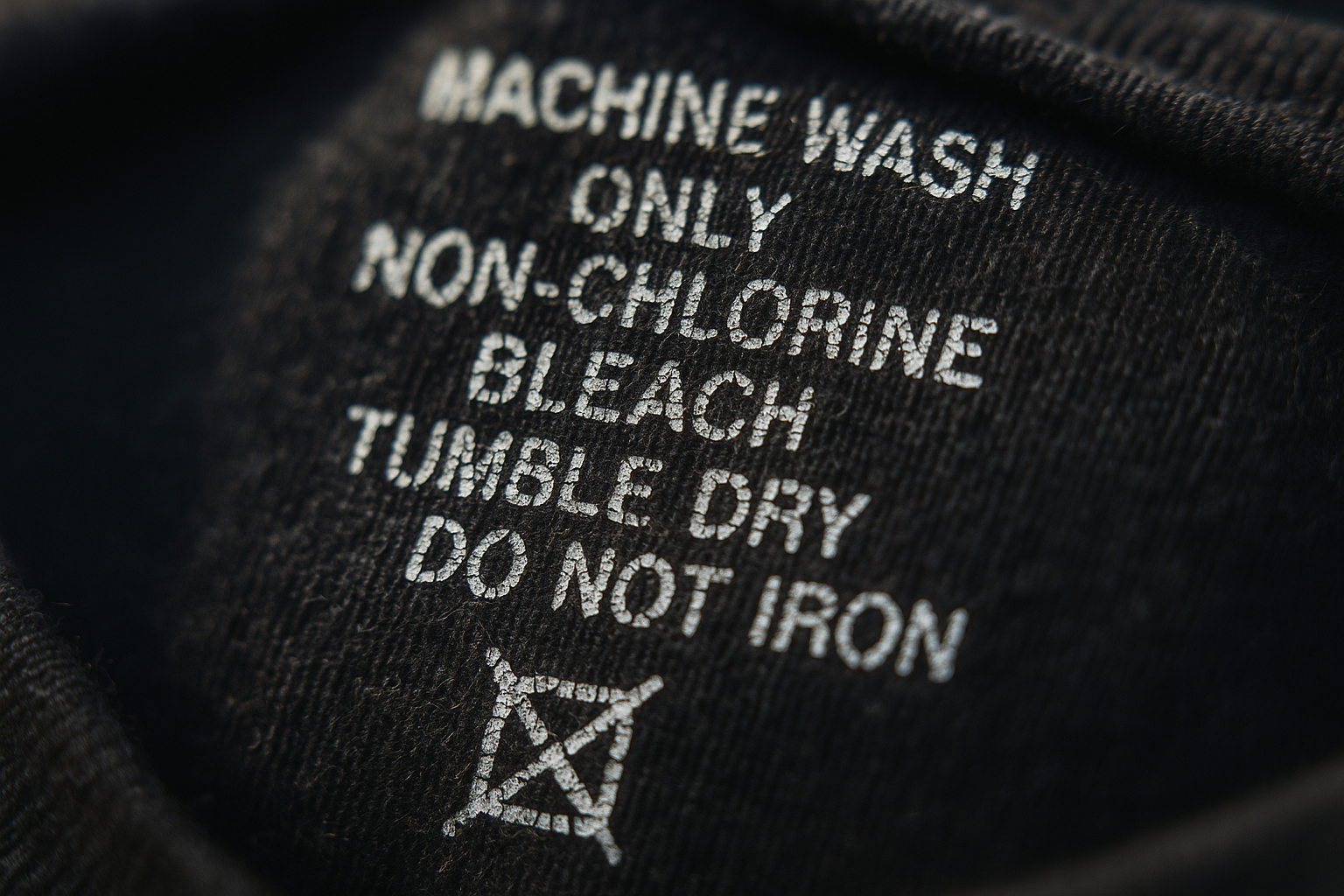
The Label Fade Test: Why Woven Tags, Care Instructions, and Brand Markers Grade Differently
Grade a faded care label by legibility, not by appearance alone: if a buyer can still read the fiber content, wash symbols, and size, the fade is a Cosmetic Appearance note; if any of that information is gone, it's a Functional Elements defect, because the garment can no longer tell the buyer how to care for it safely.
We see this mistake constantly in condition reports we review: a seller docks an otherwise Excellent flannel a full tier because the woven brand tag looks a little dull, while a genuinely illegible care label — the kind that will send a buyer's $80 cashmere sweater into a hot dryer — gets waved through as "minor wear." Both calls are wrong, and both come from treating every tag as one defect category. It isn't. A garment can carry three separate label types, and each one fades, cracks, or fails on its own timeline and under its own grading rule.
Three Labels, Three Different Failure Modes
Before you can grade label condition, you need to know which label you're looking at. Manufacturers use different substrates and printing methods for different information, and each one degrades differently.
- Woven brand label — satin ribbon or damask-woven tag at the back neck or waistband, usually carrying the logo. Threads are dyed before weaving, so color loss requires bleach exposure or serious UV damage. What actually happens over time is fraying at the cut edge, loosening stitching, or the label curling away from the seam.
- Printed care instructions — heat-transfer or screen-printed ink applied directly to fabric, typically inside the neck or a side seam on tagless garments. This is the label that fails fastest. Repeated washing and drying cracks the ink layer, and cracked ink flakes off in the wash until the print is a ghost of itself.
- Size and content tag — sometimes woven, sometimes printed, sometimes a small separate paper-style swing tag on new stock. Grading follows whichever substrate it's printed on.
Two of these three are cosmetic problems. One of them is a functional problem. That distinction is the whole test.
The Legibility Threshold: When Faded Becomes a Defect
Fading itself isn't a defect. A brand label that's a shade lighter than it was in 1995 is expected wear on a forty-year-old tee, and it doesn't move the grade if you can still read every character on it. The threshold that matters is legibility, not intensity of color loss.
Ask three questions of every label on the garment:
- Can you read the brand name and logo without guessing at a letter?
- Can you read the full care instruction line — fiber content, wash temperature, and any special handling (dry clean only, do not bleach, lay flat to dry)?
- Can you read the size marker without cross-referencing measurements to confirm it?
A "yes" to all three keeps the label defect in Cosmetic Appearance territory, even if the label looks visibly worn. A "no" on question two moves the defect into Functional Elements, because a buyer who can't confirm wash instructions is one hot cycle away from a shrunk or ruined garment — and that's the exact scenario that generates "not as described" claims when they blame the seller instead of the washing machine.
The Label Fade Test: Step by Step
Run this test on every garment before you write the condition report, not just the ones where the tag looks obviously worn. Faded labels are easy to miss under a quick glance and hard to defend after a buyer complains they couldn't identify the fabric content.
- Locate every label on the garment: neck label, side-seam care tag, waistband tag, and any printed size marker.
- Photograph each label under bright, even, diffused light — the same lighting standard you'd use for a defect shot, not ambient room light that can hide cracking or flatten contrast.
- Read every line of text on each label aloud, without zooming in on the photo or squinting at the garment. If you have to guess a character, it fails legibility.
- Note specifically which information is illegible: brand name, fiber content, wash symbols, dry-clean designation, or size. Partial loss (fiber content readable, wash symbols gone) still counts as a functional gap.
- Check whether the label itself is structurally intact — still stitched down, not curling, cracking, or half-detached from the seam.
- Cross-reference what you found against the grade tier table below to assign the correct sub-grade and identify which of the five factors it affects.
- Write the defect into the condition report by location and specifics — "care label at neck, wash symbols no longer legible, fiber content readable" — not a vague "tag is worn."
Where Label Fade Fits in the Five Factors
GradeThread's condition report scores five weighted factors: Fabric Condition, Structural Integrity, Cosmetic Appearance, Functional Elements, and Odor & Cleanliness. Label defects touch two of these, and knowing which one keeps your grade honest.
- Cosmetic Appearance — faded woven brand label, dulled logo color, minor fraying at the label's cut edge, as long as the brand and any printed text remain legible. This is a light touch on the grade, similar to how you'd treat a scuffed hardware finish.
- Functional Elements — illegible or missing care instructions, illegible fiber content, or a size marker that can't be confirmed without separate measurement. This is the same factor that covers a broken zipper or a missing drawstring: it's not about looks, it's about whether the garment still delivers the information or function it's supposed to.
- Structural Integrity — only when the label itself is coming apart from the seam: loose stitching, a label hanging by one thread, or a printed label cracked to the point of flaking off in sheets. This is rare and usually pairs with other seam wear nearby.
Grading Reference: Label Condition by Tier
| Tier | Woven Brand Label | Printed Care Instructions |
|---|---|---|
| NWT | Full color, crisp weave, no handling marks | Fully legible, ink uncracked |
| NWOT | Unused, may show a light fold crease from packaging | Fully legible |
| Excellent | Minor edge fray, color intact, fully legible | Minor surface cracking, every line still legible |
| Very Good | Noticeable fading or fraying, still fully legible | Partial cracking, all critical text (fiber content, wash symbols) legible with close reading |
| Good | Heavy fraying or curling at the seam; brand name legible, secondary text may not be | Fiber content legible; one or more wash symbols illegible |
| Fair | Loose stitching, label partially detached, or brand name difficult to confirm | Fiber content and wash instructions both illegible; size may remain readable |
| Poor | Label missing or unreadable entirely | Print flaked to blank or near-blank fabric |
Notice the pattern: a garment can be Excellent overall with a Fair-grade care label, or Good overall with a fully crisp brand tag. Grade the label against this table on its own, then let it pull the relevant factor score down — don't let a rough-looking tag drag the whole garment grade by itself.
Common Mistakes We See Resellers Make
- Docking the whole grade for a faded but legible brand label. If you can read it, it's a minor Cosmetic Appearance note at most — not a reason to drop from Excellent to Good.
- Waving through an illegible care label as "just wear." Missing wash instructions is a real functional gap. Disclose it specifically, because buyers who ruin a garment in the wash because they had no instructions will file it as not-as-described, not as their own laundering error.
- Confusing a replaced label with a fake one. A resewn or replaced care tag isn't an authenticity flag by itself — it's a repair, and it should be disclosed the same way you'd disclose a replaced button: what was done, and whether it affects Functional Elements.
- Skipping the label shot entirely. A blurry or missing tag photo forces buyers to guess, and guessing is exactly what standardized grading exists to eliminate.
Marketplaces increasingly expect this level of detail. eBay's item specifics fields for clothing now often ask for care instructions and fiber content directly — if your tag is illegible, you're guessing at fields the platform is asking you to fill in accurately. That's the real cost of an unlegible label: it doesn't just cost you a grade, it costs you accurate metadata everywhere downstream.
Try It on One Garment
Pull a garment from your rack where the tag looks a little rough and run the three-question legibility test on it before you list. Better yet, run it through GradeThread and see how the report separates the Cosmetic Appearance note on the brand label from the Functional Elements call on the care instructions — the same distinction a buyer's dispute reason will eventually make for you, whether you called it or not.