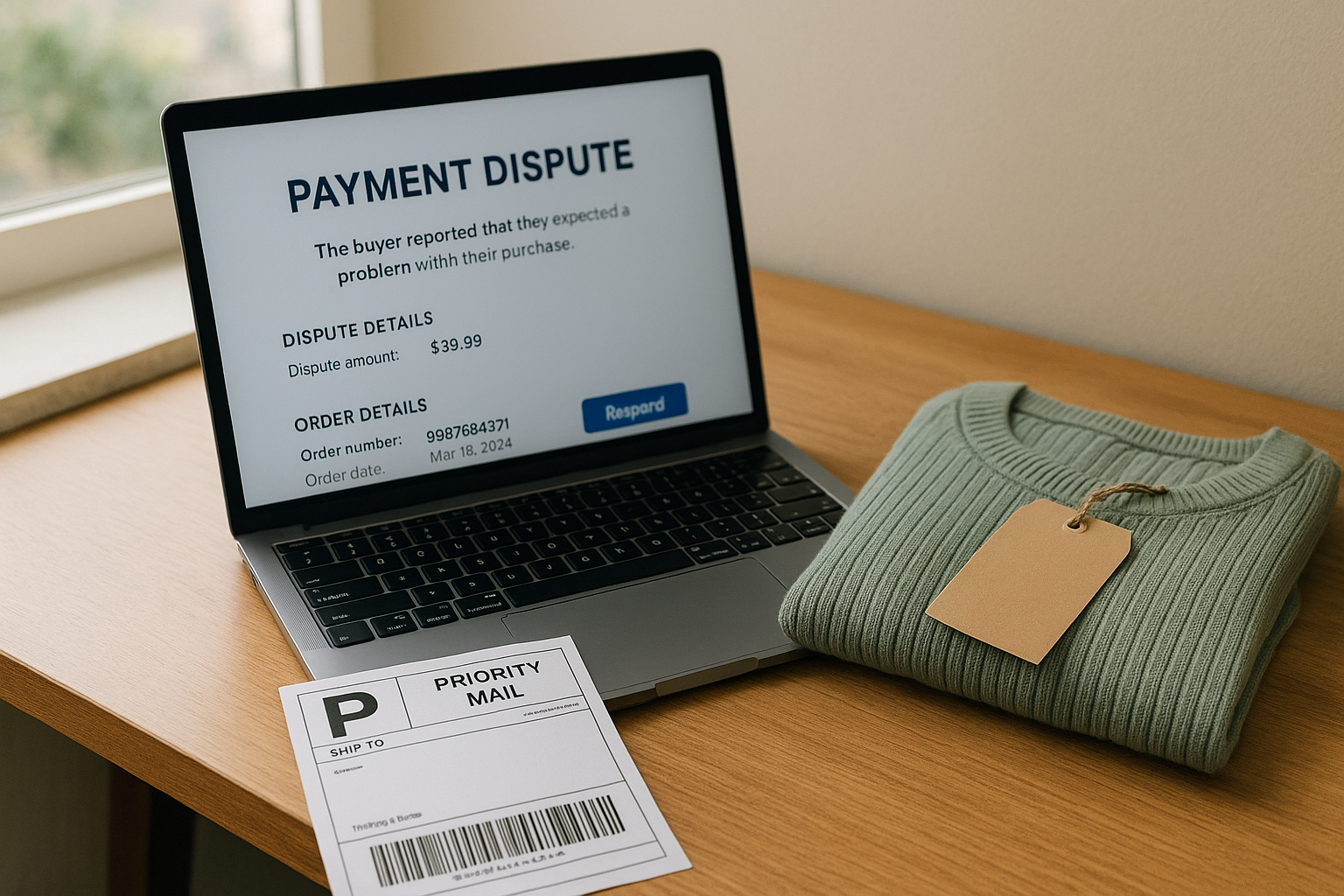
Chargebacks vs. Returns: Which Costs More and How to Prevent Both
A credit card chargeback almost always costs a reseller more than a standard eBay return. With a return, you're refunding a sale you already made and may get the item back. With a chargeback, you typically lose the item, the payment, and a separate $15–$25 chargeback fee charged by the payment processor — while eBay's return protections often don't apply at all.
Most sellers lump these together in their mental math as "customer got their money back." They're not the same event, they don't hit your account the same way, and they don't require the same defense. If you're only building a playbook for eBay's Money Back Guarantee returns, you're unprepared for the more expensive problem sitting one step outside eBay's system.
How a Return and a Chargeback Actually Work
An eBay return happens inside eBay's Money Back Guarantee (MBG) system. The buyer opens a case, selects a reason code, and eBay mediates if you and the buyer don't resolve it directly. You can accept the return, offer a partial refund, or contest it with photos and documentation. Either way, the process runs on eBay's rules, eBay's timeline, and eBay's evidence system.
A chargeback is different. The buyer contacts their card issuer — Visa, Mastercard, Amex, Discover — directly, bypassing eBay entirely. The issuer pulls the funds back from eBay's payment processor (currently Adyen, since eBay moved to managed payments), and eBay in turn pulls them from your payout or account balance. You often don't find out until the money is already gone. eBay then decides whether to represent you in the dispute using its own evidence, or pass the fight to you.
The buyer's stated reason matters less here than the network's dispute code. Common chargeback reason codes include "item not as described," "item not received," and straight-up "fraudulent transaction" — and each has different evidence requirements set by the card network, not by eBay.
The Real Cost Comparison
Here's what a $60 sale actually costs you under each outcome, using typical eBay managed-payments fee structure as an example.
| Cost line | Standard eBay return (item back) | eBay MBG return (no item back) | Credit card chargeback (lost) |
|---|---|---|---|
| Refund to buyer | $60.00 | $60.00 | $60.00 |
| Item recovered? | Yes — resellable | No | No |
| Final value fee credited back | Yes, in most cases | Yes, in most cases | Often not automatically credited |
| Chargeback/dispute fee | $0 | $0 | $15–$25 |
| Original shipping cost | Lost (unless buyer pays return label) | Lost | Lost |
| Net loss (example) | ~$8–12 (shipping + relist labor) | ~$60–68 | ~$75–90 |
The gap between the middle and right columns is the point. A no-item-back return costs you the item and the shipping. A lost chargeback costs you the item, the shipping, and a flat processor fee on top — a fee that exists regardless of who was right about the condition of the garment.
Why a Chargeback Hurts Your Account Health More Than a Return
Returns are a normal, tracked part of eBay's seller performance metrics. Your return rate shows up in Seller Standards, and a high rate can trigger a below-standard rating, but eBay expects some return volume from every store.
Chargebacks are murkier. They don't always show up cleanly as a "return" in your dashboard, which means you can be bleeding margin to disputes without seeing it reflected in the metric you're watching. Worse, a pattern of chargebacks — especially unresolved ones — can flag your account for a payments review, delay payouts, or in repeat cases trigger a hold on your ability to receive funds until eBay resolves the dispute pattern. A return dings your stats. A wave of chargebacks can freeze your cash flow.
Where Chargebacks Actually Come From
In our experience moving volume, chargebacks on clothing sales cluster around three triggers:
- Buyer's remorse dressed up as a fraud claim because it's faster than requesting a return through eBay.
- Genuine condition disputes where the buyer skipped eBay's return process because they didn't know it existed or didn't trust it.
- Actual card fraud — someone else's card was used to buy the item, and the real cardholder is disputing a charge they didn't make.
Only the last one is unrelated to your listing quality. The first two are preventable with the same tools you'd use to cut ordinary returns.
The Documentation That Wins (or Loses) a Chargeback Case
When eBay represents you in a chargeback dispute, it submits evidence to the card network on your behalf. When it doesn't, you're submitting evidence directly, and the bar is higher than a standard MBG case. Here's what you need on file for every sale, ready to pull within minutes:
- Proof of delivery with tracking number and delivery confirmation — this alone defeats most "item not received" chargebacks.
- Timestamped intake photos taken before the item was packed, showing the garment's actual condition.
- The original listing photos and description, archived — not just the live listing, since it can be edited or end.
- The condition grade and report you assigned at listing time, matched against your intake photos, showing Fabric Condition, Structural Integrity, Cosmetic Appearance, Functional Elements, and Odor & Cleanliness were disclosed consistently.
- Any buyer messages exchanged before or after the sale, especially questions about fit, condition, or authenticity.
- Your shipping receipt and packaging photos, showing the item left your hands in the condition described.
Card networks want a clear paper trail that the item shipped, arrived, and matched its description. A vague listing with three blurry photos gives you nothing to point to. A listing with a specific condition grade — Excellent, not "good used condition, some flaws" — and photos that back it up gives you a defensible record.
How to Prevent Both: A Step-by-Step Workflow
Most of the prevention work for returns and chargebacks overlaps, because both start with the same failure mode: a buyer's expectation not matching the item in hand.
- Grade every item honestly before listing, using a consistent tier — NWT, NWOT, Excellent, Very Good, Good, Fair, or Poor — instead of subjective adjectives that mean something different to every buyer.
- Photograph every defect you disclose in the description, not just the flattering angles. A buyer who sees the flaw before buying has no case for "not as described."
- Write the condition section of your listing around the five factors — Fabric Condition, Structural Integrity, Cosmetic Appearance, Functional Elements, Odor & Cleanliness — so nothing is left to interpretation.
- Use tracked shipping on every order over roughly $20 in value; tracking defeats the single most common chargeback reason code outright.
- Respond to buyer messages before the sale, especially condition or sizing questions, and keep the message thread — it becomes evidence later.
- Save intake photos and listing photos in a folder tied to the item's SKU so you can retrieve them in under two minutes when a dispute lands.
- When a buyer opens an eBay return instead of going straight to their bank, resolve it fast and fairly — a quick, documented resolution through eBay's system is cheaper than letting frustration escalate into a chargeback three weeks later.
Step three deserves emphasis. A standardized, third-party-verified condition grade does more preventive work here than any policy you can write in a listing description, because it removes the seller's own adjective choice as the point of dispute. "I graded this Very Good and the report shows moderate pilling on the sleeve cuffs" is a harder claim to chargeback than "gently used, no flaws."
When to Fight, When to Concede
Not every dispute is worth fighting. If your documentation is thin — no intake photo, no tracking, no saved messages — the math often favors a fast refund over a drawn-out chargeback representment you're likely to lose anyway. Representment takes time, and eBay doesn't guarantee it wins even with strong evidence.
Fight when you have delivery confirmation, matching photos, and a documented condition grade. Concede quickly when you don't, and use the loss as the reason you tighten intake photography and grading before the next batch goes out. The goal isn't winning every dispute — it's shrinking the number of disputes you have to fight in the first place.
Try It on Your Next Batch
The fastest lever you have against both returns and chargebacks is a condition record you can point to before the buyer ever opens a case. Run your next few listings through GradeThread's standardized grading before you list — a numbered grade, a defect breakdown across all five factors, and a certificate the buyer can check themselves. It won't stop every dispute, but it turns "he said, she said" into a paper trail, which is exactly what wins chargeback cases and keeps return reasons honest.