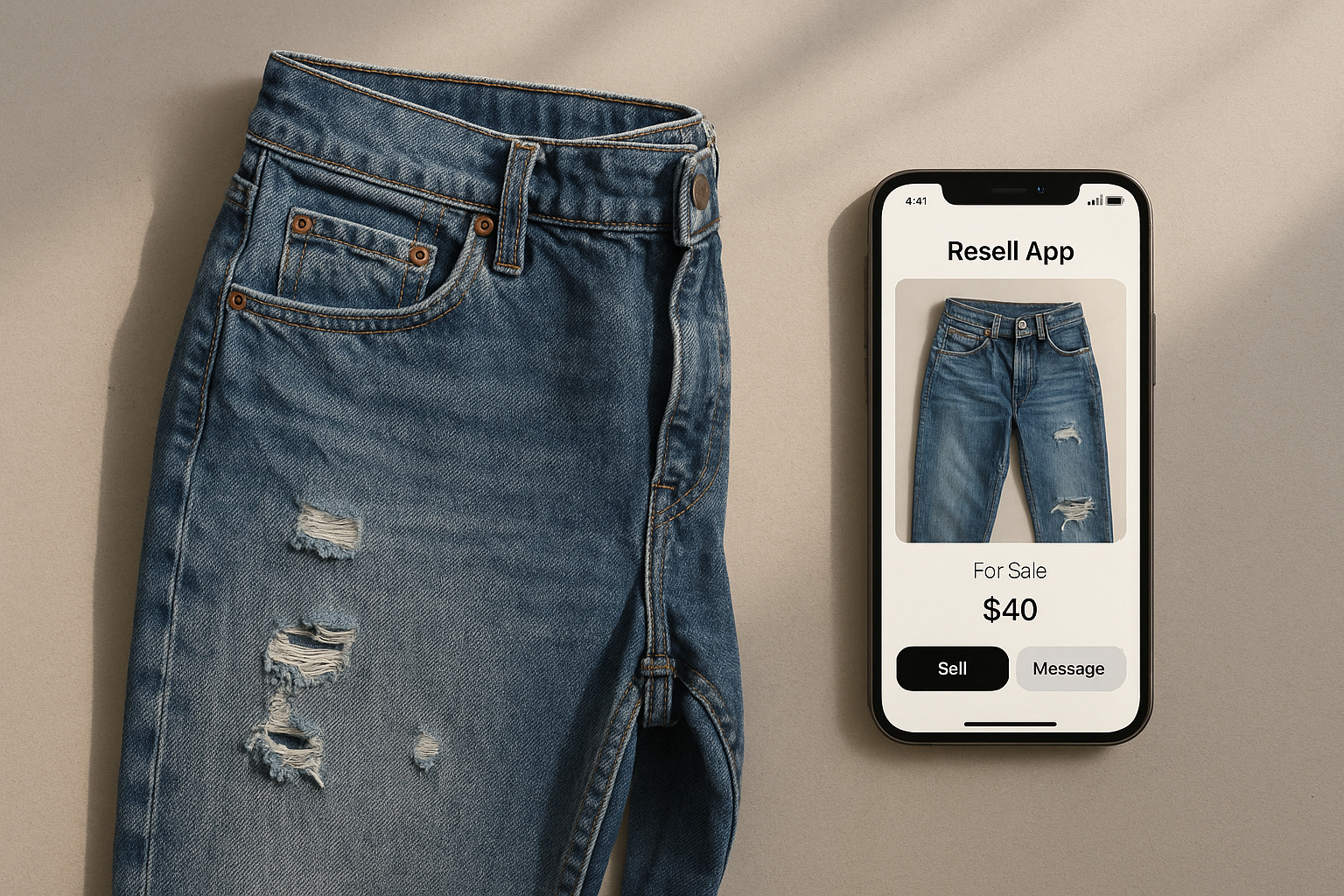
Depop wins with Gen Z buyers hunting streetwear, vintage, and Y2K pieces at lower price points. Poshmark wins with a broader, slightly older audience buying brand-name basics and closet staples at higher average order values. Their audiences barely overlap, which is exactly why most serious resellers end up running both — not choosing one.
We're not going to tell you to pick a lane. We're going to show you the actual fee structures, the actual buyer behavior, and the actual workflow for listing the same garment on both platforms without your condition descriptions contradicting each other or your inventory getting sold twice.
Who's actually shopping on each app
Depop skews young. Most of its active buyers are under 26, browsing on mobile, following individual sellers like they follow influencers, and searching in slang terms — "y2k baby tee," "grunge flannel," "90s windbreaker" — instead of brand-and-size combinations. Depop shoppers respond to aesthetic, styling, and a seller's personal curation. A $12 graphic tee with the right caption can outsell a $40 designer blouse if the vibe lands.
Poshmark skews older and more brand-literate. Buyers search by brand, size, and category the way they'd shop a department store app. Poshmark's "Posh Party" sharing culture, bundling, and offer negotiation reward sellers who list consistently and engage daily. The audience trends toward workwear, mid-tier designer, and recognizable labels — Lululemon, Coach, J.Crew, Free People — over pure vintage or streetwear finds.
Neither platform is "better." They're different storefronts for different closets. A pair of ripped 501s with a hand-painted patch belongs on Depop. A gently worn Kate Spade tote belongs on Poshmark. A lot of your inventory could go either way — and that's where the fee math starts to matter.
Poshmark vs Depop fees: the real math
Fee structure is the single biggest operational difference between the two platforms, and it changes your net on every single sale.
- Poshmark: flat $2.95 fee on sales under $15; a 20% commission on sales of $15 and above. No separate payment processing fee — it's baked into that structure.
- Depop: a 10% transaction fee on the sale price, charged through Depop Payments. There's no additional processing fee stacked on top under the current unified structure — what you see is close to what you pay.
Here's how that plays out on a $40 sale, before shipping costs:
| Line item | Poshmark | Depop |
|---|---|---|
| Sale price | $40.00 | $40.00 |
| Platform fee | $8.00 (20%) | $4.00 (10%) |
| Seller nets | $32.00 | $36.00 |
On paper, Depop's fee structure is cheaper at higher price points. But Poshmark's average sale price tends to run higher for brand-name items, and its offer/bundle mechanics push buyers toward larger baskets — so the 20% often lands on a bigger number. Run the math per category, not per platform. A $15 graphic tee nets you $12.05 on Poshmark ($2.95 flat fee) versus $13.50 on Depop (10%) — Depop wins on low-ticket items. A $150 leather jacket nets $120 on Poshmark versus $135 on Depop — Depop wins there too, on fee percentage alone. The gap that actually decides your total revenue is sell-through speed and price realization, not just the fee line.
Listing culture: how each platform expects you to sell
Depop rewards personality. Sellers who shoot on-body photos, write casual captions, and post consistently build a following that buys repeatedly — closer to a mini creator economy than a marketplace. Item specifics and structured data barely exist; search is driven by hashtags and captions you write yourself.
Poshmark rewards volume and engagement mechanics. Sharing your own closet and other sellers' listings feeds the algorithm. Poshmark Parties (themed sale events) surface category-specific inventory to buyers actively shopping that category. Offers and bundles are core to how deals close — buyers expect to negotiate, and sellers who never send offers leave money on the table.
Neither app has anything close to eBay's item specifics fields, which is part of why condition disputes on both platforms tend to come down to seller adjectives — "barely worn," "like new," "good condition" — that mean something different to every buyer. That inconsistency is exactly what drives returns and INR-adjacent disputes on social resale apps, and it's the gap a standardized condition report closes.
Depop vs Poshmark at a glance
| Factor | Depop | Poshmark |
|---|---|---|
| Core audience | Gen Z, under 26, mobile-first | Broader age range, brand-literate |
| Best categories | Vintage, streetwear, Y2K, statement pieces | Recognizable brands, workwear, mid-tier designer |
| Fee structure | 10% flat transaction fee | $2.95 flat under $15; 20% at $15+ |
| Discovery mechanic | Hashtags, captions, seller following | Sharing, Posh Parties, offers/bundles |
| Negotiation culture | Light — direct offers, less structured | Heavy — bundles and counteroffers expected daily |
| Item specifics/search filters | Minimal structured data | Category and size filters, still adjective-driven for condition |
Why not both?
The audiences don't cannibalize each other much. A buyer scrolling Depop for a distressed band tee isn't the same buyer browsing Poshmark for a Kate Spade crossbody. Running both apps means your inventory gets two separate shots at the right eyeballs, and your fee exposure shifts item by item depending on price point and category — which is a net win, not a wash.
The friction isn't platform access. It's keeping your condition description consistent when you're writing it twice, in two different tones, for two different audiences — and making sure the same physical item doesn't sell on both apps at once.
Mapping one garment's condition across both platforms
This is where a lot of resellers get sloppy, and it's where returns start. Depop's casual voice tempts sellers into vague, upbeat language ("barely worn, so cute") that doesn't match a more clinical Poshmark listing for the same item — and neither matches what a buyer actually finds when the package arrives.
Use one condition assessment as your source of truth, then translate the tone — not the substance — for each platform. Here's how a single GradeThread condition report maps to listing copy on both apps, using a pair of jeans graded Very Good as the example:
- Fabric Condition: light overall softening, no thinning at stress points.
- Structural Integrity: seams intact, no repairs.
- Cosmetic Appearance: faint fading at the knees consistent with normal wear, no stains.
- Functional Elements: zipper and button function normally.
- Odor & Cleanliness: clean, no odor detected.
On Depop, that becomes: "Loved pair of 501s, soft with a little natural knee fade, everything works perfectly, freshly washed." On Poshmark, it becomes a more structured bullet list: "Condition: Very Good. Light fading at knee, no stains or repairs. Zipper/button fully functional. No odor." Same facts, different delivery, zero contradiction if a buyer cross-shops both your storefronts.
The tiers stay identical everywhere: NWT, NWOT, Excellent, Very Good, Good, Fair, Poor. Whichever platform you're writing for, anchor the copy to the tier and the five factors first, then adjust tone. That's the difference between a return rate you can live with and one that eats your Depop or Poshmark rating.
Cross-listing without the chaos: a 6-step workflow
- Grade the item once. Run it through a standardized condition assessment covering Fabric Condition, Structural Integrity, Cosmetic Appearance, Functional Elements, and Odor & Cleanliness before you write a single listing.
- Write the Poshmark listing first, using structured, factual language and the condition tier explicitly stated.
- Translate — don't rewrite — the same facts into Depop's casual tone, keeping every claim (fading, function, cleanliness) identical to the Poshmark version.
- List on both platforms with matching photos, same angles, same lighting, so a buyer who finds you on both apps sees the same item represented the same way.
- Set inventory tracking (a spreadsheet at low volume, a cross-listing tool at scale) to flag the item as "pending" the moment it sells on either app, so you can pull the duplicate listing before a second buyer purchases it.
- Log the actual sale price, platform fee, and shipping cost per item so your P&L reflects which platform is actually earning you more per hour of listing effort — not just per item.
That last step is where most resellers lose the thread. Depop's lower fee looks better on a spreadsheet until you count the time spent maintaining a following, posting consistently, and shooting on-body photos. Poshmark's higher fee looks worse until you count the offers and bundles that push a single sale into a $60 basket instead of a $20 one. Track both, and the real answer to "Depop or Poshmark" becomes obvious for your specific inventory mix within a month.
Try it on one item
Grade one garment, write both listings side by side, and see how much cleaner your condition language gets when it starts from a standardized report instead of a vibe. GradeThread gives you the tier and the five-factor breakdown once — you write the Depop caption and the Poshmark bullet list from the same facts, every time.