AI Clothing Inspection: How Computer Vision Grades a Garment From Photos
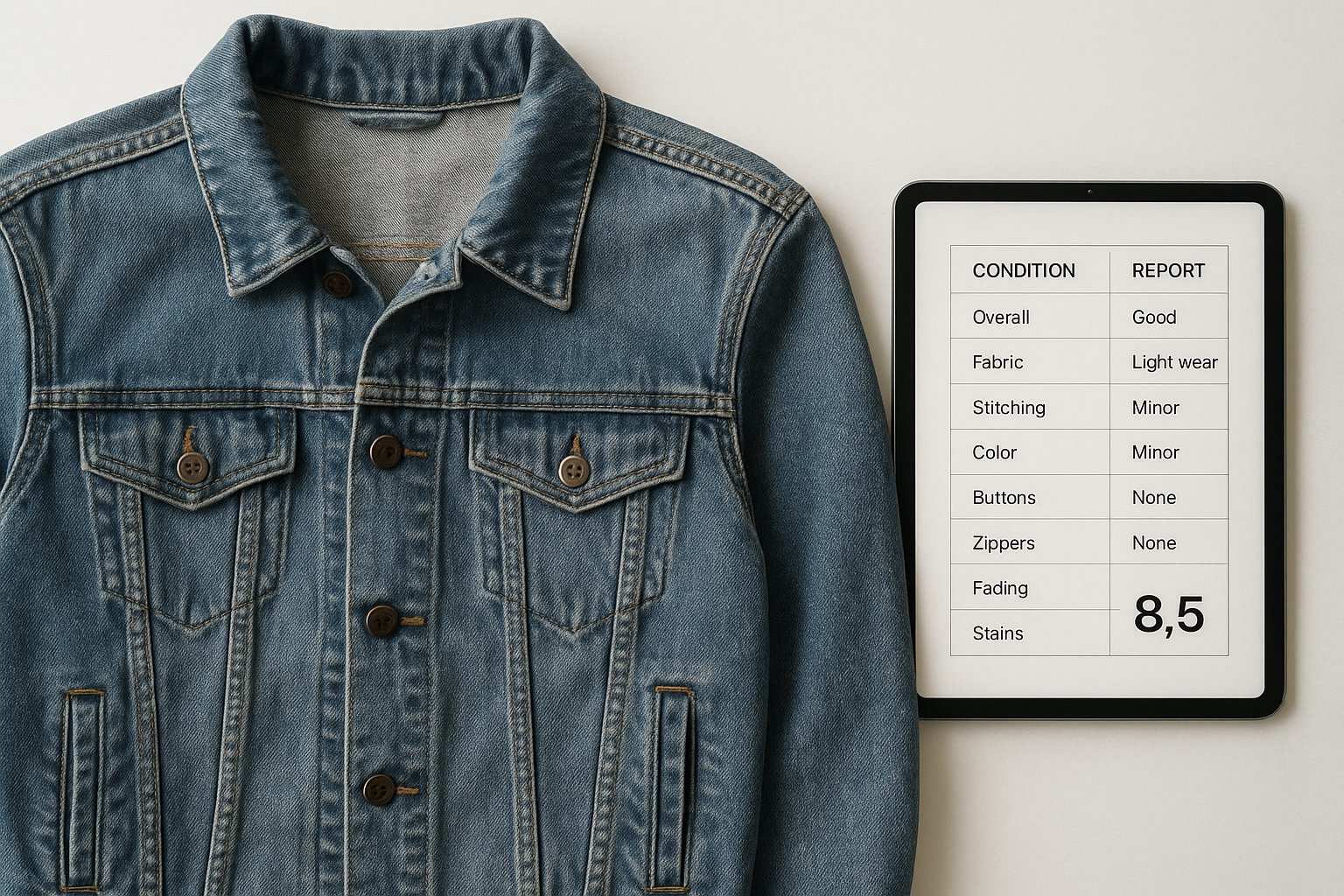
GradeThread's AI clothing inspection reads a set of photos and returns a 1.0–10.0 grade, a factor-by-factor condition report, and a verifiable certificate — typically in under two minutes. Here is exactly how that works, where the model is confident, and where a human steps in.
Why "I'd say it's Excellent" Is a Business Problem
Every reseller has a mental condition scale. The problem is it shifts. The Levi's 501 you graded Excellent on a Tuesday after a good sourcing run gets graded Very Good on a Thursday after three returns. Buyers can't see inside your head, and neither can the next person who lists from your consignment pile.
Standardized AI grading fixes that by applying the same criteria, weighted the same way, every time. No fatigue, no optimism bias, no "it looks fine in this light." The output is a numerical score tied to named tiers — NWT, NWOT, Excellent, Very Good, Good, Fair, Poor — with the evidence logged.
That matters for returns. A buyer who disputes a "not as described" claim on eBay has to argue against a timestamped report, not against your memory of what the jacket looked like three weeks ago.
The Five Factors the Model Evaluates
GradeThread grades every garment across five weighted factors. The model doesn't produce a single holistic score from a vibe read — it scores each factor independently, then combines them into the final 1.0–10.0 grade. The factors are:
- Fabric Condition — Surface integrity of the textile itself. The model looks for pilling density (number and clustering of bobbles per square centimeter of visible fabric), fading gradients across panels, fiber distortion, and thinning in high-friction zones like inner thighs on denim or underarms on knits. A garment with dense Stage 3–4 pilling across the chest drops here regardless of how clean it is.
- Structural Integrity — The garment's ability to hold its shape and hold together. Computer vision checks seam alignment, seam separation (visible gap between joined panels), seam stress marks (thread tension lines that precede a pop), collar roll consistency, and shoulder structure on tailored pieces. A blazer with a collapsed shoulder pad scores lower here even if the fabric is pristine.
- Cosmetic Appearance — Visible surface defects that don't affect wearability but affect perceived value. Stains, discoloration, crocking, hardware tarnish, pen marks, and print cracking on graphic tees all land here. The model classifies stain size relative to the garment panel and location — a 2cm stain on a back hem scores differently than the same stain on a front chest panel.
- Functional Elements — Hardware and closures. Zippers, buttons, snaps, drawstrings, and elastic. The model checks zipper pull presence, pull alignment, visible teeth damage, button completeness against visible buttonholes, and elastic deformation in waistbands and cuffs. A missing button on a hidden placket scores differently than a missing button on a visible front placket.
- Odor & Cleanliness — This is the one factor computer vision cannot directly assess. More on how GradeThread handles it below.
What the Model Is Actually Seeing: Computer Vision in Plain English
The underlying approach is a convolutional neural network trained on hundreds of thousands of annotated garment images. "Annotated" means a human grader looked at each image and labeled what they saw: pilling location and density, seam stress indicators, stain type and placement, hardware condition. The model learned to recognize those patterns by seeing enough labeled examples that it can generalize to new photos.
In practice, when you upload photos, the model runs several detection passes:
- Panel segmentation — It identifies distinct zones of the garment (front body, back body, collar, sleeves, hem, lining if visible) so defects can be located precisely rather than just flagged globally.
- Defect localization — Within each panel, it draws bounding regions around anomalies: a pilled patch, a stain, a frayed seam edge. These regions appear in your condition report as annotated thumbnails.
- Severity classification — Each detected anomaly gets a severity score. Pilling, for example, is classified on a four-stage scale from light surface fuzz (Stage 1) to dense, matted bobbles that obscure the weave (Stage 4). That severity feeds directly into the Fabric Condition factor score.
- Confidence scoring — Every detection carries a confidence value between 0 and 1. High confidence (≥0.75) means the model has seen enough similar patterns to be certain. Low confidence (<0.75) means the image evidence is ambiguous — the lighting is off, the defect is partially obscured, or the pattern is rare enough that the model isn't sure.
Photo quality matters here. A single flat-lay shot in mixed indoor light gives the model much less to work with than four shots — front, back, detail, label — taken under diffuse daylight or a softbox. That is not a limitation unique to AI; a human grader working from one blurry photo would also hedge.
Why Low Confidence Scores Go to Human Review
When any factor score carries a confidence value below 0.75, GradeThread routes that garment to human review before the final grade is issued. This is not a fallback for when the AI "fails" — it is the designed behavior for genuinely ambiguous cases.
The most common triggers:
- Structural anomalies on heavily textured fabrics (bouclé, heavy cable knit) where the weave pattern can look like surface defects
- Stains on dark or printed fabric where color contrast is low
- Elastic assessment on photos where the waistband is folded or obscured
- Vintage garments with intentional distressing that the model could misread as wear damage
The human reviewer sees the same annotated images the model flagged, the model's proposed grade, and the specific factor that triggered review. They confirm, adjust, or override. The final certificate records whether the grade was AI-only or AI-plus-human-review — buyers can see that distinction.
This matters for trust. A grade issued at 0.91 confidence across all five factors means something different than one issued at 0.62 confidence on Structural Integrity. Surfacing that difference is more honest than hiding it behind a clean number.
The Odor Problem: What AI Can't See and How It's Handled
Odor & Cleanliness is the one factor that cannot be graded from a photo. A camera has no olfactory sensor. A jacket that looks immaculate in photos can carry cigarette smoke, mildew, or heavy fragrance — all of which are grounds for a return and all of which fall under eBay's "not as described" policy.
GradeThread handles this with a structured self-report protocol. When you submit a garment for grading, you answer a short odor assessment checklist:
- Does the garment have any detectable odor after airing for 30 minutes?
- If yes: classify as smoke, mildew/musty, fragrance/perfume, or other.
- Intensity: faint (detectable only up close), moderate (detectable at arm's length), strong (detectable immediately on opening the package).
That self-report feeds directly into the Odor & Cleanliness factor score. A "strong smoke" response drops the garment to a Fair or Poor tier on that factor regardless of how the other four score. A "faint fragrance" on an otherwise Excellent garment might hold a 7.5 overall but will be disclosed in the condition report so the buyer knows what to expect.
The honest answer here is that self-report introduces some subjectivity back into a system designed to remove it. Two resellers might rate the same mildew smell differently. We know that. It is still better than no odor disclosure at all, and it creates a paper trail: if a buyer returns a garment claiming smoke smell and the seller reported "no odor," that discrepancy is documented.
Grade Tiers: What the Final Number Means
The five factor scores combine — with different weights by garment category — into a single 1.0–10.0 grade that maps to a named tier. The tier vocabulary is fixed:
| Grade Range | Tier | What It Means |
|---|---|---|
| 10.0 | NWT | New with original tags attached, no signs of wear or washing |
| 9.0 | NWOT | New condition, tags removed, no wear or washing evidence |
| 8.0–8.5 | Excellent | Worn minimally; no visible defects under normal inspection |
| 7.0–7.5 | Very Good | Light wear; minor cosmetic signs only, fully functional |
| 6.0–6.5 | Good | Moderate wear; defects present but disclosed and proportionate to price |
| 5.0–5.5 | Fair | Heavy wear or significant defects; functional but clearly used |
| 3.0–4.5 | Poor | Major defects, damage, or odor; parts or upcycle value only |
Category weights shift the math. On a vintage denim jacket, Fabric Condition and Cosmetic Appearance carry more weight because fading and wear patterns are both the primary value drivers and the primary return triggers. On a tailored wool blazer, Structural Integrity carries more weight because a collapsed shoulder or a popped lining seam is a functional failure, not just a cosmetic one.
What AI Grading Actually Gets You as a Reseller
The practical upside is not that the AI is infallible. It is that the grade is documented, consistent, and shareable.
When you list on eBay and attach a GradeThread certificate link, a buyer can verify the grade before they purchase. That shifts the burden of proof in a dispute. eBay's "not as described" process asks whether the item matches the listing. A listing that references a timestamped, factor-level condition report is a much stronger position than a listing that says "Excellent condition — see photos."
On Poshmark, where condition disputes often happen in the comments or offer stage, having a shareable certificate URL answers "what condition is this really?" without a negotiation. On Whatnot, where you're grading live, being able to say "this is a 7.5 Very Good, here's the report" moves faster than reading out a paragraph of description.
It also protects you from your own optimism. The jacket you sourced for $18 and love is not automatically Excellent. The model doesn't know what you paid for it.
Try It on One Garment
The fastest way to understand what AI clothing inspection actually catches is to run a garment you've already graded yourself and compare the output. Pick something you called Excellent or Very Good. Upload four photos — front, back, close detail on any wear area, and the label. See where the model lands and which factor it flags.
If it agrees with you, you have documentation. If it doesn't, you have information worth having before a buyer does.
Grade your first garment at GradeThread — no commitment, one report, see exactly what the model sees.