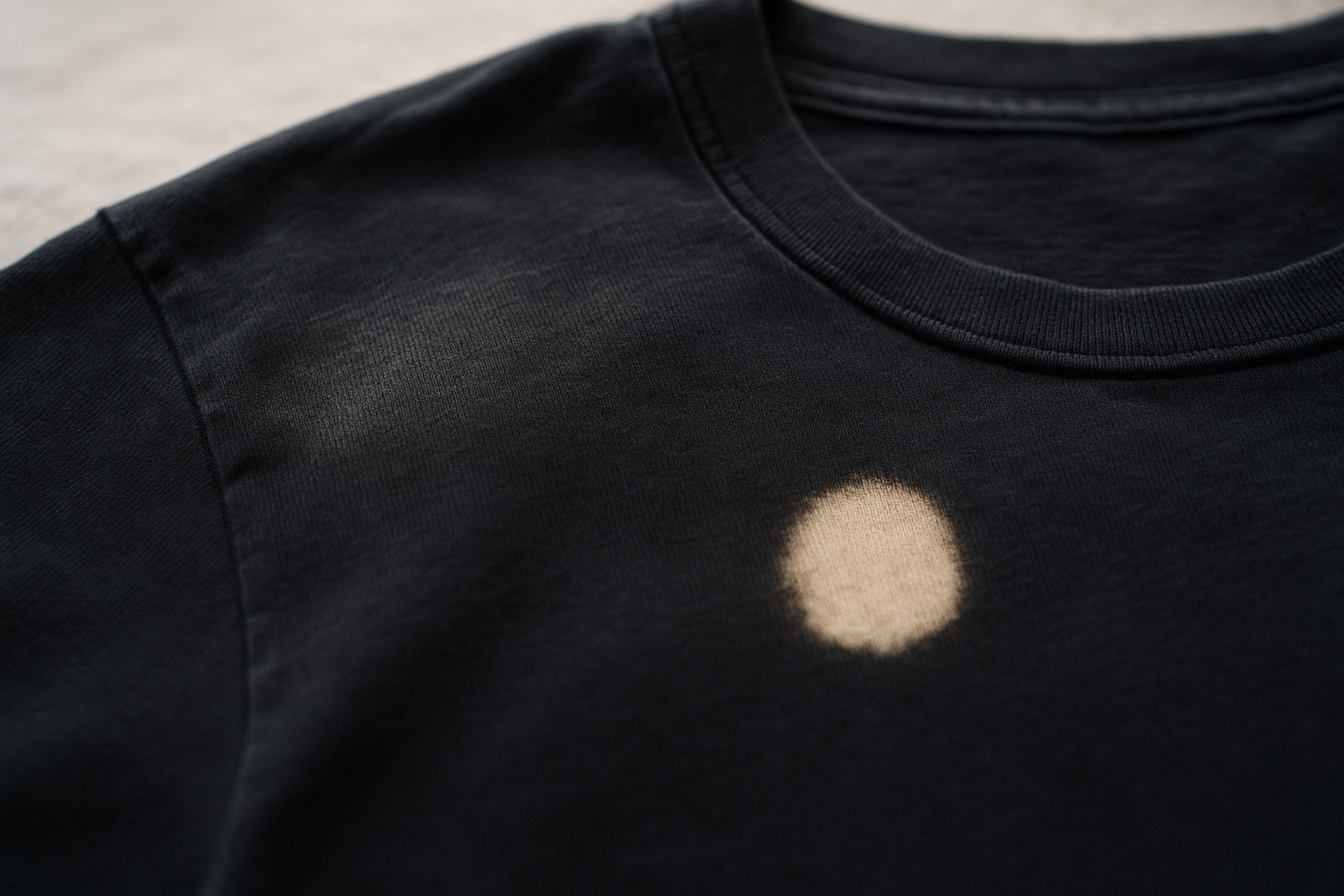
Fading vs. Discoloration: How to Grade Sun Damage and Chemical Stains Separately
Sun fading and chemical discoloration are two different defects, and grading them the same way is how sellers under-call bleach damage and over-call ordinary UV wear. Fading is gradual, even, and tied to exposure pattern — it's a Fabric Condition and Cosmetic Appearance issue that can still land at Excellent in mild cases. Chemical discoloration is sharp-edged, localized, and permanent — it caps a grade at Very Good even at its smallest, and drops fast from there.
We see this mix-up constantly in reseller listings: a black tee with sun-faded shoulders gets called "has a stain," and a garment with an actual bleach dot near the hem gets called "slightly faded from wash." Both descriptions are wrong, and both lead to buyer disputes when the item doesn't match the photos. Here's how to tell the two apart and grade each on its own standard.
Why Fading and Discoloration Aren't the Same Defect
Sun fading is photodegradation. Ultraviolet light breaks down the dye molecules and, in advanced cases, the fiber structure itself. It happens gradually, follows a light-exposure pattern, and shows up as an even lightening or color shift — never a sharp edge. A jacket that hung in a store window for a season will fade uniformly across the shoulders and back panel, with the underarms and side seams staying close to original color because they were shielded.
Chemical discoloration is a contact event. Bleach, chlorine, hair dye, cleaning solvents, or dry-cleaning chemicals touch the fabric and react with it directly. The result is localized, often has a hard or feathered edge where the liquid contacted and stopped spreading, and doesn't correlate with how or where the garment was worn. A bleach splash on a black hoodie sleeve doesn't care about sun exposure patterns — it shows up wherever the drop landed.
This distinction matters because it changes which grading factor takes the hit and how severely:
- Sun fading is primarily a Cosmetic Appearance defect. In advanced cases, where UV has broken down fiber integrity (fabric feels dry, chalky, or loses tensile strength), it also becomes a Fabric Condition defect.
- Chemical discoloration is a Cosmetic Appearance defect first, but active chemical damage — bleach that has thinned or weakened the fabric at the contact point — becomes a Fabric Condition and sometimes Structural Integrity issue if fibers have degraded to the point of thinning or holes.
How to Identify Sun Fading vs. Chemical Discoloration
Before you can grade either defect, you need to correctly identify which one you're looking at. Use this sequence every time you spot a color irregularity:
- Check the shape of the discoloration. A gradual, soft-edged color shift across a broad area points to fading. A sharp-edged spot, streak, or ring points to chemical contact.
- Compare the affected area to a shielded reference point on the same garment — inside a collar, under a placket, inside a cuff. If the exposed area is lighter and the shielded area matches the original swing tag color, that confirms UV fading.
- Map the location against a plausible exposure pattern. Sun fading shows up on shoulders, upper back, sleeve tops, and the side that would face a window or car dash. It does not show up as an isolated dot mid-chest or a drip pattern down the front.
- Look for a color shift versus a color removal. Fading shifts color toward a lighter, often warmer or grayer version of the original (black fades to charcoal-brown, navy fades to blue-gray). Bleach removes color entirely, often leaving a near-white or yellow-white spot with no trace of the original dye.
- Run the hand-feel test. Rub the affected area between your fingers. UV-faded fabric that has also lost fiber integrity feels dry, slightly stiff, or chalky. Bleach-damaged fabric at the point of contact often feels thinner or slightly stiff/crusty compared to the surrounding weave.
- Check for a matching odor or residue. Fresh or improperly rinsed bleach stains can carry a faint chlorine smell. Chemical dye transfer (from another garment bleeding in a wash) sometimes leaves a slightly tacky feel if incompletely rinsed.
- Photograph both the defect and the shielded reference point together, so the grading record shows the comparison, not just the flaw in isolation.
Grading Sun Fading: What Each Tier Requires
Sun fading is graded on severity, evenness, and whether it has progressed into fiber degradation. It rarely disqualifies a garment outright, but it does cap the grade based on how visible and how structural the damage is.
- Excellent (8): No visible fading, or fading so slight it's only detectable when compared directly against a shielded reference point. Fabric hand feels unchanged.
- Very Good (7): Mild, even fading on one panel or exposure point (shoulder, sleeve top) visible in direct light but not distracting in normal wear. Fabric hand is unchanged.
- Good (6): Noticeable fading across a larger area — a full back panel, both shoulders, or an entire garment with a visible tonal shift from original color. Still no loss of fabric hand.
- Fair (5): Significant fading combined with early fabric hand changes — fabric feels drier or slightly stiffer at the faded area. Color shift is obvious even in casual viewing.
- Poor (3–4): Extensive fading paired with fiber breakdown — fabric is brittle, chalky, or shows thinning at the exposed area. This crosses from Cosmetic Appearance into Fabric Condition and, if thinning is advanced, Structural Integrity.
Grading Chemical Discoloration: A Stricter Standard
Chemical discoloration doesn't get the same benefit of the doubt as fading. It's active damage from a specific event, it's rarely uniform, and buyers read it as a stain even when it's technically a color change rather than added residue. That's why the ceiling is lower even for small chemical marks.
- Very Good (7) — ceiling, not typical: A single trace bleach dot smaller than a pencil eraser, located in a low-visibility area (inside hem, under a placket), with no fabric hand change. This is the best a chemically discolored garment can grade, and only in the mildest, best-hidden cases.
- Good (6): A visible bleach spot or chemical discoloration in a moderately visible area, under a quarter-sized mark, with no fabric thinning.
- Fair (5): Multiple discoloration spots, a single spot larger than a quarter, or any discoloration in a highly visible area (chest, front panel) even if small.
- Poor (3–4): Discoloration combined with fabric damage — thinning, stiffness, or holes at the chemical contact point. This is a Fabric Condition failure, not just cosmetic.
Fading vs. Discoloration: Side-by-Side Grading Comparison
| Factor | Sun Fading | Chemical Discoloration |
|---|---|---|
| Cause | Gradual UV exposure over time | Single contact event (bleach, chlorine, solvent) |
| Edge pattern | Soft, gradual, no hard border | Sharp or feathered edge, defined border |
| Location logic | Follows light exposure (shoulders, back, sleeve tops) | Random — wherever contact occurred |
| Best possible grade | Excellent, if minimal and only visible on comparison | Very Good, and only for a single trace mark in a hidden area |
| Primary factor affected | Cosmetic Appearance, then Fabric Condition if severe | Cosmetic Appearance, then Fabric Condition if fibers weakened |
| Worst-case tier | Poor, with brittle or thinning fabric | Poor, with holes or thinning at contact point |
When Both Defects Show Up Together
Vintage garments often carry both. A tee that spent years folded in a sunlit closet can have overall shoulder fading and a small bleach dot from a laundering accident years earlier. Grade these as two separate defects, not one compounded flaw — but apply the lower of the two resulting tiers as your ceiling. If the fading alone would grade Very Good but the bleach spot caps at Good, the garment grades Good, and your condition report should call out both defects individually so the buyer understands they're looking at two distinct issues, not one bigger one.
This separation matters for disclosure language too. "Shoulder fading from sun exposure" and "small bleach spot on hem, approx. 1cm" read very differently to a buyer than a vague "some discoloration." Specific, separated defect language is what keeps a Good-grade vintage tee selling at Good-tier prices instead of getting hit with a not-as-described claim because the buyer expected uniform fading and got a bleach spot instead.
Try It on One Garment
Pull a faded or discolored piece from your current inventory and run it through GradeThread. You'll get a numerical grade, a condition report that separates fading from chemical discoloration across the five weighted factors, and a certificate your buyer can verify — so the next dispute isn't about what "some fading" actually meant.